There’s something oddly thrilling about stepping into a film set. It is a world that looks finished on camera but is constantly under construction in reality. When t2 reached Bharat Lakshmi Studio on a breezy spring afternoon, that strange magic was already in motion. Director Abhirup Ghosh was deep into filming Mrigaya 1.5, the spin-off to his 2025 action thriller Mrigaya: The Hunt. If Mrigaya was about the chase, the confrontation and the moral greys of law enforcement, Mrigaya 1.5 feels like something more intimate, a step backwards in time to understand the man behind the badge. And that man is OC Debanjan Dutta, played by Ritwick Chakraborty.
GOING BACK
Before the franchise expands into a larger ensemble-driven sequel, Ghosh is choosing to slow down, not in pace, but in narrative. Mrigaya 1.5 is the bridge. The connective tissue. The emotional groundwork that will define what is increasingly beginning to look like Abhirup Ghosh’s own cop universe.
In Mrigaya, Debanjan Dutta stood out because he wasn’t the stereotypical chest-thumping, perpetually enraged police officer. He was sharp, sardonic, and always thinking three steps ahead. His sarcasm cut deeper than his gunfire. His instincts were unpredictable. And beneath the wit, there was a quiet loneliness that the first film only hinted at. That is precisely what Mrigaya 1.5 seems determined to explore.
It’s a character excavation. The kind that asks: what shaped Debanjan Dutta? What made him this way? What compromises did he swallow? What scars did he carry long before the audience met him?
The decision to pause the larger narrative expansion and instead focus on one man’s emotional and psychological baseline is interesting. It signals confidence. It signals patience.
A NEW WORLD
Joining Ritwick in this spin-off is Koushani Mukherjee, stepping into the role of a headstrong female police officer, Joyita Sen. While details about her character are being kept under wraps, her presence on set already hints at an energy shift. If Debanjan is instinctive and sarcastic, Joyita feels structured, alert and equally unyielding.
THE SCENE
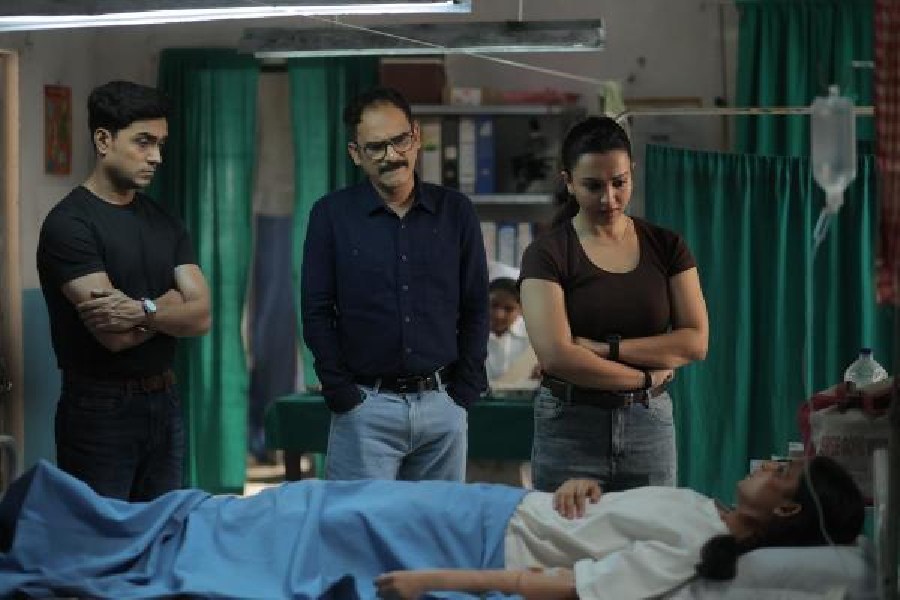
The set that day was a hospital — stark white walls, green curtains, and metal bed railings. The artificial lighting inside the studio recreated a harsh clinical glow. Yet somehow, it felt disturbingly real. The sequence being filmed was pivotal to the film. Debanjan Dutta, along with his colleagues, Joyita Sen and Arpan Ghosal’s officer, attempt to extract a confession from a severely abused young woman lying in a hospital bed. The victim, played by Ananya Bhattacharya, looked almost unrecognisable under layers of prosthetic bruises and swelling.
The stillness she maintained between takes was chilling. When the camera rolled, her breathing changed, shallow, fragile, fearful. The team of officers tried to coax information from her without pushing her into further trauma. The dialogues weren’t loud. They were low, measured and tense. Then came the second layer of the scene. An alleged suspect is brought into the hospital. The room tightens. Air feels heavier. The victim’s eyes shift. The officers observe everything.
Another scene filmed that day took place in the hospital corridor. Debanjan and Joyita walk side by side, discussing the whodunit angle. And then something subtle happens. A patient walks past them. The sound of a prosthetic foot clicking lightly against the floor interrupts the conversation. It is faint but distinct. Joyita pauses. She hears it. And then she nudges Debanjan. It’s a fleeting moment. Barely seconds long, but it shifts the investigation’s direction. The rhythm of the walk had to feel natural. The pause had to feel instinctive, not scripted. Precision is invisible on screen. But on set, it is everything.
THE LOOK
In this sequence, the police officers were dressed in civilian clothes. Ritwick wore a navy blue shirt paired with jeans — simple, sharp, controlled. The familiar Debanjan Dutta moustache and glasses were intact, but there was a slight refinement this time. The edges felt crisper. The posture was more assured.
“When we did Mrigaya, Debanjan Dutta was already in the middle of chaos. The audience met him as someone who had figured out how to survive in that world, with sarcasm, intelligence, and a certain emotional distance. But in Mrigaya 1.5, we are peeling back those layers a little. This time, it’s less about how loudly he can chase a criminal and more about what goes on in his head when things go quiet. I find that space more challenging as an actor. You cannot hide behind action. Debanjan is still sharp, still unpredictable, but there’s vulnerability here. I think that makes him more human. For me, this film is about understanding why he became the officer we saw earlier, and what it cost him personally to get there,” said Ritwick.
Koushani’s look was practical yet striking: a fitted brown U-neck T-shirt, jeans, boots, hair tied cleanly. There was a certain Lara Croft-esque energy to her stance. Alert, agile and unapologetic. “For me, stepping into this world was both exciting and intimidating because Mrigaya already has a very strong tone and identity. I didn’t want my character to feel like she was simply entering someone else’s story. What I loved when Abhirup narrated the script was that she had her own spine. She is not loud for the sake of being tough. Her strength comes from observation, discipline, and instinct. In the hospital scenes especially, you realise policing is not always about action, it’s about listening carefully, noticing the smallest detail, even a sound in a corridor. That subtlety attracted me to the role,” said Koushani.
She further added, “Physically, I had to prepare to look convincing, but more than that, I had to internalise the mindset of someone who deals with violence and trauma regularly yet remains composed. Working opposite Ritwickda is always enriching because he brings so much nuance. There’s a quiet tension between our characters, and I think audiences will enjoy watching that dynamic unfold.”
Arpan Ghosal opted for an all-black fitted T-shirt and trousers, which looked understated and functional.
“Today was actually my first day of shooting for Mrigaya 1.5, and I have to admit I was a little nervous walking onto the set. I really liked Mrigaya when it was released, the tone, the intensity, the way Abhirup handled the story, so somewhere I always wished I could collaborate with him. When this opportunity came, I didn’t think twice. What struck me from the first shot itself is how detailed he is about everything, even the smallest things in a frame. That pushes you to be more alert as an actor.
Working beside Ritwickda is also very fulfilling. He is extremely calm, very focused and at the same time so supportive. On my first day, that really helped ease the pressure. He gives you space to perform and never makes you feel intimidated,” added Arpan.
Ananya Bhattacharya’s transformation into an abused victim was disturbing in its realism. Her face bore deep purple marks. Her arms were mottled with injury. Multiple layers of make-up created swelling, dried blood, and skin abrasions. Between takes, she would sit quietly, conserving energy. Then, at “action!”, vulnerability flooded her expression.
“I can’t reveal much about my character right now because it’s quite central to the investigation, and I don’t want to give away anything. But as you can see from the make-up, today I’m shooting a very intense scene. All these bruises, the swelling, the cuts, it took almost two hours to get this look right. The make-up team has done such a realistic job that when I first saw myself in the mirror, it was honestly disturbing. It immediately puts you in the emotional space of the character,” said Ananya.
“This scene is not loud or dramatic in the usual sense, but it is emotionally heavy. Playing someone who has gone through trauma requires a lot of sensitivity. You have to balance vulnerability without overdoing it. Between takes, I try to stay quiet and conserve that emotional energy. The entire team has been very supportive and respectful while filming these portions. It’s challenging, but as an actor, roles like this push you to go beyond your comfort zone, and I’m grateful for that,” she added.
BETWEEN TAKES
Film sets are paradoxical spaces. One minute, you are witnessing simulated trauma. Next, the actors are laughing over tea. Ritwick, between takes, slipped easily out of Debanjan’s intensity, chatting casually with crew members. Koushani rehearsed her lines and munched on some evening snacks.
Technicians adjusted the lights. Time stretches differently on a film set. A two-minute scene can consume two hours. And yet, nobody seems impatient. There’s a collective understanding that the final result will justify the repetition.
REEL & REAL
Director Abhirup Ghosh moved across the floor with quiet alertness. He checked continuity personally. He studied the bruising on Ananya Bhattacharya’s face to ensure it looked painfully real.
During a break, a junior artiste portraying the patient with a prosthetic foot needed further make-up detailing. The prosthetic had to look convincingly worn. Slight discolouration. Subtle texture. The director crouched down to inspect it. That level of involvement says something about the filmmaking approach.
For a film that draws inspiration from true events, as Debasis Datta, one of its creative anchors, describes, authenticity becomes a responsibility. Datta has been associated with the Mrigaya world from the beginning, often infusing narratives with elements drawn from lived realities. This time, he prefers to call the film “inspired by true events,” a phrase that carries weight. It suggests grounding and caution.
“From the beginning, with Mrigaya, our intention was never to make just a massy action film. We are trying to build a cop universe that feels rooted in reality. Even this time, the story is inspired by true events. Of course, audiences expect action from this genre, and we will deliver that. But the action has to look real, not exaggerated for effect. The punches should hurt, the chases should feel risky, and the consequences should matter. For us, authenticity is more important than spectacle. That’s what will make this universe believable and sustainable,” said Datta, who has written the story of the film, which is produced by Tenth Dimension Entertainment.
THE DIRECTOR’S EYE
With Mrigaya laying the foundation and Mrigaya 1.5 diving into character backstory, the eventual second instalment promises to expand into ensemble territory. This spin-off matters because it sets the baseline. It establishes psychological continuity. It will allow the audience to understand Debanjan Dutta before he becomes one among many in a larger narrative.
What stands out most about Abhirup Ghosh’s working style is not loud authority but sustained attention. He doesn’t shout instructions dramatically. He recalibrates, and he asks for “one more” with calm certainty. And when the shot finally aligns with the vision in his head, there’s a subtle nod.
It is easy to chase adrenaline in an action franchise. Explosions, chases, gunfire. But watching these hospital scenes unfold, it teases that Mrigaya 1.5 might also derive its adrenaline from tension. “The hospital sequence we’re shooting today is very important because it changes the direction of the investigation. On the surface, it looks like a simple questioning scene, officers talking to a victim, bringing in a suspect, but the tension lies in what is not being said. When a person has gone through trauma, silence speaks louder than dialogue. The corridor scene is also crucial. A small detail, the sound of a prosthetic foot, becomes a trigger. In thrillers, we often rely on big twists, but I believe sometimes the smallest sensory clue can shift everything,” said Ghosh.
The title 1.5 might suggest something in-between, not quite a sequel, not quite a prequel. But perhaps that in-between-ness is its strength. It is a pause that deepens. A narrative inhalation before the next sprint. By focusing on Debanjan Dutta’s evolution and introducing a formidable female counterpart, the film appears ready to strengthen its own universe. Not just in scale, but in emotional density.
“With Mrigaya 1.5, I wanted to explore the characters a little more closely before we move into the bigger world of the franchise. This film will give audiences a glimpse into some of the backstory and the events that shaped characters like OC Debanjan Dutta. While it is a spin-off, it also works as an important link in the larger Mrigaya universe we are building. We are keeping the narrative sharp, fast and rooted in the city. And yes — viewers can definitely expect a lot more action, along with plenty of twists and turns. Mrigaya 1.5 will be a complete entertainer,” said Ghosh.
As the spring sun dipped slightly outside the studio and the artificial hospital lights remained unforgivingly bright inside, it felt clear that something deliberate was taking shape here. A carefully layered expansion of a world that refuses to simplify its heroes. And if the precision on set is any indication, Mrigaya 1.5 may not just be a connector film; it might be the spine that holds the entire franchise upright.