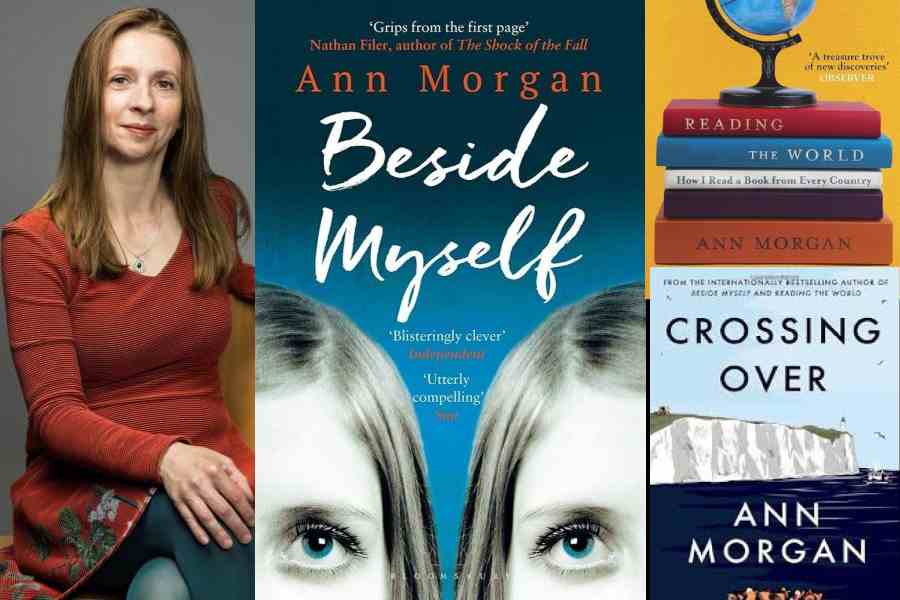
A simple blog turned into a mission and in no time transformed into a sort of movement for Ann Morgan, a UK-based writer, speaker and editor. Morgan is a voracious reader. However, it’s not just her voraciousness that gives her charisma. It is her approach towards reading that makes her a role model for many. In 2012, Morgan decided to broaden her reading perimeter, and the literary world opened up to her like floodgates, with stories from across the world filling up her reading list. The experience birthed Reading the World: How I Read a Book From Every Country (2015).
Morgan, who has also authored two international bestsellers — Beside Myself and Crossing Over — was in India last month to attend the Dibrugarh University International Literature Festival in Assam. Apart from her infectious energy, and global outlook, she also carried her latest non-fiction, Relearning to Read: Adventures in Not-Knowing.
Starting point
Tracing the genesis, we asked: At what point did this personal experiment turn into a larger argument about how we read the world today? “Pretty quickly,” quipped Morgan. Continuing her answer and sharing her initial experience, she added, “Four days after I announced my intention to read a book from every country in 2012, I got a message from a stranger called Rafidah in Kuala Lumpur, offering to choose and post me my Malaysian book. From that moment, the project was larger than me because other people were invested in it and going out of their way to make it happen.” Since then, Morgan has been in correspondence with thousands of readers and writers around the globe. These interactions broadened her horizon and made her realise how stories travel and connect the world. The project remains an ongoing process, a manifesto constantly under revision.
Embarking on a journey like that in a linguistically diverse world must have its own challenges. Morgan shares one such instance that challenged her assumptions as a reader. “My correspondence with and reading of the work of Alemseged Tesfai in Eritrea was pretty mind-blowing. Here was a writer in the heart of what we in the UK often hear is one of the world’s most repressive societies, writing and speaking about censorship and politics in ways that felt very free. It made me think very carefully about the narratives we absorb about other places and how those narratives may serve to perpetuate certain distortions. It also made me examine what the suspicion of censorship does to the reading experience. We often hear about self-censorship in writing, but in reading? That was thought-provoking.”
Beyond Translations
Opening up to a non-English world means picking up translated works. And Morgan treads with care when navigating her way into a translated voice. “Reading a translation is an exercise in trust; it is reading through another person’s eyes. This may sometimes add an extra layer of richness. Passages about translation in the English version of Yun Ko-eun’s novel Art On Fire, for example, are enhanced by the knowledge that we are reading them through the filter of Lizzie Buehler’s words,” said Morgan, citing an example. The Korean novel was Morgan’s Book of the Month in December 2025.
Continuing and talking about keeping an open mind, she added: “There is so much I can’t know about many of the texts and traditions I read books from. But I can try to be as mindful as possible of my own tendencies and limitations as a reader. Over years of exploring incomprehension, I have sharpened my awareness of my conditioning and biases, and the things I tend to reach for to plug the gaps when I don’t understand. This means that I will be more careful about reserving judgment, remaining humble and keeping questions alive in my mind when I’m aware a book is far outside the scope of writing with which I am familiar, and (I hope) it will mean I am better at avoiding pitfalls and misreadings arising from assumptions woven into my conditioning. It’s impossible to be perfect at this, but that is part of what makes reading widely interesting. In a sense, it is a way to read ourselves better too.”
Indian literature
On her fifth trip to India, Morgan is quite well-versed with the Indian literary scene and has read many authors across different languages. She has read works of Perumal Murugan, Geetanjali Shree, Vivek Shanbag, Banu Mushtaq and many others. Praising Deepa Bhashti, the translator of Heart Lamp, Morgan said: “I think Bhashti’s translation was fantastic, weaving English into a new fabric, shot through with rich threads that captured the beauty and intricacy of those stories.”
She also expressed her interest in the work of the famous Malayalam author Kottayam Pushpanath. In fact, she has devoted a chapter of Relearning to Read to his novel Dracula Asiayil. “I am intrigued by the idea of this author taking the character of Dracula, a British creation, and repurposing it for his own stories. You can’t yet read the novel in English, but Suneetha Balakrishnan, who helped guide my Indian choice in 2012, kindly prepared a translation of a sample for me. I found it fascinating to see how this European character had been reconceived through an Indian lens. It felt like a powerful reimagining.”
Relearning to Read
Relearning to Read: Adventures in Not-Knowing is anchored in her readiness to embrace not-knowing. Did writing this book change the way she now reads British or Western literature, knowing what sits alongside it in the wider literary ecosystem? An emphatic “Yes” slipped Morgan’s lips. Elaborating on it and the cultural arrogance that exists in the Western world, she shared: “I’m more aware of some of the narrownesses and blind spots that dog Western literature. There are many brilliant books written in the UK, but because of the imbalances in the way stories travel, and the historical injustices and misconceptions flowing from colonialism, there is sometimes a cultural arrogance that positions Anglo-European work as the gold standard and regards everything else as trying to match up to it. This is clearly nonsense and when you truly read the world, you realise what a sad, narrow way that is of looking at things. Storytelling is so much richer and more varied than many institutions have historically recognised, and we all have so much to learn from one another.”
Morgan’s last read was The Summer My Mother Had Green Eyes by the Moldovan author Tatiana Țîbuleac, translated by Monica Cure. Translations of Moldovan literature into English are quite rare, and she writes about it in detail in her blog ‘A Year of Reading the World’. In terms of her own literary work, she informs that she has finished a manuscript which brings together her fiction and non-fiction.