What is ornithophobia? This word, meaning ‘fear of birds’, has been put to use cleverly and succinctly in Bibi Payra, a film by National Award-winning director Arjunn Dutta. Arjunn is a new-generation filmmaker who has consistently explored various social anomalies in all his films. Deep Fridge, his previous film, dealt with a divorced couple spending a night together because of inclement weather and their son’s illness. The ramifications of this action in their lives came out of the cold recesses of their lives as if being brought out of the deep fridge to thaw at least somewhat. The film was a serious relationship drama.
Straight after that, Arjunn turned 360 degrees and came up with a black comedy that deals with domestic violence, male toxicity, women’s compliance against their will and the ultimate revolt of the bibi payras, lady pigeons! Several social taboos have been dealt with. Substance abuse by women, a man’s toxic nature and inner fear, the male ego and its suppression when living at his wife’s abode, the widow and single woman’s desires.
And all this with the director-script writer duo’s (Arjunn and Ashirbad Maitra) tongues firmly in their cheeks. Doves or pigeons are instruments of appeasement; just as women are even today expected to bear the brunt of all family discord with magnanimity, the dove is the symbol of peace. But Arjunn has broken prototypes with the two merging for reprisal. This is where the director has played his ornithophobia card!
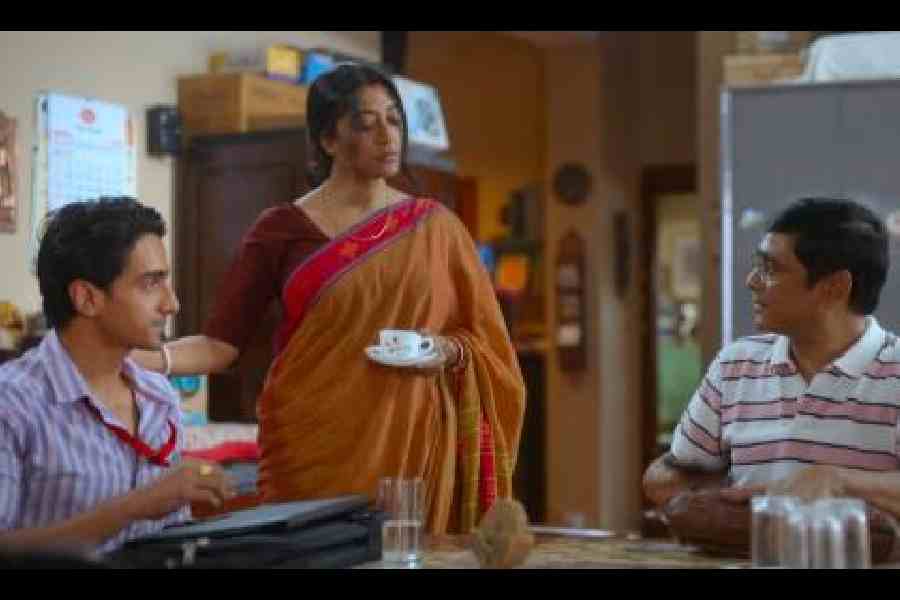
The film, in its entirety, is a caustic representation of middle-class Bengali life. The aspirations, the hypocrisies behind the closet and of course the skeletons in the cupboard are exposed through comic, as well as tragic expressions and experiences. Arjunn and his team have, at every turn and bend, shouted out loud that empowerment is in the heart and soul of every woman; she just needs to either coax it out or force it out, as the case may be.
All the actresses in the film have done this so convincingly that at times they seem too loud, which is what happens when women put their foot down and the world, unused to this, tries to put them down by saying, “Lower your voice!” Paoli and Swastika are two ends of the same coin! Their fights, arguments, suspicions and expressions of pain cry out loud. But the strength of women united is indelibly proved when the two decide to let their hair down and face their destiny head-on.
Bhabani Mukherjee as the widowed aunt and Ankita Majhi as the spinster sis-in-law are archetypal women who have been deprived of a healthy sexual relationship. Both are extremely adept at expressing this through their nuanced acting. Anirban Chakrabarti is convincing as the toxic husband at home and browbeaten government servant at work. He has the greed and desire for many a lusty thing, but needs to hide behind a prop to grab it all. The meekness and the toxicity are well blended.
Subrata Dutta, in his dual life in the film, maintains a balance in acting that needs to be mentioned specifically. Not at any point does he overdo it! Anindya Sengupta’s look of innocence gives him an advantage that he makes full use of. The film’s music by Mainak Mazoomdar and editing by Sujay Datta Ray have provided unequivocal support to the script. The costume designer’s (Poulami Gupta) mundane touch in the nightie and scarf combo is worth a mention.
The claustrophobic indoors where the couples live have been well documented by DOP Supraatim Bhhol. The art directors, Hochi and Sanjay Pal, have brought out the garish lack of taste amongst wannabes. The bright, shiny curtains are, to say the least, an eyesore! What needs to be mentioned is his and the director’s guts to have used them. To conclude, Bibi Payra is perhaps Arjunn’s conscious attempt at projecting non-commercial taboo subjects in a mainstream mode. And the support he received from his producer Nandy Movies is quite apparent.