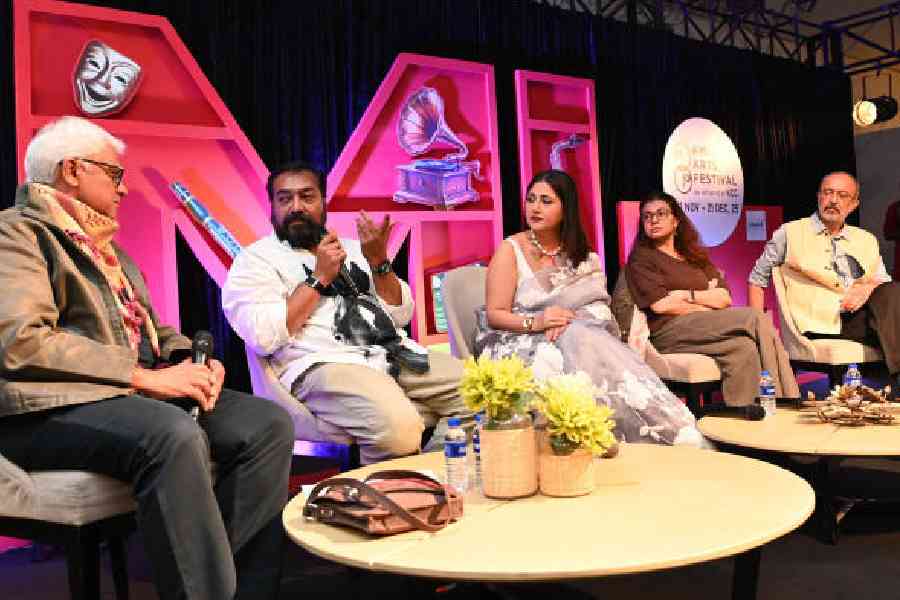
The problem that contemporary Indian cinema is facing is not singular. Multiple factors at many levels are curbing the creativity of filmmakers. To throw more light on this, AMI Arts, the one-month-long festival by Kolkata Centre for Creativity, got together filmmakers Anurag Kashyap and Alankrita Shrivastava, actor Swastika Mukherjee, and acclaimed writer Anjum Rajabali to discuss ‘Challenges Faced by Contemporary Indian Cinema’.
Sudhanva Deshpande, noted thespian and director, who moderated the discussion, in a cautionary tone, termed the topic as “slippery yet urgent”, warming up the audience to a passionate discussion that lay ahead.
“I hope that we can speak frankly about censorship, corporatisation, fear, gatekeeping, but also, and perhaps more importantly, about possibilities, about courage and the small stubborn victories that keep the cinematic imagination alive,” said Deshpande before urging the Lipstick Under My Burkha director, Shrivastava, to share her views on masculinity and misogyny in the sector and how she negotiates this space. “Historically, we have had a history of cinema that really does perpetuate the patriarchy, and I think particularly from the ’70s onwards, ’80s, and well into the ’90s. I see a sense of continuity between the assertion of that kind of toxic masculinity from before, so it’s just an extension of that and not something sudden. It’s there because we have embraced that cinema. So I think when you have that kind of a history of cinema, then where we are is actually the logical growth,” said Shrivastava, acknowledging the responsibility that the audience shares in giving alternative perspectives their due space.
Swastika, who has essayed many notable roles in Tollywood and some equally impactful roles in Bollywood and OTT, answered the same question from the perspective of an actor. She shared two instances when the censorship board raised eyebrows. “After working in the industry for 10 years or so, I became so vocal about the ‘ifs’ and ‘buts’ and ‘nots’, that patriarchy-backed scripts stopped coming to me. And yes, I faced numerous problems with the censor board. It came to a point where I started actually making a joke out of it that I think they just see my name in the cast and they send it to the revision committee,” she said, sharing that two Mainak Bhaumik films — Ami and Amar Girlfriends and Family Album — perturbed the board, and she had to fight it out.
Kashyap, who is known for being extremely vocal, talked about negotiating the space both as a director and actor. He started by declaring, “I hate acting. I act because one, I get good money, and second, I am not getting to make the films that I want to make.” While the first declaration made the audience chuckle, the other one brought seriousness back to the table. “It’s a tough time. I literally cannot make the same films that I have made in the past. Like, I cannot even do a Sacred Games or a Raman Raghav or a Gangs of Wasseypur or a Dev D. I am just unable to sit down and figure out how to go about doing things. There are so many restrictions,” stressed Kashyap, pointing out how Nishaanchi, his latest work, was released in two parts and how the second part, released on OTT, doesn’t hold back on the language and retains the authenticity.
Continuing the flow of his thoughts, Kashyap added: “Just to keep the very centre of the film intact is a very big fight, and censor is the last word today. Every production house and every platform has a lawyer. First, the lawyer approves the script, then it goes ahead. So there’s a constant dilution of what you want to do, and you get frustrated by the end of it. I’ve been so frustrated that I’ve literally quit, walked out of so many projects.”
When Rajabali took the mic, he brought the perspective of writers who face a very different level of sabotage. “There is a whole spectrum of factors concerning screenwriters today, and I believe they are the most vulnerable group. It’s that out of fear that writers have begun to self-censor,” said Rajabali.
He drew attention to the indemnity clause that binds a writer, and that works in great favour of producers. “If there is any reaction from the audience, or from CBFC, or anywhere else, where objection is taken on any part of the film, saying that this has actually disturbed the peace in society, or hurt religious sentiments, or offended some cultures… if that were to happen, whatever losses that the producer may incur, including legal costs, including the loss that the producer might face, if the film is blocked, or delayed, the writer is supposed to indemnify the producer,” he said, expressing dismay at the absurdity of the clause.
So, what is the way forward? “If we don’t continue to break our heads against the stone wall, if we don’t continue to kick it… okay, maybe it will not fall immediately in our lifetime, and maybe our feet will get hurt, and maybe that will break, but the fact is that it continues to weaken. We advise writers that even if you lose the battle, fight it. Eventually, there is a certain change which is likely to come about,” said Rajabali, reiterating that not conforming to the system is the way out.
Attention was also drawn to the audience, the ultimate receiver of the content and also a big decision-maker. “The audience has been trained to pay for a certain kind of cinema. And it’s been going on for decades. Money has been spent to make them have a particular kind of taste. And that is a systemic thing. I feel like we have been trained to pay for a certain kind of cinema. And that training has come from systemic choices. And it’s a history of excluding, like I was talking specifically about excluding women from the process of making films,” said Shrivastava.
The discussion also veered towards the inequalities still existing in society, such as patriarchy, the North-South divide, and how the South’s system is much better, and how corporate culture is playing its own role in killing creativity. “This excessive corporatisation, or let’s use a larger word, commercialisation, eventually destroys art. Because it creates templates driven by data. And then you are supposed to conform,” said Rajabali, referring to the slowdown faced by the industry. Like an optimist, he, however, added: “It’s not a good situation at the moment. I’m not saying that it is necessarily going to last because this system has to collapse. That’s why there has been this massive slowdown. This cannot go on. Actually, if you ask me, I’m glad that there is a collapse taking place. I’m glad that films are not recovering their money; I’m glad that finances are drying up; I’m glad that there is confusion and chaos about what works, what doesn’t work. Out of chaos emerges some stability, out of confusion emerges clarity, out of chaos comes some order. So let there be chaos.”
All of them agreed that they see the silver lining in the new generation of filmmakers who are breaking the monotony and bringing new stories.
“The new generation is just starting; there is fresh energy and a lot of enthusiasm. They don’t know the system yet. We are old hands, we have known the system for long and we know what we cannot do. We are just trying to figure out things,” said Kashyap.
The session ended with Faiz Ahmed Faiz’s words: ‘Apni to zidh hai, ki hum fir bhi jiye jate hai’ — the moderator summing up the discussion and spirit of the panelists.
Before the session, t2 caught up with Anurag Kashyap for an exclusive tete-a-tete...
You are one of the strongest voices of contemporary cinema. Do you think you have as much freedom to make a film as you would want to make...
I don’t think I have as much freedom as anybody else. The most amazing cinema that is being made is by first-timers because they have not faced the system yet. So, they are very free, they have an idea, and they go and execute it. Plus, when you are new then lots of passionate people get together, and you go out, and you make a film. I have been here for so long, and now I have to have budgets. I know I won’t be able to do a lot of things because I know the system. So, I have to hold back on things. I cannot make a Black Friday or a Gulaal when we didn’t have money, but we went ahead and made it. There’s also the perspective of people who are putting in the money, which also limits it.
Talking about limitations or restrictions, the two major hindrances for a filmmaker are the censor board and the audience. Who are you more concerned with?
See, the audience will watch what they have to watch. You cannot control the audience, and you cannot control their reaction. Censorship also follows the dictum given to them by the higher-ups. So new rules and guidelines are made, and people in the censor board have to follow the guidelines. My main concern is retaining the authenticity of a film. In a country where once the film is cleared by the censors, it becomes the responsibility of the state to enforce the law. That responsibility is often abdicated. So, anybody can get offended anywhere and put a case, and because of that today lots of studios bring in lawyers so that there is no trouble. But that curtails that artistic expression in films; there is no authenticity in the film.
So do you think the censorship board plus the audience need to mature?
No, I think if law and order take responsibility, then censorship will also become more empowered. What happens is, whenever there is a case put up, censor people are also dragged in; everybody is dragged in. How many people will go and answer? Half the time, even the censor board is in perpetual fear that what if we pass this and somebody gets offended. So there is a dilemma. So in my opinion, there has to be a course correction from up there. The state has to enforce law and order. They have to say this is a film cleared by the censor, so it will play. People have to learn to be tolerant. We had learned to be tolerant. Sometimes we make films to make people uncomfortable. But the thing is, nobody wants to take responsibility. The problem is that the director has to bear it.
Indian cinema is increasingly finding global visibility through OTT platforms. What in your view still holds back Indian independent filmmakers from becoming a sustained global culture?
There is no support system. In September, there were so many releases that went to international film festivals. Like we, Vetrimaaran and I, presented Bad Girl. When it was released in India, nobody went to see it, and at that time it won the audience award outside (Bad Girl, directed by Varsha Bharat won the Audience Award in the Focus category at the Vancouver International Film Festival 2025). Jugnuma was released two years after it went to Berlin. Sabar Bonda was released by four people. Plus, some films go to OTT, many don’t, and many films get lost. Like Disciple and Neel Pathar. Such great films. All lost on OTT. So I think that promotion, that push, is also necessary. And mainstream cinema can make a global audience from OTT, but there are very few filmmakers who are creating a global impact. Rajamouli is there, probably, but not everyone.
You have worked with emerging talents for years now. What changes have you observed in this new generation of actors, writers, and technicians?
The new generation is very tech-dependent, but they are amazing new voices. That’s why we say that those who can’t do things as a director, they support as a producer, because we are too much in the public eye. So we support someone, an original voice, as a producer.
As someone who consistently pushes against the grain, what kind of risk-taking or experimentation do you hope to see in the next decade of filmmaking in India?
It’s a very confusing time. Right now, everybody is dealing with AI algorithms all over the world. A lot of filmmakers have written a letter to Congress in the US pledging to stop Netflix from acquiring Warner Bros. Everybody wants to save the theatre and the cinema. There is a war going on all over the world, not just in India.
But do you think cinema halls will ever shut down?
People are trying to save it. Audiences are reducing. Footfalls are reducing. It’s not that cinema halls will disappear completely, but this is a difficult time.
Talking about your latest project, Nishaanchi, what made you release the second part on OTT?
It is because when we released it (the first part), it was one film. It was broken into two because it was very long. Nobody releases a five-hour film as the theatre business is largely dependent on a large number of shows. So when the first part was released, the audience was very annoyed at the point it ended; they were very angry. I think their anger was justified. They felt like they were given half the food, so they were very upset. Hence, we decided to put both parts on the same platform and let people see the whole film. And that worked. Then that’s when people really saw what the film was.
While we spoke of the issue contemporary cinema is facing, there’s something else that is hitting filmmakers where it hurts, and that is paid marketing and arm-twisting, which Yami Gautam recently called out on her social media. What are your views?
All the critics are not genuine film critics. I have a lot of critics whom I know very well. I appreciate them. They are very honest. For example, some critics didn’t like Nishaanchi but they are honest critics. There is a problem with paid promotion and marketing issue in Mumbai and in the film industry. The one who has more capacity promotes more. Things are very different in the South. There is a ceiling, which means whether it’s a small or a big film, you promote it equally. And that’s necessary. I am happy and grateful that she put it out there. Someone said it.
Are you binge-watching anything and reading anything?
No, I am not reading anything, but yes, I am watching a lot of films. But that’s my responsibility because I am part of the Academy, as this is the Oscar season and I have to see a lot of films.