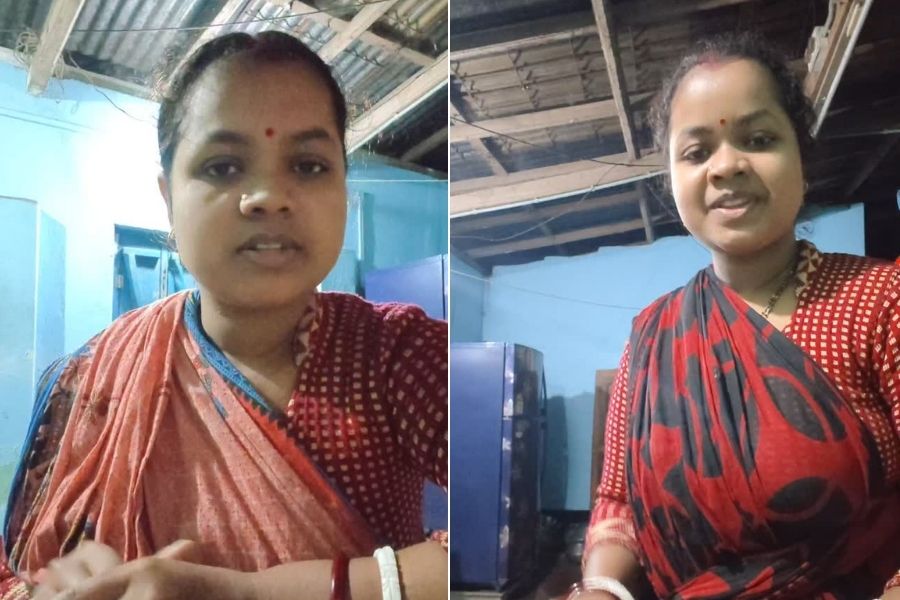
As a woman there is something intimate about watching another woman live her life when she does not demand attention but earns it. When she does not perform, or sell, or try to impress. She just exists in her true form.
Most nights, like countless others, I scroll. I scroll while food cooks, while the day winds down, while my mind refuses to switch off. Reels blur into one another, I forget the plot almost instantly. And then on one such night, a woman spoke in English that was hesitant and heavily accented, but unapologetic. She was recommending crime thrillers in a voice that sounded like it came from a home, not a studio.
I stopped. Her handle was @lifeofpuja.
I stayed, not because I was looking for book or film recommendations that she reels off with effortless ease, but because there she was — no makeup, no spotlight, nothing fancy. Hair pulled back in a loose, messy bun. A faded chhapa (printed) sari, softened by countless washes. A face that looked like it had lived a full day before pressing the record button.
She spoke as she worked, as she cooked, as she moved through the rhythms of her home. In a reel, she explained that she spoke in English because she did not want people in her village to understand what she was saying.
Women who make videos, she explained, are judged, and talked about.
I followed her without thinking twice.
If you doomscroll long enough like me, chances are you know her by now. Pujarini Pradhan is a content creator who says she is from a village in Bengal’s East Medinipur district.
She has built a loyal following — she has over 5 lakh followers on Instagram and counting – by doing something radical in the age of filters and perfection.
She shows up exactly as she is.
With the advent of first Tiktok and then reels, short-form videos have changed how stories are told. They have turned ordinary people into the centre of their own narratives. And for viewers, the comfort does not lie in recognition or celebrity. It lies in the relatability factor. To be able to relate to people like us. Lives that resemble our own.
Pujarini’s reels are not about aspiration in the glossy sense. They are about contrast. While chopping vegetables on a boti, she talks about Japanese filmmaker Takeshi Kitano. While her son plays nearby, she reads A Thousand Splendid Suns by Khaled Hosseini.
In one video, she says she may soon reach 300,000 followers, but at home, no one really cares. There, she is only a daughter-in-law and a wife.
That sentence lands hard because women know what it feels like to gradually put their interests away and let hobbies dissolve between school runs, cooking, caregiving and responsibility. Time for yourself feels like something borrowed and never owned. ‘You can’t be a good mother if you are career driven’, ‘choosing yourself (even once in a while) is selfish’, ‘for a woman, family should always come first’. Women are always expected to choose family over career. The expectation is mostly loud and sometimes silent.
Pujarini balances both and speaks about this without anger. She acknowledges the different life she leads – even as she laments about how Covid robbed her of the opportunity to study further and how she was forced into marriage like girls across India that largely lives in villages – and the space she gets without a hindrance from her husband or mother-in-law.
Her dreams are modest and practical. She wants to buy land and build her own home. Not a house she belongs to by marriage or birth, but one that is hers. She says a woman never really has a home of her own. Before marriage, her mother told her it was not her house. After marriage, her in-laws’ home was not hers either.
When she earns a lot, she wants to save for her son. She wants to buy books and learn art. Aspirations that are quite common but ask a woman, she might tell you about the countless hurdles she has to overcome before she achieves her dreams.
There is no performance here, no ring lights, wireless lapels or aesthetic backdrops. The walls behind her are chipped, her sari is faded and the anchol is tucked around her waist as she works. The camera stays steady while life moves around her and she goes on with her life. She does not teach you how to contour your face or restock a pantry. She shows you what it looks like to hold onto curiosity when life gives you very little space to do so.
Pujarini Pradhan has over 504,000 followers on Instagram. She has also started a second account called Little Ordinary Things where she recommends films and books. This account already has more than 71,000 followers. Her English, too, has got better over the time she has been vlogging, although the heavy Bengali accent remains untouched.
And still, she says she does not want the limelight or media attention. She makes videos for herself.
On Sunday, she posted on Facebook, where she has 19,000 followers at last count: “I love this phase of my life, but I always pray that I don’t get too tangled in these things and start daily blogging or recording everything. Otherwise, I might lose touch with reality. It’s better to just watch cinema.”
That may be the most moving part of all.
I tried reaching out to Pujarini Pradhan for this story but did not receive a response. Perhaps that, too, fits the rhythm of her life. Unbothered by the noise around her.
To be clear, social media is a make-believe world where nothing is verified or sacrosanct. It may turn out that Pujarini Pradhan’s reality is not exactly what she shows. But it seems unlikely.
In a digital world obsessed with polish and performance, as a woman, her videos feel like a pause. A reminder that stories do not need spectacle to matter or to turn the spotlight. That social media need not be the cesspit it is increasingly turning out to be.
Sometimes, all it takes is a woman standing in her kitchen, speaking softly about the things she loves, and refusing to disappear.
To be someone beyond the mother, daughter, daughter-in-law labels.