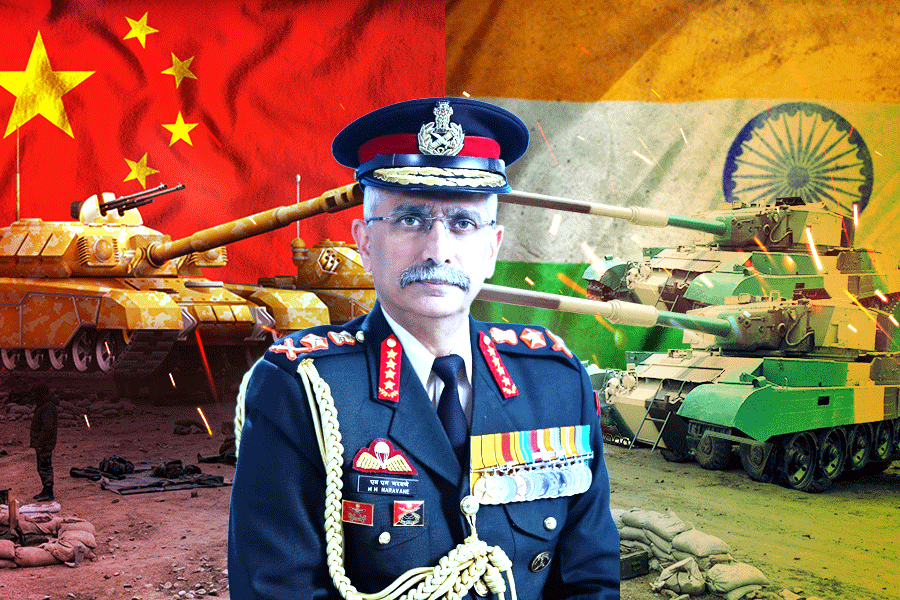
It was a moment of extraordinary tension that could have led to a full-scale war. On the night of August 31, 2020, four Chinese light tanks were moving towards Indian positions at Rezang La in eastern Ladakh, supported by infantry marching behind them. Frantic messages were flying back and forth between Eastern Army commander Y.K. Joshi and Indian Army chief Manoj Mukund Naravane. Field commanders repeatedly asked for permission to open fire. Under existing rules, the Indian Army could not shoot without clearance from “the very top”. But Naravane was in an impossible fix: his political masters, defence minister Rajnath Singh and Prime Minister Narendra Modi, were staying schtum.
M.M. Naravane says he asked a simple, straightforward question: “What are my orders?” Soon afterwards, it briefly appeared that a truce might take place and a military encounter could be avoided. Chinese Major General Liu Lin suggested a truce and a flag meeting the next morning. But Chinese actions did not match their words and the tanks kept advancing towards Indian troops holding the higher ground.
Rajnath Singh’s response, when it finally came, was terse: “Do what you deem appropriate.” It was to be a “purely military decision”.
India had recently seized the Rezang La heights on the Kailash Range after smart manoeuvres. Now Naravane alone had to decide whether to fire the first shots against China. He took a calculated risk. He sent Indian medium tanks into a forward position with their turrets lowered. These tanks would have blown the smaller Chinese ones to smithereens. The strategy worked. The Chinese halted their advance and the crisis passed. Rezang La, incidentally, is famed as the site of the final pitched battle of the 1962 war, when 120 Indian soldiers fought to the last bullet and bayonet against 5,000 Chinese troops.
The Rezang La confrontation was the most dangerous moment after the Galwan clash two months earlier in June 2020. Naravane describes the episode in his autobiography, Four Stars of Destiny, which was scheduled for publication in April 2024. But the government insisted the book be vetted and it has been sitting with the authorities ever since.
Now Caravan magazine has obtained the manuscript and published a detailed account.
The manuscript was thrust into a political storm in the Lok Sabha on Monday when Congress Opposition leader Rahul Gandhi tried to read from it and was shouted down by the government benches. Amid the uproar, Gandhi pushed back, demanding to know what the government was “so afraid of” and why the former army chief’s account could not be heard in Parliament.
The author of the Caravan article, Sushant Singh, points out that “going to war can never be a purely military decision”. It is a political one as well. But Naravane says he was left on his own without the slightest guidance. Adds Singh: “According to Naravane’s account, there was neither any authorisation to fire nor any restriction. No guardrails. No contingency framework.” All this unfolded as the world’s two most populous countries edged towards conflict while Covid-19 swept the globe and economies were struggling.

India and China had maintained relative border peace for decades, barring a few skirmishes such as Doklam in 2017. The brutal Galwan encounter, in which 20 Indian soldiers and an acknowledged four Chinese soldiers were killed in a vicious club and lathi fight, marked the first fatalities in nearly half a century.
What exactly has triggered heightened Chinese aggressiveness in recent years remains unclear, though under Xi Jinping, so-called “Wolf Warrior” diplomacy has become common across China’s borders. Beijing has had repeated confrontations with the Philippines over uninhabited islands and similar disputes with Japan. Taiwan, of course, faces constant pressure from its powerful neighbour.
Contrary to Naravane’s account, the Rezang La standoff has often been presented publicly as a tactical Indian victory. According to Naravane, that is far from the truth. He vividly describes sitting in silence, weighing the options. “All was quiet save for the ticking of the wall clock,” he writes. He decided not to be the one to fire the first shot. “The PLA tanks, which had by then reached within a few hundred metres of the top, stopped in their tracks. Their light tanks would have been no match for our medium tanks. It was a game of bluff and the PLA blinked first.”
Naravane contrasts the handling of Rezang La with earlier conflicts such as the 1971 war and Kargil, where elected governments explicitly authorised military action through the Cabinet Committee on Security.
After the late-August 2020 standoff around Rezang La and Rechin La on the Kailash Range, the Ladakh crisis shifted into a military-diplomatic phase. Both sides reinforced flashpoints along the Line of Actual Control, particularly around Pangong Tso, and moved to corps commander-level talks. In Naravane’s telling, this stabilisation effort was shaped by the mid-June Galwan clash, which he describes as the culmination of weeks of steadily escalating Chinese incursions that had been treated as localised incidents. The Galwan confrontation, triggered during efforts to remove a Chinese post, turned into a night-long hand-to-hand fight.
In the aftermath of the deadly clash, phased pull-backs were negotiated at Galwan, Gogra-Hot Springs and Pangong. While these separation arrangements were designed to prevent fresh face-offs, Naravane notes that they also restricted Indian patrolling in areas previously accessed and quietly altered ground realities.
The memoir also makes clear that Naravane, who served as the Indian Army chief from 2019 to 2022, strongly opposed the Agnipath short-term enlistment scheme. It became one of the most contentious points of friction between him and the government during the final phase of his tenure. In the manuscript, Naravane records that he was effectively blindsided by the recruitment reforms, which introduced short-term, contract-based service and fundamentally altered the army’s traditional structure.
Far from being a policy he helped shape, Agnipath was pushed through despite vigorous objections from the service chiefs, including Naravane. He indicates that he did not agree with the manner in which the proposal was taken forward and that the army’s professional concerns were overridden. He notes that his final meeting of the Cabinet Committee on Security in March 2022 was “not so pleasant”.
The episode underscores an underlying theme of the memoir: that major structural decisions affecting the armed forces were increasingly driven by the political leadership, with limited input from military leaders, and that Agnipath, in particular, was imposed rather than brought about through consensus with the Indian Army’s top brass.