As a gargantuan global cinema industry curbs and crushes the infinite potentials of the cinematic vision, so lovingly explored and nurtured and nourished by generations of Masters from the origins of the medium, and drives the viewer to a dumbed-down desert of virtual hypnosis, it was left to a small team of six committed young Bengali film aficionados — with the right technical knowhow — to take up the challenge and open up afresh the power of cinema to probe with passion the sheer spirit and grit of a rebel defining himself even as he tears himself up in his encounter with Authority.
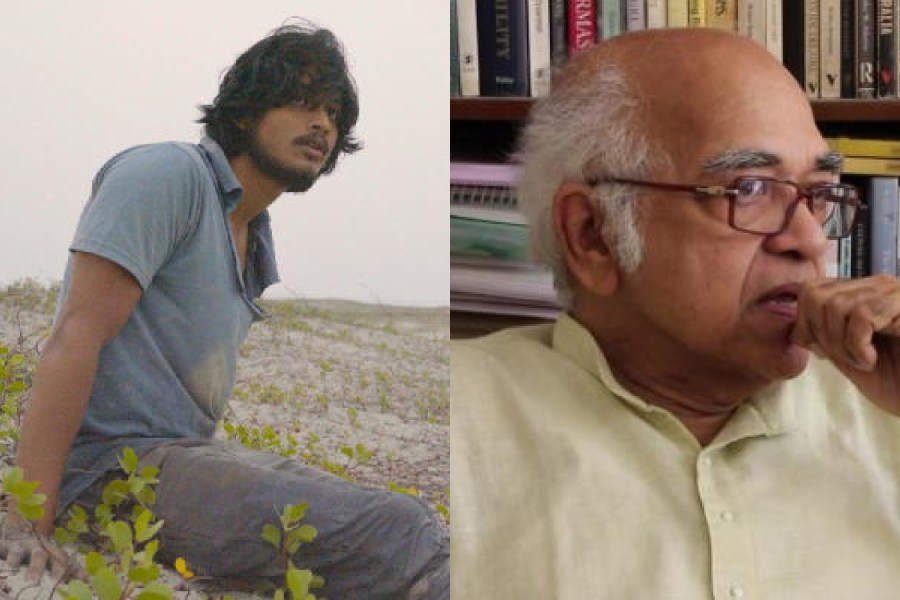
A botched political assassination, leaving the state, the police, the media, and the ever-lurking company of hired goons trailing the lone assassin on the run, till the cops catch up with him and shoot him dead at point-blank range — that is the narrative at the core of Adamya (I would prefer to translate it as ‘indomitable’). But the lone rebel’s (played by Aryuun Ghosh, who assisted the director and handled the costumes and art for the film, in addition to singing an overpowering rap version of a Sukanta Bhattacharya poem) long journey to his hideout in a village, somewhere deep in the Sundarbans, with its river, its slush, its jungle cover, with an overwhelming grey spread over it most of the time, with the brief glimpses of moonlit or sunlit greenery, sharpening the grey in contrast, builds up cinematically a visual, dynamic space throbbing with terror and resistant grit.
If verbal conversations are rare, brief, and clipped throughout the film, heightening the lonesomeness and precarity of the protagonist, the conversations carry shades of attachments, obligations, and engagements in other relational spaces — the home and the world, the single mother family that still has its delicate, fragile hold on him; and the ties that draw him back to ‘betrayals’ of comrades in desperate circumstances, and the irreparable shame and guilt that haunt him. In his hiding, with the occasional connects with his ‘comrades’, and the insecurity and threats that hang on him, the rebel takes meticulous care of his habitation, laboriously making a home of it, nurturing a treasured privacy. With the director wrapping his protagonist with his lived space, the camera holding them together closely, the viewer may even come to feel that making a home of it could be the protagonist's dreamscape — the home that he envisages for the people for whom he fights his battle!
The measured tense space that the protagonist inhabits with constant caution is violently disrupted in an encounter leading to a gunbattle with a gang of local goons, in which the protagonist manages to make his escape, having killed two of the attackers. This second escape changes the tight, taut run of the film to a more relaxed, lingering rhythm, a typically cinematic swing, as the protagonist makes his way to a trawler in mid-river and finds himself in an open space with the sky and the water in full flush.
With the riverscape the film steps out of the shut-in interior to an exterior, that automatically expands to a wider, more elemental battlespace, reaching its peak in the protagonist's long, strenuous swim through the swirling tidal waves and piles of slush, shot in all its brutal reality, followed by a few minutes of idyllic peace and rest, only to be shattered by the desperate chase and encirclement by the police — and the ‘death by encounter’.
The close visual watch that the director Ranjan Ghosh and cinematographer Arka Prabha Das maintain throughout over the Sundarbans terrain gives the film a physicality that is searingly charged. The physicality of the terrain rubs off against Aryuun's constant activity in close detail — and in the explosive burst of his rap song blasting the silence apart. It goes to the credit of the young team that, in their commitment to the core values of cinema, they achieve a rare breakthrough with a total engagement with their visionary, libertarian thrust.