 |
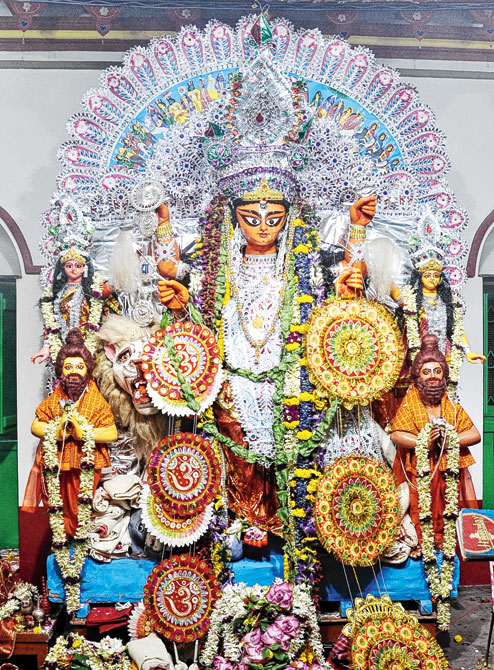
| Jagadhatri at the Tosh Bari puja in Santragachhi. Pictures by Anup Bhattacharya |
The fresh paint on the walls of the house and colourful lights at the entrance are a giveaway. A celebration is on at a house that is mostly under lock and key all year round. A porch leads from the entrance to a courtyard that in turn leads to a thakurdalan. A crowd of people sit on the clean marble of the thakurdalan facing the courtyard. The Navami pushpanjali of Jagadhatri puja is on. Most of the ladies have kept a fast through the day.
Jagadhatri Puja is the only time in the year when this ancient mansion comes alive. Members of the Ghosh family, who are descendants of Ashutosh Ghosh, gather here for the festival. The family of tea traders is better known as the owners of A Tosh and Sons, tea-makers. Ashutosh Ghosh was a wealthy man from Santragachhi who started the tea trade. The name ‘Tosh’ was a British abbreviation of Ashutosh, as the Brits could not pronounce the full name at the tea auctions. However, it was Ashutosh’s son, Prabhash Chandra Ghosh, who established A. Tosh & Sons in 1916. “My grandfather was an innovative man and had toiled hard to establish the business, without taking any help from his father,” said Gautam Ghosh, a member of the family.
 |
| Kumari puja at the Tosh family puja |
Jagadhatri Puja at this house is 140 years old. However, no one knows how the puja started. Some say that Ashutosh’s mother, Chamatkarini Devi had initiated the puja at the house. Later, a trust was formed, Chamatkarini Devi Trust, through which the puja is still conducted. “The activities start at the house from Lakshmi Puja onwards. A lengthy kathamo puja is held on that day on the wooden frame which is kept at the thakurdalan. The frame is the same that was made when the puja started, with repairs from time to time. It is removed from the pond 15 days after immersion of the deity. Clay is applied on the frame and then the idol-maker starts his work,” said Ghosh.
The idol is made in the courtyard itself and the clay cannot be dried artificially. The idol is placed at the thakurdalan after bodhon on the day before Jagadhatri Puja. The deity along with Jaya and Vijaya are adorned with gold ornaments and silver weapons. Along with them are two other idols of sage Vasishtha and Narad on both sides of the goddess. An important ritual at this Jagadhatri Puja is offering puja at the local Jaichanditala temple in Santragachhi. Members of the family walk to the temple and offer prayers there and distribute the prasad among the local people. “We have been doing this through several generations. Jaichandi is the village deity and we have to offer prayers at that temple as well,” said Ghosh.
Saptami, Ashtami and Navami pujas are held on the same day at the Ghosh residence. Three sets of bhog are offered, but none of them include rice or cooked food. They can only offer fruits and sweets. “The narkel nadu is made at the house seven days before the puja starts. Rice is not prepared at the house on that day and all members of the family as well as guests are treated to luchi or kachuri and vegetables,” said Ghosh.
Bali takes place in the evening during Navami puja. A goat used to be sacrificed earlier, but that ritual was done away with several years back. “My father had fainted on seeing blood when he was a boy and my grandfather decided to do away with goat sacrifice. Instead we sacrifice sugarcane, batabi lebu (pumalo) and chaal kumro (ash gourd),” said Ghosh. Kumari puja and dhuno pora are also part of the Navami rituals.
During Ashutosh Ghosh’s time and after that, the community lunch would continue for three days at the house. Now, that takes place on the puja day itself. “Santragachhi has changed a lot over the years. Our family members have also relocated to Calcutta. So, we have lost touch with the local people. The meals are restricted to friends and family and of course the guests who come for the puja,” said Ghosh.
The Jagadhatri Puja at advocate Manindranath Moitra’s house in Baksara is 14 years old. A pandal is made for cultural programmes at the entrance to the house and the long driveway ends at the puja mandap. This year the puja started a 6am and ended at 6pm, completing Saptami, Ashtami and Navami pujas on the same day. Friends and family members who come for the puja, stay back for some more activities later in the evening. The stage outside was made for Neelachaley Mahaprabhu, the jatra staged by Howrah Samaj.
 |
| The evening arati at the Moitra residence in Baksara |
Jagadhatri Puja was started at the Moitra residence as a result of a long-standing wish of Manindranath’s father. “My father wanted to start Durga Puja at the house. However, his wish remained unfulfilled at the time of his death. The thought would often bother me, and one day I expressed my wish to my son, Pranab. Durga Puja is a long affair and we do not have the manpower to conduct a five-day puja. So we decided on performing Jagadhatri Puja at the house,” said Manindranath. In 2001, the puja was organised within 20 days at the house and Manindranath believes that the goddess visits his house on this day. “I had found a bel pata under the goddess’ feet one year and after that I feel the divine presence here,” he said.
An elaborate arrangement is made for the bhog offered three times through the day. “For Saptami we offer khichuri and fritters, for Ashtami we make pulao and vegetables and for Navami we have fried rice and other vegetables. At the evening arati, we offer luchi and halwa to the deity,” said Lalita Moitra, Manindranath’s wife, who is in charge of the bhog. Narkel nadu is made at home, whereas all the other sweets are ordered from the shops. Another ritual observed by this family is purifying a coconut with gold and silver rings before offering it to the fire during hom. “We also have to offer seven different kinds of leaves, apart from bel leaves, representing each planet of the astrological system. These are collected from far off places in Howrah,” said Pranab.
Apart from the puja, the cultural programmes are also an attraction at the Moitra residence. Every year, some form of folk art is shown here. This year it was Howrah Samaj’s jatra. “A jatra group from Chitpur had performed here one year. Bhaba Pagla’s nephew from Khalna had come to perform here another year. This year, I decorated the pandal using patachitras by village artisans in Pingla in Midnapore,” said Pranab.
A sit-and-draw competition is organised on the morning after the puja where children come from various parts of Howrah, Calcutta and the 24 Parganas to take part. A tubri competition takes place the same evening. “We get a huge number of entries for this one. The winners get a cash prize and trophy,” said Pranab.
Dalia Mukherjee