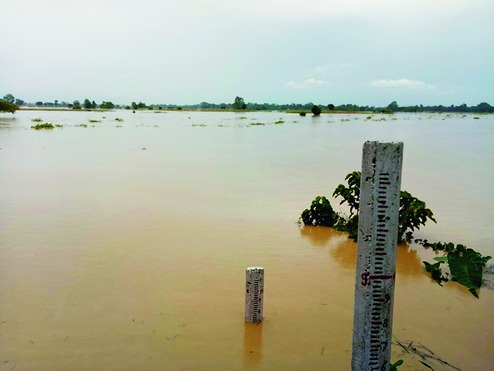

Dhemaji, July 24: Water flowing through the breached dykes after release of water from the North Eastern Power Corporation Limited (Neepco) Ranganadi project has once again led to flooding in Lakhimpur district in Upper Assam.
As the breach, which occurred on the Ranganadi dykes on July 11 because of release of water from the Neepco project, is yet to be plugged, the release of 200cumecs of water today flooded nearly 96 villages and affected 46,560 villagers, compelling the affected to take shelter in makeshift camps on dykes.
People whose houses were damaged on July 11 are still stranded on dykes. The water released will also affect adjoining Majuli, a source said.
The previous release of water from Neepco had breached the dykes on both sides of the Ranganadi, nearly 5km from Lakhimpur town, affecting 356 villagers.
Sanjay Gogoi of Bogalijan village, where the breach occurred on the Ranganadi eastern bank, said this year they can't expect any agricultural production as water will continue to enter through the breached area with changes in weather or release of water from the project.
Lakhimpur deputy commissioner Barun Bhuyan said today's release of water by Neepco was a routine drill during the rainy season and as the breached area couldn't be closed since the monsoon is not yet over, water will continue to enter the villages through the breached dyke easily. He appealed to the villagers to remain cautious.
Neepco recently defended its 405MW Ranganadi hydro electric project in Yazali in Lower Subansiri district in Arunachal Pradesh, nearly 45km north of Lakhimpur, while the All Assam Students Union has called for demolition of the Ranganadi project and that of the National Hydroelectric Power Corporation Limited (NHPC) in view of devastation caused by floods in Lakhimpur district.
According to V.K. Singh, Neepco director (technical), release of water today was routine as is the case when there is excess water in the reservoir. He said since the opening in the dyke was still there water may enter human habitats but will "not" affect much. "The release of 200cumecs of water is normal. Even in 2008 there was flood in Lakhimpur. Many other rivers join Ranganadi before it enters the Lakhimpur area causing inundation," Singh said.
Even if routine, the release of water has become a rallying point for the people of Lakhimpur against the project. It has also fuelled fears against construction of big dams.
Lakhimpur district Congress committee has organised a mass protest on the banks of Ranganadi on July 31, for closure of Neepco and NHPC, said Lakhimpur district Congress president Joy Prakash Das. He said they have appealed to the people of Majuli and Dhemaji to join them to create pressure on government and authorities, to compensate the affected people.
On July 22, at a public meeting held at Lakhimpur Commerce College, group named Save Lakhimpur was formed to fight against Neepco and NHPC. Speaking at the meeting, Lakhimpur district Asam Sahitya Sabha general secretary Bipul Sharma said projects by Neepco and NHPC on Ranganadi and Subansiri are like "atom bomb" and "hydrogen bomb" for the people of Lakhimpur, Dhemaji and Majuli, and that they will have to "fight against both or else their future is dark".
He demanded that the Ranganadi project authority arrange for drawing of excess silt deposit in the river bed for free flow of water in the channel.
He said since the first flood caused by the project in 2008 after its commissioning in 2002, floodwaters have taken the life of 30 people leaving many homeless and since the commissioning of another NHPC project will clear up, it is the right time to fight with state and central government for their closure.