 |
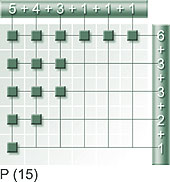
| Partition pair: Two ways to make the number 15 are related. Illustration by M. Iqbal Shaikh |
Karl Mahlburg, a graduate student at the University of Wisconsin in Madison, US, is very happy, for he has solved a puzzle that?s 75 years old. We in India share his elation as the riddle originated from the research of the mathematical genius Srinivasa Ramanujan.
Why is Mahlburg making headlines? Well, to put it simply, his 10-page paper to the Proceedings of the National Academy of Sciences (PNAS), published in the US, accomplishes something that eluded even Ramanujan. The feat concerns some strange behaviours of numbers.
In how many ways can you show the number 4 as the sum of smaller numbers? The answer is five, as
4=4
4=3+1
4=2+2
4=1+1+2
4=1+1+1+1.
So, there are altogether five ways for breaking 4 apart. In mathematical parlance 4 is said to have five partitions. Symbolically this is written as p(4)=5.
You needn?t be an Albert Einstein to realise that the bigger the number, the more numerous its partitions are. Bigger numbers can be expressed as sums of their components in many more ways than the smaller ones. For example, p(5)=7; p(6)=11; p(7)=15; p(10)=42; and p(50)=204,226. The numbers 100 and 200 can be shown as sums of their parts in 190,569,292 and 3,972,999,029,388 ways respectively. Again, symbolically, p(100)=190,569,292 and p(200)=3,972,999,029,388.
An interesting fact about partitions of a number is that some of them come in pairs which seem, at a glance, to have no connection with one another, but on closer inspection are found to be intimately related. The point can be illustrated with p(15). Of the 176 ways it can be partitioned, a pair of sums ? of course, among many ? are:
5+4+3+1+1+1,
and
6+3+3+2+1.
If assembled in a grid-like patttern, the relation between the two members of this pair of partitions becomes obvious (See picture). If you read downward instead of across, you?ll get the second partition. So partitions, besides being an intrinsic property of a particular number, do show a pattern within themselves also. Mathematicians, forever seekers of order in chaos, find partitions alluring enough to study in detail ? in case they yield hidden clues to study and make use of numbers.
 |
| Srinivasa Ramanujan and (below) Karl Mahlburg |
 |
Is there a formula to predict how many partitions a number will have? Yes, there?s one, and it was discovered by Ramanujan and his British collaborator Godfrey Harold Hardy during the former?s stay in the UK.
But despite their success in devising that formula, they couldn?t explain the mysterious properties of the partitions of some numbers. For example, they found that numbers of the form 5n+4, where can have any value, had partitions that could be divisible by 5.
If =1, then 5n+4=5x1+4=5+4=9.
And p(9)=30, which is divisible by 5.
If =2, then 5n+4=14.
And p(14)=135; it is also divisible by 5. Similarly, p(19), p(24), p(29), p(34), ... are all divisible by 5. In short, partitions for all numbers of the form p(5n+4) are divisible by 5. This shared characteristic is called a congruence.
Interestingly, congruences are noticed for partitions of other numbers as well. For example, p(7n+5) is always divisible by 7, and p(11n+6) is always divisible by 11. Have you noticed a peculiarity in all this? Yes, 5, 7 and 11 are all prime numbers ? numbers which are divisible by themselves only.
Why this regularity? No one had any answer initially. ?In some sense, no one understood why you could divide some partitions into five equal groups,? says Prof. George Andrews, a mathematician at the Pennsylvania State University and discoverer of Ramanujan?s lost notebook. For quite some time it was also not understood why partitions of some numbers were divisible by 7 and 11 also.
The scenario changed in the 1940s when Freeman Dyson, a young physicist working at the Institute for Advanced Study in Princeton, New Jersey, US ? Einstein?s home in the US after he fled Nazi Germany ? studied the matter. Dyson, a polymath, studied in the UK. He envisaged a career in mathematics, but later shifted to physics. Like many of his peers, he worked in the Manhattan Project, the secret US endeavour to make the atom bomb. When World War II ended, he devoted his mind to solving a very hard problem of physics, namely the ironing out of the ugly mathematics that resulted from the calculations of interactions between light and matter. The theory to describe that interaction was called quantum electrodynamics (QED). A number of physicists bagged the Nobel prize for their contribution to this theory. Although Dyson wasn?t one among them, his exclusion from the list of awardees is still considered in physics circles as an injustice.
Pure mathematics ? or, more specifically, the study of the properties of numbers ? has remained one of Dyson?s great passions despite all his work in theoretical physics. It was his love for, and mastery over, things mathematical that bore fruit in the 1940s when he explained a rule ? which he called ?rank? ? to explain congruences for 5 and 7 in partitions of some numbers. That kicked off a serious search for a rule that covered congruence for 11 as well. This new rule was discovered in the 1980s by Andrews and Prof. Frank Garvan of the University of Florida. The duo called the rule ?crank?.
Then in the late 1990s Mahlburg?s advisor at the University of Wisconsin, Prof. Ken Ono, stumbled across an equation in one of Ramanujan?s notebooks that led him to discover, to his utter surprise, that any prime number ? not just 5, 7, or 11 ? had congruences. ?He found, amazingly, that Ramanujan?s congruences were just the tip of the iceberg ? there were really patterns everywhere,? Mahlburg has told the New Scientist. ?That was a revolutionary and shocking result.?
No prizes for guessing what mathematicians? next task would be. Yes, the number theorists began to search for ?the reason behind the rhyme noticed by Ono,? as one mathematician put it. Mahlburg was one among those who wanted to have a crack at the problem. In his four years as a graduate student at the University of Wisconsin he wrote three papers, more than enough to earn a PhD. When Mahlburg said he wanted to continue Ono?s work on congruences, the professor was nervous. He didn?t want his students to fail, but Mahlburg couldn?t be dissuaded. ?Not everyone,? Ono said, ?has the ability to work out a problem that at the end of a year might not work out at all.?
That didn?t happen. Mahlburg succeeded in his assignment, proving why the crank rule can be noticed with all the prime numbers. It took him pages after pages of mind-bending calculations. Although he played classical piano to get the numbers out of his head to get a break, he lived with his problem day in and day out, until perseverance finally saw him through.
?This is something way beyond what anybody has done before,? comments Andrews. ?This is a very bright guy who has done something very hard.? Dyson, too, is very impressed with Mahlburg?s success. ?It?s beautiful,? says he. ?Beautiful and totally unexpected.?
Giving an analogy, Mahlburg likens his find to going to a hugely crowded bar and being able to guess that there are an even number of people there. Rather than counting every person, Mahlburg uses a special technique showing that people are dancing in pairs. ?Then, it?s quite easy to see there?s an even number,? he says.
According to Andrews, the methods used to arrive at the result may find an application even in electronic commerce, because partitions have been used in encrypting credit-card information sent over the internet.