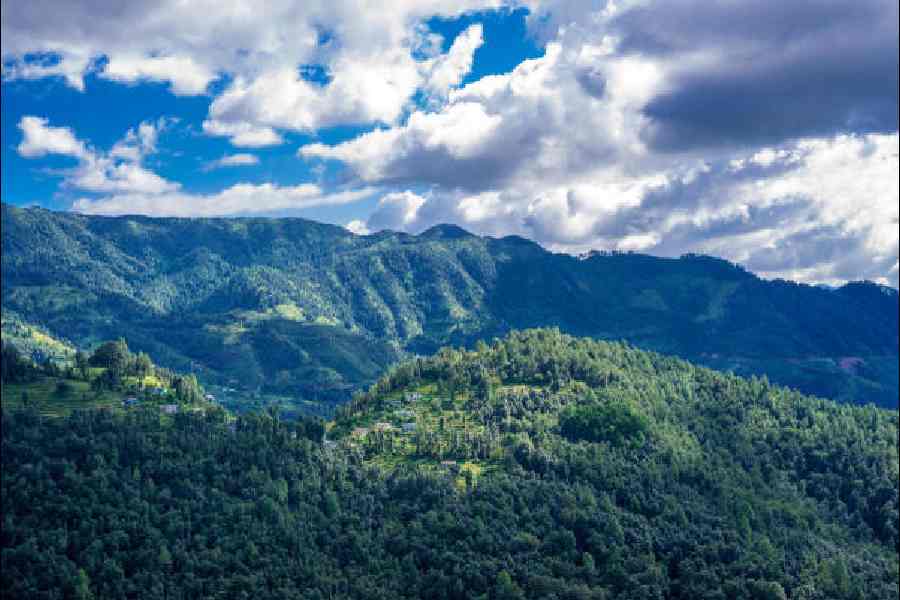
For nearly 50 years, a geologist held onto a suspicion others dismissed.
As a doctoral student in the late-1970s, Mallickarjun Joshi noted similar patterns of folds in rocks near Almora in the Himalayas and in Rajasthan’s Aravalli range — features that hinted that the Almora rocks might be far older than the Himalayas. His supervisors discouraged him from pursuing that idea. Under the dominant tectonic narrative at the time, the India-Asia collision about 50 million years ago would have driven older rocks under the crust where intense heat and pressures would have thoroughly transformed them into new rock as the Himalayas rose.
But Joshi did not abandon the idea. He continued studying the rocks, raising his hypothesis about older rocks from time to time at geology conferences, while tracking advances in geochronology — the science of determining the age of rocks and embedded minerals. He waited for access to tools precise enough to test the idea. Now, Joshi and his colleagues have identified in rocks from Pithoragarh in Uttarakhand minerals dated to be 1.8 billion and 1.6 billion years old, which they say record two distinct phases in the final assembly of an ancient supercontinent known as Columbia.
Their discovery calls into question the idea that the India-Asia collision would have obliterated any older metamorphic rocks. “The much older rocks we’ve found have escaped that destructive process,” Joshi, former professor of geology at the Banaras Hindu University in Varanasi told The Telegraph.
The findings, published in February in the journal Precambrian Research, add a new angle to the geological history of the Himalayas. For decades, the prevailing model has held that the immense pressures generated by India’s collision with Asia would have intensely reworked pre-existing rocks, erasing much of their earlier history. Yet the newly dated minerals — tiny zircon crystals that can survive multiple tectonic cycles — record events from nearly two billion years ago.
German geologist Alfred Wegener was the first to propose in 1912 the hypothesis that throughout Earth’s history, the continents have been engaged in a cycle of assembly and fragmentation — drifting into each other, creating supercontinents, separating — changing both land and ocean formations. Many geographers had noted that parts of certain continents such as Africa and South America appear as if they could fit together like pieces of a jigsaw puzzle.
Wegener’s hypothesis initially met with scepticism, but discoveries in the ensuing decades — seafloor spreading, palaeomagnetic reconstructions and converging geochemical evidence — firmly established the concepts of plate tectonics and continental drift by the mid-20th century. By the early 1970s, the northward movement of India after the breakup of Gondwana and the subsequent India-Asia collision had become the dominant explanation for the uplift of the Himalayas. Within this emerging framework, mountain ranges were understood not as isolated features, but as products of a long, repeating tectonic cycle operating over tens of millions of years.
Against that backdrop, in 2002 American geologist John Rogers put together data he had gathered from India, east Africa and other regions to propose an ancient supercontinent he named Columbia. In a landmark paper in the journal Gondwana Research, Rogers and co-author M. Santosh argued that Columbia assembled around 1.8 billion years ago and began breaking apart about 1.4 billion years ago. Their reconstruction suggested that fragments now scattered across multiple continents were once sutured together as an ancient, vast landmass.
The concept of supercontinents has since become central to understanding Earth’s deep past. Geological evidence indicates that Columbia was followed by other supercontinents — Rodinia, which formed around 900 million years ago and began breaking up about 700 million years ago, and Pangaea, which formed roughly 330 million years ago before fragmenting around 200 million years ago. Each cycle reshaped oceans and the arrangement of landmass, leaving behind sutures, metamorphic belts and mineral signatures that geologists can trace today.
India itself preserves some of the planet’s oldest continental fragments. An international research team showed in 2021 that the Singhbhum region in eastern India may have been the first continental land to rise above the ocean about 3.2 billion years ago. Sandstones there contain signatures of ancient river channels, tidal plains and beaches — evidence that parts of Earth’s crust had risen above the oceans far earlier than previously thought.
The presence of ancient rocks in the Himalayas is therefore not, in itself, unexpected. Scientists say what makes the Pithoragarh rocks unique is their metamorphic character and their survival within mountains created by a relatively recent tectonic collision.
Joshi and his colleagues describe their findings as a “hitherto missing piece of evidence” that shows that the Askot Klippe rocks record two mountain-building events long before the Himalayas emerged. Using advanced geochronology equipment at the Wadia Institute of Himalayan Geology in Dehradun, the team dated zircon crystals in the rocks to 1.8 billion and 1.6 billion years.
What we found matches the idea that after the central part of the supercontinent Columbia had come together around 1.8 billion years ago, more continental fragments kept getting added slowly along its far outer edges for a long time,” Biraja Das, an assistant professor of geology at Dharanidhar University in Keonjhar, Odisha, and one of the study’s lead authors told The Telegraph. “This final assembly went on at least until 1.6 billion years ago. Our evidence tells us that the growth and accumulation did not really finish at 1.8 billion years but carried on a little longer in far-side spots.”
Beyond documenting ancient rocks in a young mountain range, the study also suggests that the Aravalli-Delhi belt, the northern edge of the Indian continental plate, and segments of southeastern China known as the Cathysia block were once adjoining pieces of Columbia. If confirmed, these links would help refine models of how continents collided and fused nearly two billion years ago.