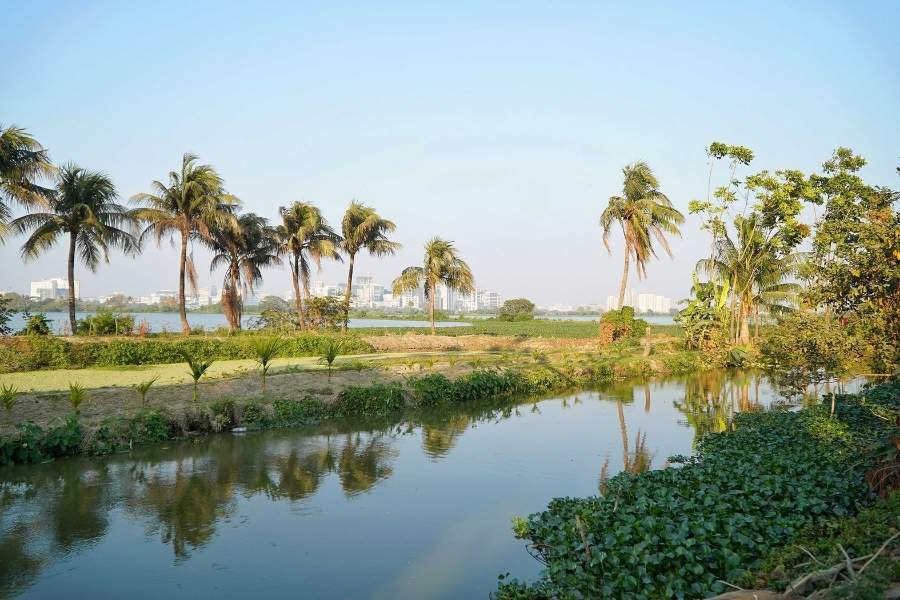
West Bengal does not lack water; it lives with it, negotiates with it and, at times, suffers because of it. Yet the state’s wetlands continue to be treated as peripheral landscapes rather than as critical ecological infrastructure. This is a costly oversight.
As climate risks intensify and public resources remain stretched, carbon finance is emerging as a potential instrument to support wetland protection and restoration. Carbon finance links monetary value to verified climate outcomes. Projects generate carbon credits only when they demonstrate measurable greenhouse gas benefits relative to a credible baseline scenario. This is where additionality becomes critical. A wetland intervention must establish that protection or restoration would not occur in the absence of carbon revenue.
West Bengal’s wetland geography presents both opportunity and urgency. Beyond the iconic Sundarbans, the state hosts an extensive mosaic of coastal wetlands, aquaculture landscapes, riverine systems, tanks, ponds and seasonally waterlogged areas. Emerging scientific attention also points to organic soil and peat-influenced pockets within deltaic and floodplain environments that merit careful assessment. Together, tidal wetlands, mainland systems and potential peat landscapes represent a significant but underutilised climate asset.
However, presence alone does not create carbon value. Eligibility depends on demonstrable threat, methodological alignment and the feasibility of long-term monitoring. Many wetlands in the state are already under pressure from encroachment, drainage modification, pollution and competing land uses. Where such pressures are real and documented, they can form the basis for credible climate interventions. It is also important to move beyond the narrow perception that wetland carbon projects are primarily about plantation activity. In practice, many of the most effective interventions are hydrological and management-oriented. Restoring tidal exchange, improving creek connectivity, stabilising water regimes in inland wetlands, managing sediment flows, controlling invasive species and strengthening protection systems often yield more durable outcomes than isolated planting.
The policy challenge lies in moving from fragmented wetland schemes to a coordinated landscape approach. Governance fragmentation remains a persistent constraint, with wetlands intersecting multiple departments and local authorities. Without institutional convergence, even well-designed financing mechanisms will struggle to scale. Equally important is clarity on tenure and carbon rights. Wetlands in West Bengal frequently involve overlapping ownership and community use patterns. Unless benefit-sharing and rights are transparently defined, investor confidence and community trust will remain fragile.
Risk management must also be built into programme design. In the Bengal context, permanence risks from cyclones, erosion and hydrological shifts are real. Similarly, leakage risks arise if protection in one location simply displaces pressure elsewhere. These concerns do not weaken the case for wetland carbon finance; they underline the need for careful, landscape-level planning.
Where the state holds a comparative advantage is in monitoring capability. Advances in remote sensing and GIS make it possible to track water persistence, land-cover change and vegetation dynamics across large wetland networks. When combined with targeted field verification, these tools can support credible monitoring, reporting and verification systems across tidal and mainland landscapes.
What is now required is policy intent. West Bengal should begin with a systematic feasibility screening of priority wetland clusters, followed by pilot programmes aligned with recognised standards and supported by strong safeguards and community participation.
Carbon finance, if used judiciously, can help unlock sustained resources for the protection of wetlands.
Sayanta Ghosh is Associate Fellow, The Energy and Resources Institute, New Delhi