Could it be that the American politician, Harvey Milk — he was assassinated in 1978 — is chuckling in the afterlife? One of the concepts that Milk pioneered in the course of his relatively short life centred on the theatricality of politics. The intertwining of the political and the performative, according to Milk, is instrumental in not only fostering a sharper public discourse but also enabling politicians to make a statement through theatricality. In other words, the optics garnered by theatricality has substantial political returns. Bengal, which has, over the decades, served as a fecund proscenium for this kind of political theatre, has just witnessed another chapter in this genre of performance art.
On Thursday, officials of the Enforcement Directorate had conducted raids on the Indian Political Action Committee, a private entity that handles data and electoral campaigns of political parties, including those of the Trinamool Congress, Bengal’s ruling party. Apparently, the raid by the Central agency is connected to a case involving coal smuggling. But as is often the case in Bengal, the script took an unanticipated turn: the alleged raiders were met with a raid by no less than the chief minister of the state. Mamata Banerjee interrupted the ED’s investigations, carrying away what she claimed were sensitive, poll-related documents that, she added, were being eyed by the Central agency. The ED, complaining against the impeding of its probe by a constitutional authority, approached the Calcutta High Court for relief.
Ms Banerjee, on her part, accused the Union home minister of targeting her party by weaponising the ED. On Friday, the legal proceedings could not take place as the judge was unable to conduct the hearing because of overcrowding: the hearing was
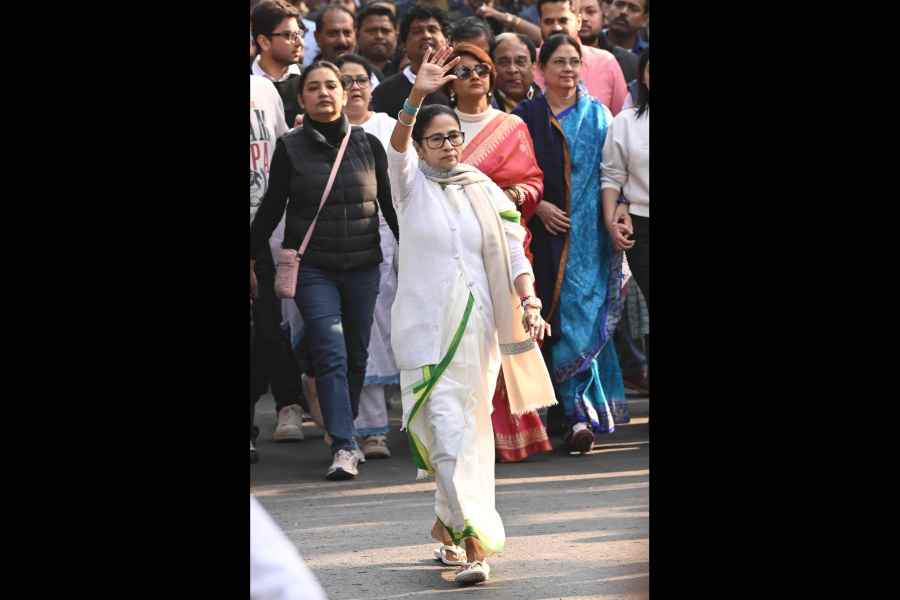
postponed to January 14. Dissatisfied, the ED approached the chief justice of the Calcutta High Court for a speedier hearing but the plea was not accepted here as well. In the meantime, the chief minister took the matter to the streets, leading a protest rally in the city. On the same day, her partymen also laid siege to the Union home minister’s house in Delhi. That is where the curtains have dropped on the scene — for now.
Political pundits are likely to spend the ‘intermission’ speculating on the brownie points earned by the warring parties in the course of their respective performances. The Bharatiya Janata Party, eyeing Bengal’s crown, would be striving to depict
Ms Banerjee as an obstructive force in the path of an investigation. Ms Banerjee, on the other hand, would want to play the victim card, portraying her party to be at the receiving end of the excesses of an authoritarian regime in the year of an election. This is understandable in strategic terms given the fact that there is data to suggest that Central investigative agencies have been employed to disproportionately target Opposition leaders and parties under the BJP’s watch. The public consumption of the theatrics would, undoubtedly, have a bearing on the upcoming assembly elections. But this is unlikely to be the final scene; more political drama awaits Bengal with the approach of the electoral season.