The Indian Air Force (IAF) has grounded its indigenous Tejas fleet for safety checks following the crash of a light combat aircraft (LCA) earlier this month, sources said on Sunday.
This is the third accident involving the Tejas fighter jet, hailed by Prime Minister Narendra Modi as “India’s pride”, since its induction in 2016.
The latest crash of a Tejas LCA Mk-1 comes at a time when the IAF is preparing to induct its advanced variant (Mk-1A).
The IAF has, so far, remained tight-lipped on the latest accident.
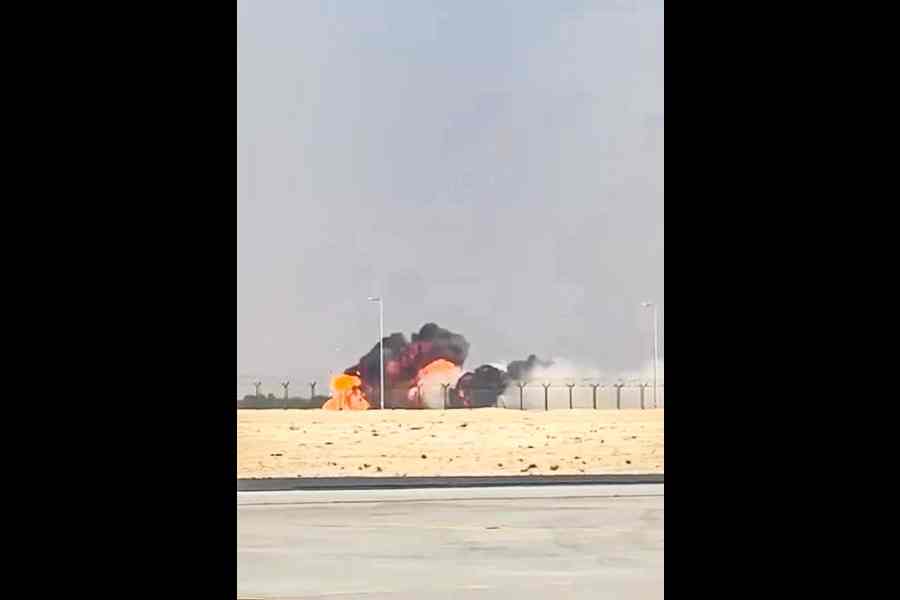
Sources said the crash took place on February 7 at a key forward airbase during landing after a training sortie. The pilot of the single-seater aircraft ejected safely, but the jet suffered serious structural damage.
“The initial probe suggested a possible brake failure leading to the crash,” said a defence ministry official.
In November last year, an IAF pilot was killed after a Tejas fighter jet nosedived and crashed during one of the world’s largest aviation exhibitions in Dubai.
A single-engine Tejas jet had crashed near Jaisalmer in Rajasthan in March 2024.
Modi, who has been pushing for “Make in India” in defence, had called the Tejas “India’s pride and a manifestation of the strength and skills of 140 crore Indians” after taking a sortie on the jet in 2023. The government has been promoting Tejas as the future mainstay of the IAF.
Tejas is India’s first home-grown fighter aircraft, albeit with a foreign engine. It is equipped with an aerial refuelling probe mounted on the starboard side of the forward fuselage.
Sources in the IAF said the Tejas line had both one-seat and two-seat combat aircraft that are used by the IAF and the navy. The engine is provided by General Electric, a US company.
Tejas is a 4.5-generation multi-role combat aircraft designed for air defence missions, offensive air support and close-combat operations. It is recognised as one of the lightest and smallest fighters in its class. Among its key safety features is the Martin-Baker zero-zero ejection seat. The seat is engineered to enable pilots to eject safely even at zero altitude and zero speed — such as during takeoff, landing or low-level manoeuvres — by explosively jettisoning the canopy, propelling the pilot clear of the aircraft and deploying parachutes to stabilise the descent.
Sources said the IAF inducted its first Tejas aircraft in 2016 and currently operates two Mk-1 squadrons (each comprising 16-18 aircraft). All three aircraft involved in the crashes belonged to the Mk-1 fleet, the first variants of the LCA.
The IAF, which is grappling with a shrinking fighter fleet, heavily relies on the indigenous LCA programme that specifically aims to replace the now-retired MiG-21 fleet.
The programme, launched in 1983, has seen repeated setbacks. The delivery of the advanced Mk1A variant has been delayed by Hindustan Aeronautics Limited (HAL) and has missed multiple deadlines. The IAF has placed an order for 180 Mk1As from HAL.
The IAF currently has 29 fighter squadrons against the authorised strength of 42. An internal assessment following Operation Sindoor indicated that the air force may need to field more than the authorised number of squadrons to meet future challenges.