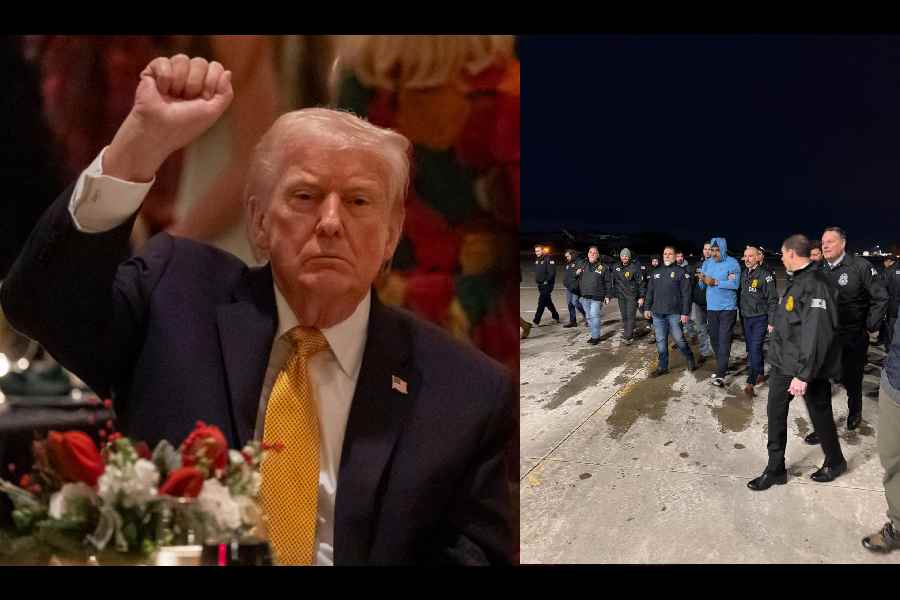
In the early hours of January 3, the Donald Trump administration did something no modern American government has openly attempted: it seized a sitting, foreign head of state and flew him to New York to face federal prosecution. The Venezuelan leader, Nicolás Maduro, long indicted in the United States of America on narcotics and related charges, was captured during a US military operation in Caracas and transferred to American custody. The US administration portrayed the raid as a dramatic escalation of its ‘war on drugs’ campaign and a shortcut around the slow grind of sanctions and diplomacy.
The operation immediately scrambled the geopolitics of the Americas and reignited a debate at home about whether the US can, or should, use military force to address what is ultimately a political problem under the banner of law enforcement. The American Right’s fixation on Venezuela and on Maduro long predates this dramatic arrest. For decades, conservative politicians and commentators have used Venezuela as a shorthand for what they describe as the failures of ‘socialism’ and as a threat to Western security. Maduro’s regime has been portrayed not merely as an authoritarian outlier but as evidence of systemic danger to the southern flank of the US. Figures such as then Senator Marco Rubio, now the US secretary of state, and allied conservative media voices have cast the Venezuelan government as both a narco-terrorist network and a proxy for the US’s adversaries, arguing that Maduro’s removal is necessary to stop drugs as well as defend hemispheric security and counter foreign influence. Drawing on Cold War tropes and the ‘troika of tyranny’ framing, this narrative has turned Venezuela into a political symbol in domestic culture wars rather than a subject of nuanced foreign policy debate.
President Trump has framed the seizure in similarly expansive terms. In televised remarks, he suggested that the US would temporarily “run” Venezuela during transition and repeatedly gestured toward oil, speaking about “getting the oil flowing” and conversations with US companies eager to re-enter Venezuela. That emphasis has made it easier for critics to argue that the drug case functions as much as a justification as a motive.
Maduro’s first American stop is not a courtroom but a jail. He is being held at the Metropolitan Detention Center in Brooklyn, a facility notorious for dysfunction and harsh conditions. The facility is also familiar on account of other high-profile federal cases, such as those involving the singers, R. Kelly and Sean ‘Diddy’ Combs, the infamous narco-trafficker, Joaquin ‘El Chapo’ Guzmán, the Jeffrey Epstein confidant, Ghislaine Maxwell, and Trump’s former lawyer, Michael Cohen.
The new mayor of New York City, Zohran Mamdani, who was sworn in on New Year’s Day, strongly condemned the American operation in Venezuela, calling it a “blatant act of regime change”. Mamdani said he called Trump to convey his opposition, adding that he “registered [his] opposition clearly and left it at that.” The administration’s legal case rests on a familiar premise: accusing Maduro of being the head of a transnational criminal enterprise rather than a legitimate sovereign leader. It draws on a long-running US indictment accusing him and other senior Venezuelan officials of narcotics trafficking. Even if the criminal allegations themselves are not new, the method of his extradition is. Extradition typically relies on treaties and cooperation between governments, not military force and the direct transfer of a captive leader to US soil. That distinction sits at the heart of the international-law controversy. With limited exceptions, international law prohibits the use of force on another country’s territory without the authorisation of the United Nations Security Council or a claim of self-defence. If Washington can seize an adversarial leader in the name of a domestic indictment, critics ask what prevents other powers from doing the same?
That aftermath remains the hardest element to define. Reuters reported that Maduro’s allies continue to control key institutions inside Venezuela, while Trump has publicly floated the possibility of further strikes if the government “does not cooperate”. The White House has tried to present the raid as being consistent with its broader anti-drug posture. In this telling, Maduro represents the apex of a narco-State and removing him is what serious enforcement looks like. A White House statement attributed to Rubio framed the action in hemispheric-security terms, warning that the US would not tolerate threats in “our hemisphere”.
While narco-trafficking may be the legal rationale, it is a specious explanation of motive. Just weeks earlier, Trump issued a presidential pardon to Juan Orlando Hernández, the former president of Honduras, who had been convicted in the US on drug-trafficking charges and sentenced to decades in prison. The pardon prompted outrage from anti-corruption advocates who argued that the ‘tough on drugs’ rhetoric is being applied selectively. Hernádez had been held at the same Metropolitan Detention Center that now houses Maduro, but received a starkly different fate.
Watchdog groups such as Washington Office on Latin America warned that the move undermined US credibility on rule-of-law and anti-impunity efforts in Central America. FactCheck.org emphasised the severity of the US court record, describing Hernández’s role in facilitating cocaine flows into the US, making his pardon harder to square with the narrative that the Maduro operation was purely principled law enforcement. But deploying hard power theatrically against enemies and extending leniency strategically to allies are already familiar elements in Trump’s power play.
For Venezuela’s democratic Opposition, already weakened by years of repression and distrust, Maduro’s sudden removal could either open space for a transition or poison it. If Venezuelans perceive the US as an occupying referee or as privileging oil interests over legitimacy, support could collapse quickly. For the region more broadly, the fear is escalation. Retaliatory violence, renewed refugee flows, and the normalisation of cross-border raids that Latin America has spent decades trying to leave behind could all flare.
Maduro’s court trial takes place in Manhattan. But the larger trial — that of American power, international norms, and whether anti-drug rhetoric is a principle or a prop — is already underway.
Carol Schaeffer is a journalist based in Berlin, Germany, and is a senior fellow at the Atlantic Council in Washington D.C.