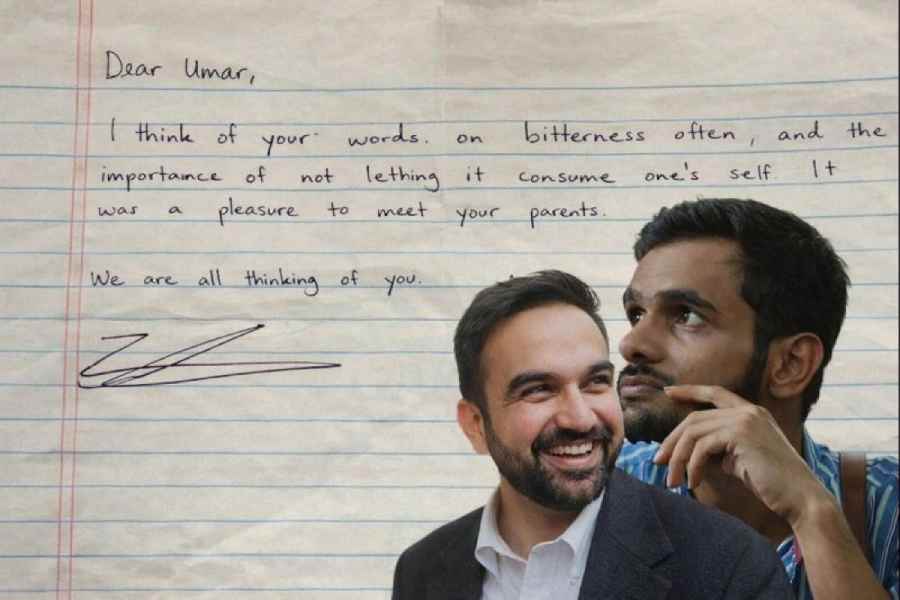
Zohran Mamdani’s brief, handwritten note to Umar Khalid, imprisoned without trial for five years under the rights-wrecking Unlawful Activities (Prevention) Act, is a model of understated empathy. “Dear Umar,” it goes, “ I think of your words on bitterness often, and the importance of not letting it consume one’s self. It was a pleasure to meet your parents. We are all thinking of you. Zohran.”
It doesn’t mention his imprisonment, nor the withholding of bail, or even the denial of a life in scholarship. Ramachandra Guha wrote of the quality of Khalid’s research in these pages in November ago and the intellectual tragedy that his seemingly endless incarceration represents. Mamdani’s note doesn’t refer to any of this, it reproaches no one. It speaks only of Khalid’s refusal of bitterness and lets him know that he isn’t forgotten.
When this note was made public by Khalid’s partner, the response of the Bharatiya Janata Party’s spokesperson was the tonal opposite of Mamdani’s message. Asked to comment, Gaurav Bhatia defaulted to the nation-in-peril rhetoric that BJP spokespersons deploy against all non-orange outsiders.
“If any person supports an accused, comments on Bharat’s internal affairs, Bharat will not tolerate it. Each Indian citizen has complete faith in India’s judiciary. Who is an outsider to question our democracy and judiciary? And that too in support of someone who wants to break India into pieces? This is not right… when it comes to India’s sovereignty, 140 crore Indians will stand against it under the leadership of Prime Minister Narendra Modi.”
If the disproportion of this response sounds unhinged, it’s because it is. Bhatia transports us to a place where the sovereignty of India is imperilled by Mamdani’s message and heroically defended by 1.4 billion Indians in lockstep with Modi. This need to dial up the volume to ten while genuflecting in the direction of the Great Leader makes the BJP’s leaders sound like fawning filmi villains.
Mamdani’s great talent is that like virtuoso singers, he has perfect pitch. There are no false notes; he just says his piece. His concision has the curious effect of provoking his enemies into rants that are also confessions. Bill Ackman, the fanatically Zionist billionaire, implicates himself by supplying alibis for Israel’s genocidal violence in Gaza while Bhatia and his ilk make themselves absurd by trying to cast Muslim men as existential threats to an implausibly fragile Hindu nation.
The twinning of Mamdani and Khalid on the front pages of Indian newspapers is a moment for reflection. They are both politically engaged men in their thirties. They are both, after a fashion, Indian Muslims. They both belong to religious minorities and that identity has often inspired suspicion amongst the political establishments of their respective countries. That is where the similarities end.
Zohran Mamdani has just taken office as the mayor of America’s greatest city while Umar Khalid has been consigned to the cruel limbo of preventive detention. In this time of global reaction, it is tempting to club countries led by extreme-Right governments into one bloc of illiberal democracies. This is a mistake because we need to discriminate among different stages of reaction.
Modern right-wing politics across the world is uniformly majoritarian, which is to say it is focused on consolidating a self-aware ethnic or religious majority by singling out a minority as the enemy within. This is obvious in the rhetoric of the National Rally in France, of the AfD in Germany, of the Reform UK in Britain, of MAGA politics in the United States of America, of virtually every political party in Israel, and majoritarianism is self-evidently the raison d’être of the sangh parivar’s politics in India.
The institutionalisation of majoritarianism has gone furthest in Israel, which was constituted as a Jewish state and has, through its history, violently leaned into that identity. The second-class status of Palestinian citizens of Israel, the apartheid imposed on the occupied territories, the explicit commitment to ethnic cleansing in both Gaza and the West Bank, and popular support for the genocidal bombing of Gaza make Israel, amongst electoral democracies, the exemplary extreme-Right majoritarian state.
Israel is much admired by the ideologues of the BJP who see in its brazen targeting of Palestinians a model for the subordination of Indian Muslims. The strategy of collective punishment pioneered by Israel where the homes of Palestinians were demolished without due process has, for example, been extensively used by Yogi Adityanath’s government in Uttar Pradesh. But it’s important to acknowledge that India’s size and diversity have slowed and sometimes stalled the advance of Hindu majoritarianism.
Trump’s America, with its ICE raids, the bigotry of its Republican leaders from the president down, and the increasingly explicit racism of its mainstream political discourse, is located on this majoritarian spectrum but is still some way short of India’s position. And this is why Mamdani’s message to Umar Khalid touches a nerve in India’s ruling party.
Mamdani is a peculiarly cosmopolitan figure. His middle name is Kwame, his father’s family was part of the Indian diaspora in Uganda. His mother is a Punjabi Hindu
and his wife is an American of Syrian descent. Mamdani hasn’t been shy of affirming his Muslim identity or criticising Israel in the most Jewish city in the Western world, and despite this he ran a campaign centred on affordability and was elected mayor by the most diverse electorate in the US.
The idea of a cosmopolitan Muslim makes majoritarian Hindus uneasy. The world they are most comfortable in is the one in which Muslims are typecast as fifth columnists. Muslims as jihadis, Muslims as illegal immigrants, Muslims as citizens of failed states are grist to their mill. But a Muslim who speaks the idiom of the Left, who is fluent in the language of worker solidarity, who refuses to let right-wing abuse distract him from a focus on affordability, who welds the ethnic diversity of New York into a political constituency and, who, in some irreducible way, is desi embodies the pluralist cosmopolitanism that they have been raised to detest.
Mamdani reminds Indians that a cosmopolitanism that embraces diversity is politically possible. His message to Umar Khalid reminds us that Khalid is, like Mamdani, a cosmopolitan whose scholarship and politics and friendships and causes transcend the communal categories that provincialise the BJP’s imagination. The reason that its spokesperson had to rhetorically summon a billion and a half Indians against Mamdani’s small act of solidarity is that nothing scares sectarians more than an inclusive politician who wins.
mukulkesavan@hotmail.com