
IN OTHER WORDS By Jhumpa Lahiri, Hamish Hamilton, Rs 399
In Other Words enacts the desire for transformation. In the chapter entitled "The Metamorphosis", Jhumpa Lahiri discovers that once she is immersed in the effort not just to learn Italian but to write in it, she can, for the first time in her life, unhesitatingly name her "favourite" book - Ovid's Metamorphoses. She recalls the moment when Daphne, the nymph, is transformed into a laurel tree, a metamorphosis worked by the nymph's river-god father, to whom she had prayed for rescue from an amorous Apollo in chase. Lahiri quotes, in the original Latin, Ovid's description of the climax, concluding with the moment when Apollo places his hand on the trunk of the tree and "'feels the breast still trembling under the new bark'". In Other Words is written in Italian, Lahiri's first book in the language she is fighting to enter - the account of her struggles modestly rejects the word 'master' - and the quotation from Ovid brings out the many layers that she uncovers in her own quest.
Daphne's change marks metamorphosis as both "violent" and "regenerative". For Lahiri, there is violence in abandoning English completely. That language gave her her identity as writer, and brought her awards and fame. She does not translate her own book, for she does not want to go back to English at this crucial stage of her search for confidence; Ann Goldstein, the translator of Primo Levi and Elena Ferrante, does it instead. The author plunges into the heart of metamorphosis through Ovid's text, showing how the words describing both Daphne and the tree are contiguous, literally juxtaposed, suggesting both contradiction and entanglement, giving a "double impression", having a "dual identity". But to free herself of Apollo's pursuit, Daphne, paradoxically, has to stop running and become rooted, imprisoned in a bark, confined, as Lahiri feels herself confined in Italian, unable to move as freely as she does in English. Through her imaginative and linguistic entry into the Daphne myth she conveys her experience of a change of language as a rebirth into a different kind of existence and identity as a writer, into a difficult freedom that restricts mobility, into an awareness of renunciation - she calls herself a "linguistic pilgrim" when she goes to live in Rome with her family - for in abandoning English, she is abandoning an older sense of self.
This autobiographical work is a work of courage. In it, Lahiri seeks to lay herself bare, digging deep into her sense of imperfection: not merely the imperfection of her writing in Italian, but that which has dogged her throughout her growing up and her writing life, springing from her sense of not really 'owning' any language - neither Bengali, her mother tongue that her parents speak, nor English, which she had to learn in order to fit in with her surroundings in the land to which her parents had moved. But honesty is not always exciting. The agonies and ecstasies of learning Italian may be less fascinating for Lahiri's readers than they are for her. The elegance of her English depended partly on her precision, a quality evident in the division of the memoir into perfectly ordered chapters, marking the stages of her still open-ended journey. They are perhaps hesitant explorations of the use of the language - Lahiri seems to ask the reader to see them as such - but her sombre self-absorption plunges her accounts of the little green dictionary, her bedside reading, her notebook, or her diary into simple tedium. A touch of humour would have helped, but Lahiri has never been known for playfulness.
The high drama of changing one identity for another palls quite often, but there are many passages to show that even a new language cannot obscure the writer's brilliance. She falls in love with Italian during her visit to Florence in 1994, where her response is as much auditory as visual. She hears a "humming", and becomes aware of a sound she likes, as if "the whole city were a theatre in which a slightly restless audience is chatting before the show begins". Her first Italian story, "The Exchange", which she includes, is dreamy, intriguing and subtly powerful, even without the personal symbolism - unusual for Lahiri - that she offers. "Although it came from me," she writes, "it doesn't seem completely mine." She is sure only that she "would never have written it in English". In the chapter preceding the story, she describes its amazing birth. And then, as often elsewhere, drama takes over: "I am aware of a break, along with a birth. I'm stunned by it."
Journeying through this unevenness is uncomfortable; it does not help that the author seems to wish to share her travails with the reader. The excess of metaphors - a lake changing into the ocean, a mountain, two-faced Janus, and more - is excusable only as exercises in beautiful writing. Descents into triteness are even more unnerving, whether "every unknown word" is a "jewel", or new words remind Lahiri that "there's a lot [she] doesn't know in the world", or having a new word to learn every day makes her realize that "true love can represent eternity", or similar effusions.
There are rewards for a patient reader. Lahiri's painstaking exploration of the relationship between a writer and language, even if repetitive, gains sharpness with her personal experience of the politics of language. Her embarrassment with Bengali and her conflicting emotions regarding English during her growing up set the scene for her "flight", like Daphne's, into a language she has fallen in love with. "When you live in a country where your own language is considered foreign," she writes, "you can feel a continuous sense of estrangement." For a resident Indian used to not just three languages, including English perhaps, but the sound and sight of many more, such self-torment may seem overdone. In some of the best, most direct passages in the book, Lahiri is able to convey the combined sense of reluctance and confidence in being forced to adopt the language of a new land as one's own. The undertows of race and gender are made more overt in her description of the responses she gets to her Italian in Italy.
More specifically, she is flying from English. Her desire to be "imperfect" anew, to be an "ignorant writer", echoes Samuel Beckett's wish to be "ill-equipped" when he turned to French, for then he could write "without style". Lahiri, too, says she writes without style in Italian, "in a primitive way". She chooses to change her medium; she is not forced to do so for reasons of exile or commerce. She needs to fly from English because of "everything the language has symbolized" for her, including "a continuous sense of failure" that is the source of all her anxiety. This may seem rather ingenuous from a writer as lauded as Lahiri is, but she goes on to say that becoming famous with a prize "[she] was sure [she] did not deserve" destroyed that place within her - "invisible, inaccessible" - from where all her writing comes. Her flight into Italian is her flight from fame. It seems that Lahiri wishes only to be honest, not likeable.
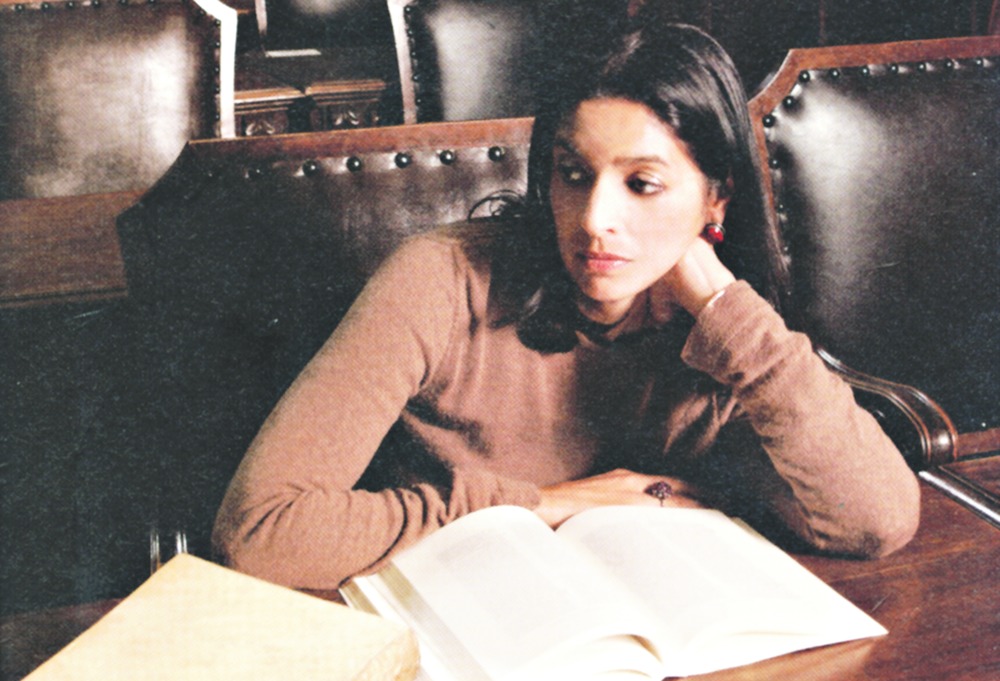
Yet the book calls out for sympathy. Recurring throughout is Lahiri's sense of exile: linguistically exiled by her early circumstances, on the margins of both Bengali and English, and choosing exile again into another language in a search for rebirth. "The concepts of exile and return imply a point of origin," she says, "a homeland." The pathos grows: "Without a homeland and without a true mother tongue, I wander the world, even at my desk." Is this why the cover carries the photograph of the beautiful author seated before large volumes among rows of lusciously upholstered leather chairs gazing wistfully 'off'? The scene is rather far removed from that of thousands of exiles travelling the world, struggling with other languages, other mores, other cultures. The difference induces more pathos. "In the end," Lahiri writes, "I realize that it wasn't a true exile: far from it. I am exiled even from the definition of exile."