|
|
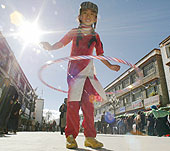
| HULA HULA: A young Tibetan girl plays with a hoop as she walks around the Barkhor pilgrimage circuit AFP |

Yonten greets me with a broad smile and a namaste. She knows an Indian when she sees one and loves to speak in Hindi. But she seems a little nervous too and quickly looks around, “Can we move to the other side and talk? There are government people all around, even inside the temple.”
We move toward the back of the Jokhang Temple, the holiest of shrines in Tibet and the centre of the Tibetan world since it was built in the seventh century. The Tibetan quarter of Lhasa with its stone and mud houses and the tourist hub of Barkhor Bazar encircle the Jokhang. An endless stream of pilgrims and maroon-robed monks, chanting the Buddhist mantras and turning their prayer wheels, flows around the temple. Some prostrate themselves at every step, offering prayers to the ancient deities inside the Jokhang.
To the northwest stands the Potala Palace rising on a hilltop, the golden motifs on its roof shining in the morning sun. Originally well outside the city, it now stands encircled by an expanding cityscape. In an arc surrounding the Tibetan city, stretching from the north to the southwest, the Chinese have built their military and other government houses and new residential blocks, filling in the space between the Jokhang and the Potala, the two symbols of old Tibet.
“For 20 years Lhasa looked so unimaginably remote to me,” Yonten says. Part of her story is familiar stuff of the Tibetan tale that the world has heard since the Dalai Lama’s great escape to India in 1959. Like several generations of Tibetans since then, Yonten left her home in Amdo (now in Sichuan province) in eastern Tibet as a young girl of 17 along with an uncle, crossed the border into Nepal and finally made her way to Dharamsala, the seat of the Tibetan government in exile in Himachal Pradesh. She stayed there for 20 years, when Tibet became only a country in her mind.
Winds of change
When she came back last year, she could hardly believe her eyes. Others had told her of the changes that had taken place in her native Amdo, in Lhasa and everywhere else in Tibet. But nothing that she had heard quite prepared her for what she confronted in new Tibet. “There is so much prosperity in Lhasa. So many new roads, houses, cars, tourists and everything else. So much of business and money even in Amdo. And, have you heard of the train that will soon come to Lhasa ?” Yonten gushes on in a fit of excitement, as if she is in a rush to paint a large picture in a few quick strokes of the brush. She was quick to adjust to this new world, set up a small business in Tibetan handicrafts and has now managed to bring back the eldest of her three children ? a young boy of 15 ? to live with her.
But, when, at the end of hectic days of business with haggling tourists, she is back home on the outskirts of the city, Yonten longs for Dharamsala or the old Tibet that she had known in Amdo in her childhood ? among the mountains, the rivers, the yaks and the nomads. “But then Lhasa today is a Chinese city with a poor Tibetan quarter,” she says, almost in whispers. And, the biggest symbol of old Tibet she misses is, of course, the Dalai Lama. “You are a journalist. You should be knowing. Will the Chinese let His Holiness come back?”
If Yonten’s story speaks of the Tibetans’ dilemma in today’s Tibet, it also shows how far China has gone to change its old policy on it. That Yonten was allowed to come back and stay and do business in Lhasa speaks of the change in China’s Tibet policy. That the monks live and work in the monasteries and the common people can practise their religion and relive their traditional cultures suggests the same change.
What is more, the government now spends huge sums of money in repairing old monasteries and other ancient structures. A massive project is on for the past 15 years to repair the Potala ? the current phase alone, beginning in 2002, costing US$ 22 million so far. The Dalai Lama’s summer residence, the Norbulingka, not far from the Potala, is also being renovated. This government policy of keeping old Tibet alive is not restricted to Lhasa or other big towns like Xigatse, the home of the Panchen Lama, Tibet’s second most important religious leader. I had an opportunity to see the old Lamaling monastery in Nyingchi, some 400 kilometres east of Lhasa, restored to its resplendent glory, thanks to the same government policy and largesse.
Critics, however, see this as a two-pronged strategy by China. The government, they say, wants to show the world that Tibetan religion and culture are safe in Tibet. The other part of the strategy is to raise money through tourism. Even the so-called freedom of religion is an eyewash, they say, because there are so many government controls on the monasteries and the monks. The Religious Affairs Bureau, the Tibetan Buddhist Association, the democratic management committees for the monasteries and the “political education” of the monks are said to be only the visible instruments of control. “There are many other invisible but as effective ones,” they say.
Even so, the return of religion is a dramatic shift from the days of the cultural revolution when religion was considered a threat to communism, when monasteries were pulled down and monks hounded and when the calls to preserve the Tibetan identity were seen as a challenge to Chinese nationalism. Things began changing with Deng Xiaoping’s call to open up China.
Horns of a dilemma
For Tibet, the change was reflected in the Chinese position that the Dalai Lama is welcome to come back to the Potala, but only if he gives up his demand for Tibet’s independence. He has since abandoned the demand, now asking for “greater autonomy” for Tibet, although he keeps crying foul of the reduction of old Tibet into several provinces. And, while he does not deny the development that has changed the face of Tibet, he complains that it has helped the “Chinese expansionism” into Tibet more than it has benefited the Tibetans.
That really is the crux of the problem for all Tibetans, at home or in exile. Development yes, but whose Tibet is it anyway ? As she sees the new roads and new townships appearing in far corners of this mountainous land, Yonten too struggles to find her answer to the question. She has only vague ideas of the railway project to connect Lhasa to the Chinese mainland. The 1,118-km Qinghai-Tibet link, with a total cost of US$ 3.2 billion, is, as former Chinese premier Zhu Rhongji put it, “unprecedented in the history of mankind”.
More than two-thirds of the line runs at 4,500 metres above sea level and will cut through three mountain ranges; 550 km of it cross permanently frozen earth. Yonten does not know all this; she only wonders if common Tibetans like her will have enough money to ride the train that will take just 48 hours to travel from Beijing to Lhasa.
“Developing Tibet to Advance China” is how Dharamsala and the International Campaign for Tibet view the project, as they view most other development projects in Tibet. The Free Tibet campaigners argue that the train to Lhasa will mean more Han Chinese coming into Tibet to settle there and more exploitation of Tibet’s vast deposits of natural and mineral resources.
Officials in Beijing and Lhasa dismiss such fears and hit back at the critics. Simply ignoring the suggestion that the demographic changes were reducing Tibetans to a minority in their native land, the vice-chairman of the Tibet Autonomous Region (TAR), Lhosang Gyaltsen, says that ethnic Tibetans constitute 95 per cent of the 2.7 million people in TAR. As TAR prepares to celebrate its 40th anniversary this September, it passes through “one of the best historical stages in Tibet’s development”. “We have a stable society, a fast-growing economy (annual growth at 12 per cent higher than China’s national growth rate) and unprecedented ethnic unity ,” he adds.
At the China Tibetology Research Centre in Beijing, its vice-director-general, Tenzin Ganpa, bristles at the question on Tibetan identity. His institute is one of the key thinktanks that provide inputs to the Chinese government on the Tibet question. “Tibetan culture has always been part of the Chinese national culture,” he says and asks, “don’t people everywhere have a dual identity, one local and another national?” He simply dismisses all talk of a clash between development and identity in Tibet. Adds one of his colleagues, Tanzen Lhundhup, “Ask young Tibetans if they want to go back to the old days when they didn’t go to schools and had nothing, while their fathers worked as serfs to landowners and monks. Ask old people what life was like in those dark days.”
With the pilgrims passing us by on their parikrama of the Jokhang, I remember Lhundhup’s words and ask Yonten if she would have old Tibet back in place of development. “How is that possible?” she asks. It is time for her to go back to the shop. Her son would be waiting. As she leaves with another namaste, she has one last thing to tell me : the train to Lhasa may be the end of old Tibet, but she hopes to ride it someday to go home to Amdo.