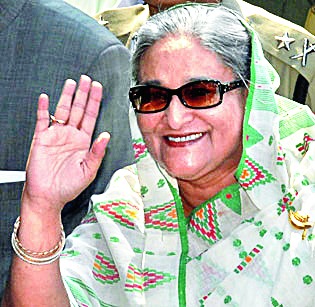

After her return from India, the prime minister of Bangladesh, Sheikh Hasina Wajed, got caught in a crossfire. The Bangladesh Nationalist Party and other Opposition parties accused her of selling out to India, arguing that the lack of forward movement on the Teesta waters issue was a huge failure for her, although India got what it wanted, including a memorandum of understanding on defence. The BNP chief, Khaleda Zia, threatened to review all the treaties signed with India if her party came to power in the next election.
Then Wajed appeared to be surrendering to the Islamists when she met the Hifazat-e-Islam leaders, promising not only to recognize the Qaumi Madrassa degrees handed down by a board administered by the Hifazat supremo, Allama Shafi, but also removed the statue of Themis, the Greek goddess of justice, from the Supreme Court premises. The removal of the statue led to a huge outcry from secular groups, including sections of Wajed's own party, the Awami League, with reports suggesting that some ministers had threatened to resign if she pandered to the Hifazat any more. Bangladesh's powerful secular groups would not buy the Awami League logic that the Hifazat was needed as a counterweight to the Jamaat-e-Islami, the country's leading Islamist party and a traditional ally of the BNP.
When the Ganajagaran Mancha and leftist students who had run the 2013 Shahbag agitation hit the streets of Dhaka, the Wajed government was forced to reposition the statue of Themis in the Supreme Court annexe, behind the court's main building.
It seemed for a time that Wajed was losing her way in the crossfire. But that changed after a Senate inquiry in the United States of America and a Canadian court judgment. Wajed had for years attacked the Nobel laureate, Muhammad Yunus, blaming him for conspiring to ensure that the World Bank did not fund Bangladesh for the Padma bridge project. Yunus is a close friend of the former US secretary of state, Hillary Clinton, who reportedly intervened several times to get the micro-credit wizard reinstated as head of the Grameen Bank. But Wajed refused to budge. When Clinton lost the US presidential polls, Wajed rushed a congratulatory message to Donald Trump, making no secret of her joy at Clinton's defeat.
Wajed recently met Trump in Riyadh at the Arab-Islamic-American summit and invited him to Bangladesh. The Bangladesh foreign secretary, Md Shahidul Haque, said later that Trump has agreed to visit Bangladesh "fairly soon". Immediately after Trump's return to the US, the Senate Committee on the Judiciary started an investigation to see if Clinton misused her position to intervene in an "independent investigation" against Yunus in Bangladesh.
Chuck Grassley, the committee chairman, in a letter asked the state department to make the former deputy chief of mission of the US embassy in Dhaka, Jon Danilowicz, available for an interview with the committee staff. Wajed's son, Sajeeb Wazed Joy, had earlier accused Clinton for threatening him with an IRS audit if his mother failed to quash investigations against Yunus and reinstate him at the head of Grameen Bank. Joy had blamed Yunus for misusing foreign funds received by his micro-credit organization to make donations to the Clinton Foundation.
Now the Senate Committee seems to be investigating precisely those allegations.
"If the secretary of state used her position to intervene in an independent investigation by a sovereign government simply because of a personal and financial relationship stemming from the Clinton Foundation rather than the legitimate foreign policy interests of the United States, then that would be unacceptable," Grassley wrote in his letter. "Co-mingling her official position as Secretary of State with her family foundation would be similarly inappropriate."
According to Grassley, emails show that state department officials, including Clinton, and staff for the Clinton Foundation, closely monitored an attempt to remove Yunus from his bank position in Bangladesh and that the US ambassador to Bangladesh sought meetings with the prime minister "to apply pressure in an attempt to end the investigation into Yunus". Yunus was removed from Grameen Bank as its managing director on the ground that he had crossed the official age limit in 2011, in the backdrop of allegations that he had siphoned off the bank's funds. He challenged his dismissal in the Supreme Court but lost.
The Senate inquiry thus boosts Wajed's stature as a nationalist leader who looked even the mighty US in the eye and did not budge before the World Bank's threats to stop funding the Padma bridge. Wajed has always been worried over the US role in Bangladesh, believing that the Central Intelligence Agency was responsible for instigating the murder of her whole family, including her father, Sheikh Mujibur Rahman.
Again, in February this year, the Ontario Superior Court dismissed the case against three officials of SNC-Lavalin after a long legal battle at the prosecution's request. The World Bank had accused the company of bribing Bangladesh ministers and officials to secure contracts in the Padma bridge project. With the Lavalin officials let off, the stigma of bribery against Awami League ministers and government officials will not wash. That again comes as a big boost for Wajed, who is using her government's development track record as Awami League's main electoral card ahead of next year's elections. Her decision to withdraw the funding request to the World Bank and instead fund the Padma bridge with Bangladesh's own resources also provides a huge image boost to a country once written off as a basket case by Henry Kissinger.
On top of that, the Canadian federal court has recently rejected an asylum petition by a BNP supporter, Jewel Hossain Gazi, on the ground that the BNP "engages, has engaged or will engage in acts of terrorism". The court referred to acts of violence like the firebombing of buses and trains, attacks on police and security personnel during strikes called by the BNP and its allies like the hardline Islamist Jamaat-e-Islami. The Awami League general secretary, Obaidul Quader, was quick to claim that the Canadian court had vindicated his government's stance that the BNP was backing terror groups to destabilize the Awami League government. This verdict will also help Bangladesh courts which are trying scores of cases against BNP-Jamaat supporters for the street violence in 2013-2015. It legitimizes Wajed's tough action against terror groups and dilutes the criticism by global human rights groups of atrocities by security forces.
The image of a strong nationalist leader focused on the country's economic development who does not compromise when pitted against the US might help Wajed out of the quandary she found herself in after the Delhi visit. That she blamed the Indian Research and Analysis Wing for bringing down her government in 2001 after she refused gas exports was an attempt to reinforce that tough image. Zia's son, Tarique, is said to have wooed both India and the US with promises to facilitate the gas exports. Later, India found that Tarique was cultivating both RAW and Inter-Services Intelligence. The boost to anti-India rebels during his mother's 2001-2006 regime has now convinced India that Delhi has only Wajed to count on.