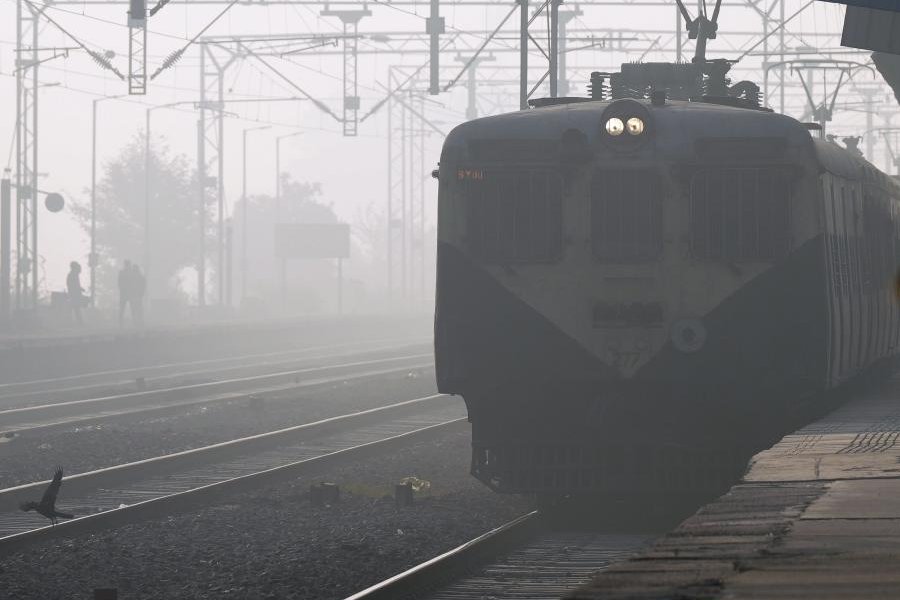
Indian Railways utilised 98 per cent of its budget for FY26, reflecting the pace of execution of projects, and in the days to come, trains will dominate flights on several upcoming corridors across the country, Union minister Ashwini Vaishnaw said on Monday.
"In the last financial year, the entire capex was spent practically by the 1st week of March itself. Practically by the last week of February, it was like 98 points some percentage. Then we had to, in a sense, stop that because we have to complete the entire year," Vaishnaw said.
He said 49,000 kilometres of railway tracks across the country have been electrified, which is more than the entire network of Germany, and 36,000 kilometres of new tracks have been added, which is about six times the size of Switzerland in the Indian railway network.
The minister said that on many of these routes, travel time will be significantly reduced, and people will prefer trains to air travel.
Vaishnaw said the government is working on new corridors from Mumbai to Pune, where travel time will come down to just 28 minutes, Pune to Hyderabad will be one hour and 55 minutes, and Hyderabad to Bengaluru will be around 2 hours.
"So nobody will fly. These sectors will be out for airlines. I'm reminding right away for those who want to invest in airlines. These sectors will be 99 per cent dominated by railways," Vaishnaw said.
He said Bengaluru to Chennai will become two cities combined into one city, with travel time between them reduced to 78 minutes.
"Delhi to Varanasi will be 3 hours and 50 minutes. Delhi to Lucknow will be significantly lesser, just about 2 hours," Vaishnaw added.
Talking about the efficient and adequate transportation of coal through freight operations, Vaishnaw said that while coal shortages at power plants were once a major problem, today these plants have abundant coal supplies.
"We have 54 million tons of coal stored at power plants even in the month of May," Vaishnaw said, adding that the normal stock level is 15–16 million tons.
He stated that the last financial year was the safest in the 150-year history of Indian Railways, as accidents had been reduced by 90 per cent.
He informed that the Dedicated Freight Corridor (DFC), whose last section up to JNPT Port was under construction, was completed on April 5, 2026. Its operationalisation has increased train frequency as well as reduced the travel time of freight trains.
He also expressed great satisfaction while announcing that India has started exporting the most complex part of a train - the propulsion system - to countries such as Germany, Italy, Switzerland, Poland, and the US.