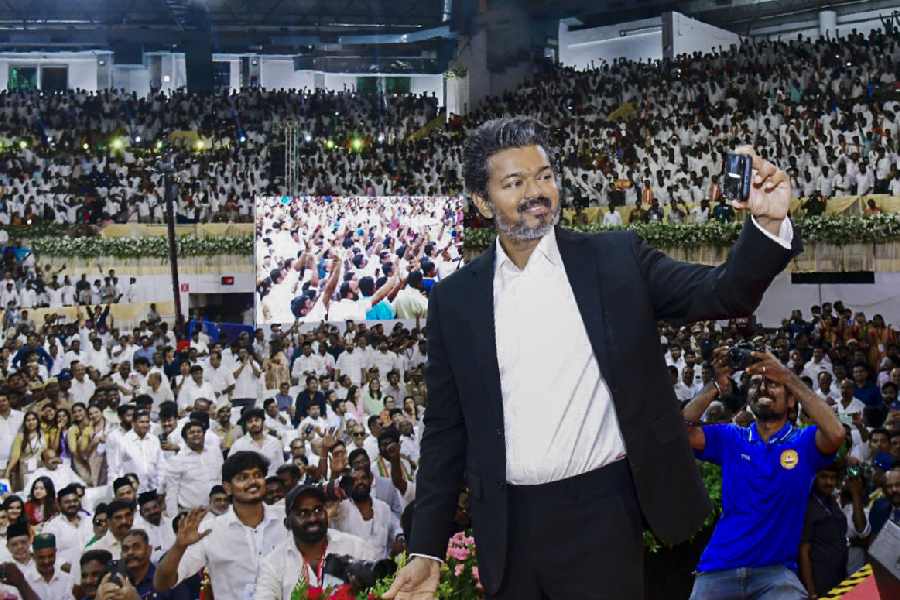
TVK leader C. Joseph Vijay's sartorial choice as he took oath as Tamil Nadu chief minister, ditching the decades-long tradition of white shirt and veshti for black blazer and trouser, has become a talking point deeper than the “Joseph met Stalin” jokes floating around on social media.
The tailored black pantsuit paired with a crisp white shirt has become one of most distinctive symbolic gestures of the new chief minister.
The choice of clothing represents a “profound shift in Tamil Nadu politics from a sub-nationalistic prism to a proud-global-Tamil prism,” senior Congress leader Praveen Chakravarthy told The Telegraph Online.
Prathap Suthan, an advertising veteran who handled the Incredible India campaign, agreed.
“People voted for Vijay for how they saw him on screen. He marks the turning point of a new modern, cosmopolitan Tamil Nadu,” he told The Telegraph Online.
“Vijay has played this part before and has done his dress rehearsal. The oath ceremony was the main act, so to speak,” Suthan added.
Shri Venkateshwaran, chief of the digital bureau of the Tamil magazine Thuglak, also underlined its uniqueness.
“We have never seen anything like this. In the history of oath ceremonies, Vijay’s dress code marks a shift," Venkateshwaran told The Telegraph Online.
Some critics interpreted the black blazer as a possible nod to the Periyarist movement. The “Blackshirts” movement initiated by E.V. Ramasamy Periyar used black clothing as a symbol of rationalism, self-respect and resistance to caste hierarchy.
Venkateshwaran, however, pointed out that Periyarist symbolism traditionally embraces an entirely monochromatic black aesthetic, making Vijay’s look less ideologically explicit and more open to interpretation.
Instead, Vijay’s choice appeared to project the image of a modern, globally aware political figure less bound by convention than aligned with aspirational politics.
“The TVK campaign was based on a ‘Generation Z victory’,” columnist Madhavan Narayanan said. “The party is no longer symbolic of your father’s Tamil Nadu, but one that has evolved into a globally aspirational state.”
Narayanan argued that Vijay’s iconography does not necessarily represent a rejection of Dravidian culture but rather its evolution into what he described as a “Neo-Dravidian” identity.
Vijay’s long cinematic legacy also informs his public image. Throughout his film career, he frequently portrayed lawyers, teachers and socially conscious men fighting for ordinary people. That on-screen persona — formal yet relatable — appears to have carried onto his political presentation.
Narayanan also recalled a story often repeated among Tamil Nadu journalists and cultural commentators: that a Tamil correspondent from The New York Times once expected DMK founder C.N. Annadurai to appear in a traditional veshti, only to be surprised to find him dressed in a suit instead.
In that sense, Vijay’s black blazer may not represent a complete break from Dravidian political culture, but the latest reinvention of it.