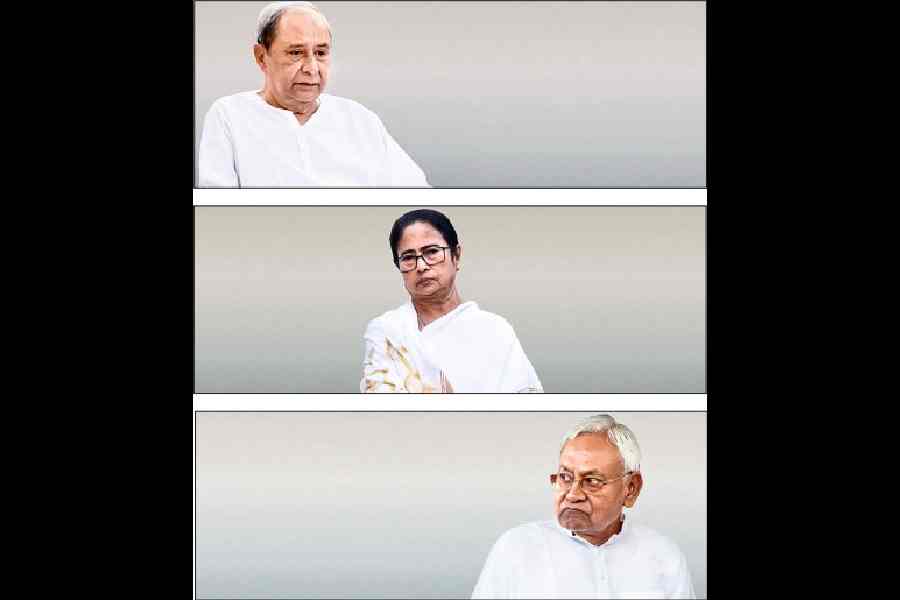
With the electoral debacle of the Trinamool Congress in West Bengal, three stalwarts that had critically impacted state and national politics in India in the last couple of decades — Naveen Patnaik, Nitish Kumar, and Mamata Banerjee — now face political fadeout. Each of them came to power as a symbol of demolition. Mamata tore down a party-State that had ruled Bengal for 34 years with the confidence of a natural monopoly. Nitish walked into a Bihar so broken by Lalu Prasad’s carnival of misrule that the mere restoration of order felt like renaissance. Naveen inherited his father’s name and, with a quiet shrewdness, used it to dismantle the Congress machine that had dominated in Odisha for decades. They were, in their origins, insurgents — celebrated, even romanticised, as proof that Indian democracy could still surprise itself. That each of them then spent the better part of two decades constructing, with considerable care, exactly the kind of personalised, unaccountable, institutionally hollow power structures they had once promised to end is not an irony but a pattern. How did such a pattern emerge?
Nitish Kumar’s Bihar was a genuine transformation. The state he inherited in 2005 was one where kidnapping was a growth industry, caste armies operated as parallel governments, and basic public services had become a form of extortion. What Nitish restored, above all, was legibility — the sense that the State existed and had obligations to its citizens. Roads were laid, girls rode bicycles to school in numbers unimaginable a decade earlier, and the flagship Bihar Rural Livelihoods Project
(‘Jeevika’) organised rural women into self-help cooperatives that gave Bihar’s most marginalised citizens a foothold in the formal economy. By the standards of what preceded him, this was transformative.
Naveen Patnaik’s distinction was different in kind. Not a man of ideology or obvious political instinct, he was temperamental and fastidious, and sought to cultivate the image of a clean administrator assiduously. His administration’s disaster management model became internationally recognised after Cyclone Phailin in 2013 when the United Nations held it up as a global benchmark. His welfare architecture for women, tribal communities, and small farmers was substantive enough to win him five consecutive mandates in a state not historically known for rewarding competence.
And Mamata Banerjee, however abysmal her later record, did something that had defeated every challenger before her — she broke the Left, not merely electorally but psychologically, by dismantling the culture of intimidation, the assumption of permanent tenure, and the belief that West Bengal was simply unavailable for democratic competition. The 2011 election was less a vote than an exorcism. That this achievement is now largely forgotten, obscured by the progressive degeneration of the following decade and a half, is one of politics’ routine injustices.
Nitish Kumar governed Bihar for two decades without building the industrial base that would have made his governance gains permanent. Bihar’s dependence on revenue transfers from the Central government — a condition he inherited — became a political instrument, propped up at every budget season as evidence of Delhi’s injustice rather than treated as a structural challenge demanding structural solutions. When he finally exited — not defeated but quietly ‘self-removed’ to a Rajya Sabha seat, with his son conveniently entering the party in what looked conspicuously like a dynasty in the making — the Bihar he left was safer than before but considerably poorer than two decades of uninterrupted power should have permitted.
Naveen Patnaik’s late-career failure is more poignant because it was perhaps more avoidable. The proximate cause of the Biju Janata Dal’s 2024 collapse was the rise of V.K. Pandian, a Tamil Nadu-born former IAS officer who wielded overbearing authority over the government, and whose projection as Naveen’s successor seemingly offended every instinct of Odia pride. That the chief minister permitted this, apparently without registering its political toxicity, suggested a leader who had governed alone for so long that he had lost the capacity to read his own state. It was not a stronger rival’s vision but Patnaik’s own opacity that swept away 24 years of accumulated goodwill in a single electoral cycle.
Out of all three, Mamata Banerjee’s transformation from insurgent to incumbent is the starkest because she performed it most loudly. The TMC in its mature phase reproduced, with remarkable fidelity, the pathologies of the Left Front it replaced — local strongmen who operated above the law, a machinery that conflated party with State, and an attitude towards electoral opposition ranging from contemptuous to violent. The 2024 Sandeshkhali episode in which a TMC-affiliated local boss stood accused of land-grabbing and, worse, was shielded for months by the party apparatus, was not an aberration but just the system working as designed. Meanwhile, her calculated politics of Muslim consolidation hardened rather than healed Bengal’s communal fault lines. She became, in the end, the author of the polarisation that destroyed her.
Maybe these three ‘exits’ represent democracy’s self-correcting mechanism in action — voters eventually punish leaders who overstay their welcome, and the system works. While there is truth in this, it obscures the more unsettling question of what replaces them. The Bharatiya Janata Party’s penetration into Odisha, Bihar, and now West Bengal is not simply a change of government but the displacement of regional political cultures by a national machine whose primary loyalty runs to a Central leadership, not to state-specific aspirations. The regional satraps, for all their venality — real or alleged — were genuinely invested in their states’ identities, languages, and peculiarities. They bargained with Delhi because, at some point or other, they had something Delhi wanted. That bargaining space — the actual operational meaning of Indian federalism — now stands severely shrunk.
Is there a deeper, structural problem here? Seemingly, India’s Constitution guarantees not strong states but strong chief ministers. When they are simultaneously president, chief fundraiser, and irrevocable authority of their parties, state government and party government become a single organism. But when that organism decays, there is no institutional immune system to contain the infection. Naveen, Nitish, and Mamata each personalised governance to the point where their parties cannot easily survive their departure. Far from being a coincidence, it is what the system — as built and practised — inevitably produces.
The ‘exits’ of these three are therefore neither pure loss nor pure gain for Indian democracy. Perhaps they are a stress test, a moment when the gap between the federal ideal and the federal reality becomes briefly, uncomfortably, visible. Whether the next generation of regional leaders learns from this pattern, or simply repeats it with fresher faces, is the critical question at this moment. The evidence does not encourage optimism. But then, neither did the evidence in 1977, or in 2011, and yet Indian democracy surprised us each time. Maybe it’s not hope but watchful scepticism that we must hold on to, with the door left open.
Jayanta Sengupta is Director, Alipore Museum; jsengupt@gmail.com