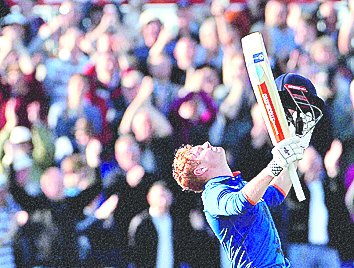

Exactly what is a quantum leap? I once used this phrase to describe some huge change in sport. Just what change, I forget. But, for instance, it might have been, though it wasn't, the recent remarkable shift in England's one-day-international cricketers, from being a side that feebly crumpled up and lost matches that it should have won, to being boldly the opposite.
I was ticked off by a scientific friend. Quantum leap, he assured me, meant a tiny leap that altered some subatomic particle from condition X to condition Y. I don't doubt it, but I reflected in my heart that, though my friend knows vastly more about subatomic physics than I do, which isn't difficult, he may know less about English.
The linguistic reality is that most speakers of English - or other languages, I suspect - use quantum leap just as I had used it and still do. It's a cliché no doubt, and perhaps better avoided, but in non-scientific English that's how we use it. Period.
Which, of course, is another cliché, and also better avoided. After all, in most contexts period means a length of time. But in this particular use, no, it's the (largely American) word for a full-stop and, cliché or not, it's entirely correct. Most words have several meanings, and this is one.
And meanings of course can change over time. As I've written till I'm tired of it, and maybe my readers are too, if enough of us one day come to describe the sky as green, then green will eventually acquire the meaning "blue", and the world's grandest experts in English (or climate) will be mistaken if they damn that meaning as incorrect. Unless, of course, the sky actually has changed colour.
So far, so good. But there's a huge caveat in this. By "enough" of us I mean seriously many. Some people I knew called their pet cat "Tiger". But that didn't alter the meaning of tiger. And by "us" I don't mean just anybody. If (which they don't) most English-speaking Germans habitually say, "How do we our sauerkraut become?" when what they mean is, "How do we get our sauerkraut?" they're simply wrong: English doesn't shove verbs to the end of a sentence, nor does become mean "get", albeit the German bekommen does. There is correct English and there is incorrect.
Just as there is correct spelling and incorrect. Near a small building-site in London I once saw a billboard that proclaimed "Free Georgian houses". What the presumably Cockney sign-writer meant was "three". He was accurately representing the word as many Londoners once pronounced it. But he was wrong. Pronunciation and accent are one thing, spelling is another.
And back with correct English as a whole, by "us" I mean most, and mostly native, well-educated English-speakers. This can vary from country to country. American English (and spelling) is correct there, British English in Britain, Australian in Australia. Indian English calls for me to modify my words a bit. There aren't countless native English-speakers in India. But plenty of Indians speak excellent English, and even the most reactionary Briton by now admits it.
But the English of Vanuatu? Or Vietnam? Or of Britain's own ignorant or its anything-goes brigade? No - as most, mostly native, well-educated speakers of English will agree.