
Globalization in the ancient world took place along the Silk Road, which connected China with the Mediterranean via Central Asia. While trade formed the basis of the exchanges happening between Asia and Europe at that time, the more lasting transactions involved ways of living, as the West and the East started coming in contact with each other. Excavations along the Silk Road have thrown up statues of Buddha where he looks both like a Chinese warrior and a Greek hero, Buddhist manuscripts in Sanskrit and Tibetan, and wall paintings in Iranian towns that bear the influence of Greco-Buddhist art from India as well as from Central Asia. Many of these excavations began in the 19th century, when the spread of the British Empire was bringing about yet another wave of globalization. Although it is impossible to think of the Orientalists now without remembering Edward Said's allegation that they were patronizing and inconsiderate, a great many of them also seem to have been motivated by the desire to know, to understand the East, where some of them found home.
Sir Marc Aurel Stein (1862-1943) was one of them. An exhibition of his works, titled Fascinated by the Orient - Life and Works of Sir Aurel Stein (March 24-April 17) was held at National Library. It was organized by the Indira Gandhi National Centre for the Arts in collaboration with the Library and Information Centre of the Hungarian Academy of Sciences. A good deal of thought and research seemed to have gone into the making of the exhibition. The texts accompanying the photographs were detailed and almost error-free. Without them, the viewer would not have been able to make sense of the strange lands and stranger objects from the ancient world documented in Stein's photographs.
Stein was born in Pest in Hungary to a family of merchants and intellectuals. His father's business had started declining by the time he was born. His family members, with their look of bourgeois solidity, could have been characters from Buddenbrooks. Stein got his doctorate degree under the guidance of Professor Rudolf van Roth, who was an authority on Vedic languages and literature. Training in cartography and surveying later in his academic career prepared Stein for the work he was to take up - mapping Central Asia while excavating the past buried in the hostile sands of the Taklamakan desert.
Stein arrived in India in December 1887. From here, he would go off on his subsequent expeditions, tracing Alexander's route, following in the steps of the traders who had once trundled along the Silk Road, studying the living traditions of the people of Chinese Turkestan. In the course of his journeys, he chanced upon the Caves of the Thousand Buddhas in Dunhuang. With this discovery, Stein had struck gold - the caves were a repository of ancient manuscripts, paintings and stucco sculptures. The way Stein went about his momentous findings exposes him to the charges Said had levelled against the Orientalists. He took away a great many of the paintings and manuscripts, giving the cue to the hordes of treasure hunters from the West and the East, who would strip the caves in subsequent decades. The exhibition made no mention of Stein's dubious deeds, perhaps for obvious reasons.

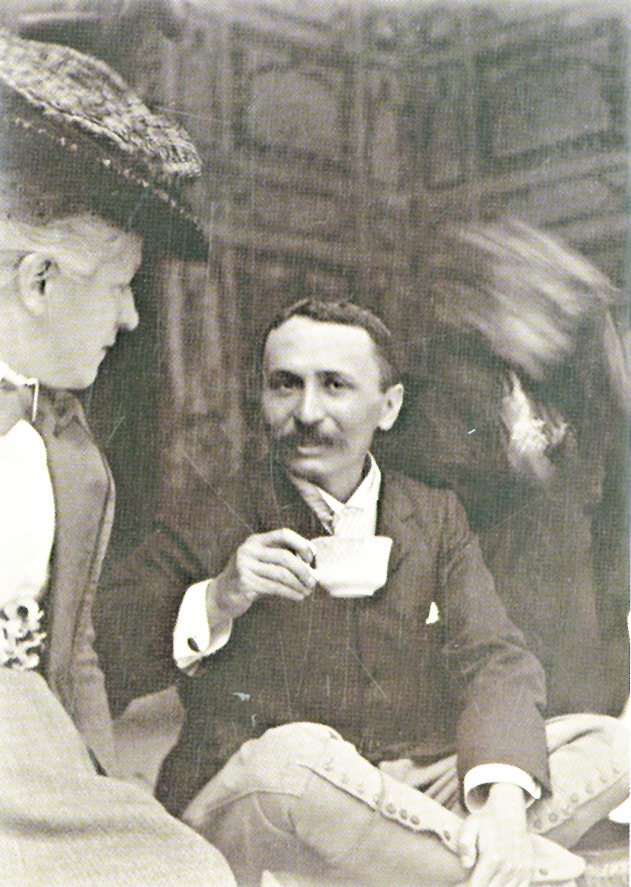
Whether Stein was moved by base or lofty motives or by a combination of both, he certainly endured a lot of physical hardship in his quest. The early photographs of Stein show a smiling, genial-looking man: one of them, probably capturing Stein in the middle of a conversation, as he drinks tea in Lahore with a lady (picture, top), is charming. Photographs of an older Stein show a severely sunburnt, hollowed-out face although the boyish smile is still intact. In one of his later expeditions, Stein lost the toes of his right foot to frostbite. Quite the indefatigable explorer, Stein carried on even after the amputation.
Kanishka's relic casket (picture, left) was found by Stein at Shahji-ki-Dheri, in the outskirts of Peshawar. Showing Buddha flanked by Brahma and Indra, with an inscription in Kharoshti (believed to be a derivation of the Aramaic alphabet), the casket is an instance of the great synthesis of cultures and religions that the Silk Road had brought about. In Kamila Shamsie's novel, A God in Every Stone, Kanishka's casket features as a symbol of syncretism and, as such, suggests an antidote to the divisiveness that occasions wars.
What was Aurel Stein's personal life like? His only constant companion seemed to be his Jack Russell terrier, Dash, who could be seen in several photographs, along with a changing cast of coolies and cooks. Stein wrote his books and documented his findings sitting at a desk shadowed by pine branches in Kashmir's picturesque Mohand Marg. Dash, who reportedly died of a broken heart after Stein had to leave for England, is buried in Mohand Marg, which Stein described as his "private kingdom".
The manuscript of Stein's book, Sand-Buried Ruins of Khotan, had mountain flowers pressed between two of its pages - were the flowers preserved in remembrance of someone? Was this lifelong bachelor a lover only of knowledge and adventure and solitude? His epitaph describes him as a "man greatly beloved" who "enlarged the bounds of knowledge".