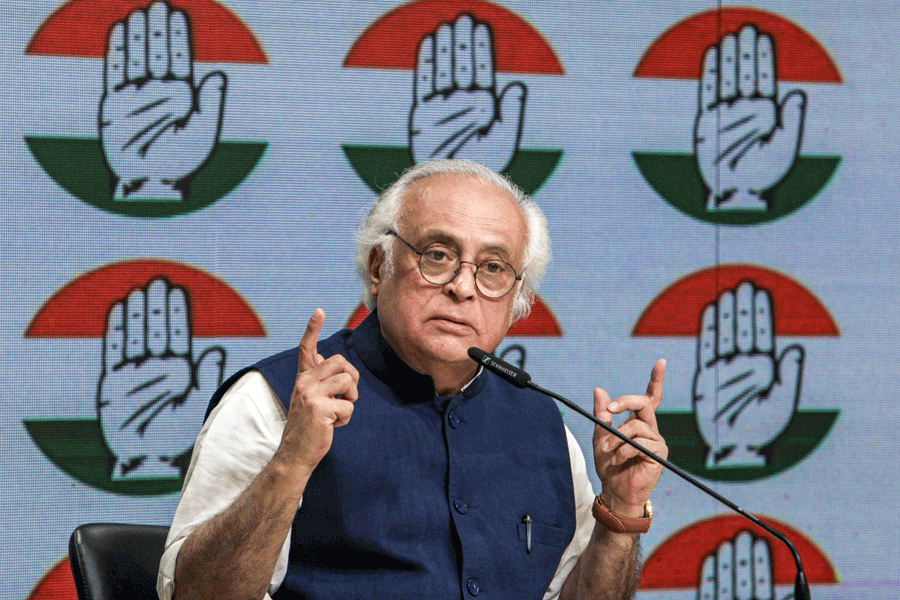
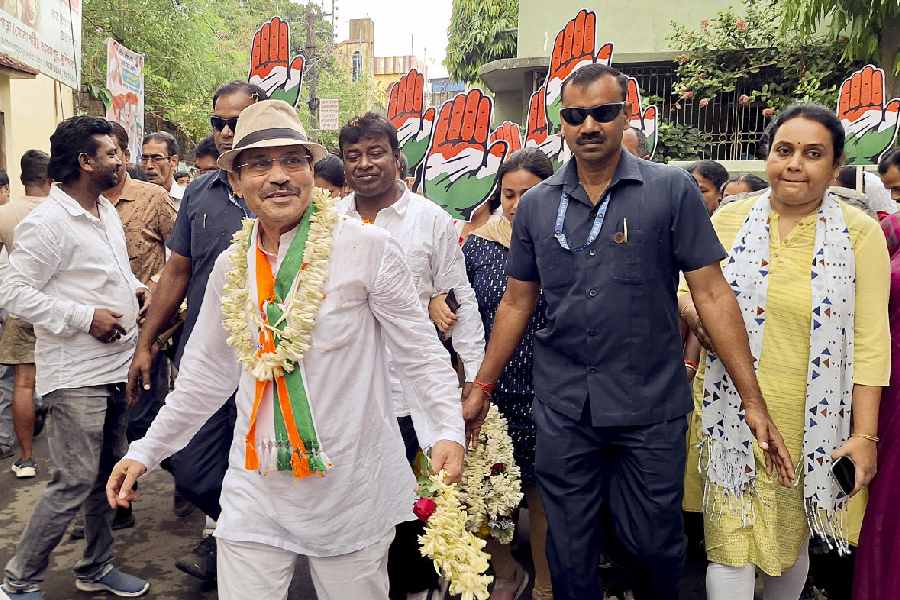
The two contrasting images together made a Kodak moment. There was, on the one hand, octogenarian Atal Bihari Vajpayee courting arrest in Delhi with faltering steps. And then there was party poster boy Navjot Singh Sidhu in Punjab, sitting atop an elephant.
That the sublime can very easily slide into the realm of the ridiculous was never more apparent than in the Bharatiya Janata Party (BJP) earlier this month. The two ? one a stalwart, and the other a relative newcomer ? were taking part in campaigns against an increase in petroleum product prices announced by the Central government. But when the former Prime Minister feebly courted arrest, it became apparent that his party still rode on the shoulders of its frail founders. And when the member of Parliament from Amritsar led a boisterous rally, it seemed like just another act in the stand-up comedy that he judges on television.
The BJP, clearly, is facing a crisis. And that’s surprising, for even a little over two years ago, all was well. The party was the majority partner in a coalition government at the Centre. Its parent body, the Rashtriya Swayamsevak Sangh (RSS), kept a close but benign watch on the party and the government. Vajpayee was Prime Minister; Lal Krishna Advani, his deputy. And a generation of young leaders, all raring to go, held various positions of power.
“But then two years ago we lost power ? against our expectations,” says senior party leader and former party president M. Venkaiah Naidu. “The net result was a feeling of disappointment and acts of indiscipline. But the party was conscious that some damage had been done.”
Many believe that the crisis is deeper than that for the party suddenly appears leaderless and rudderless. Vajpayee is ailing and Advani has been pushed aside. The RSS is trying to re-establish its control over the party. The line of succession is in a shambles, consumed by internal feuds. One of the main fund raisers of the party, Pramod Mahajan, is dead. And to top it, even his young son’s alleged tryst with drugs seems to have shaken the party.
More than anything else, it’s the Rahul Mahajan episode that’s exposed the problems within the BJP. Party president Rajnath Singh was at Delhi airport, on his way to Lucknow, when he heard that Mahajan’s son had been taken to a hospital on June 2. Singh, who had even been issued a boarding card, cancelled his trip and went to the hospital. But even when Singh was expressing concern, the party that he led was officially washing its hands off the affair. Party spokesperson Sushma Swaraj dismissed the incident as a family affair. Vajpayee had three different statements to make on the issue.
Advani, ostensibly, kept out of it. Later, he is said to have told Pramod Mahajan’s brother-in-law, Maharashtra BJP leader Gopinath Munde, that the heroin-and-champagne party that caused the death of Mahajan’s secretary, Vivek Moitra, and knocked out his son, had ripped apart the good press that the party got after Mahajan’s sudden death last month. “It’s not just an overdose of tragedy for the family, but for the BJP as well,” says a senior RSS leader.
That a 30-year-old party ? the main opposition at the Centre and ruling in states ?can seemingly unravel over the misadventures of a late party leader’s son indicates the crisis within. “The crisis lies in the fact that the leadership is split into two,” reasons social scientist Shiv Visvanathan of the Gandhinagar-based Dhirubai Ambani Institute of Information and Communication Technology. “The older lot is outdated and irrelevant; the younger lot is relevant to the Indian image of consumers and malls, but doesn’t smell of the RSS.”
The split between the generation that built the BJP and the one that seeks to take it forward has been wide open for a year. And there has been a series of events troubling the party ever since it lost power in the Parliamentary elections of 2004. Soon after the defeat, the RSS called for a change in leadership, stating that it was time old blood gave in to new. Advani lost the support of the young leaders ? most of whom he had himself propped up ? after he went to Pakistan last year and praised the party’s favourite bug bear, Pakistan founder Mohammed Ali Jinnah. The combined efforts of the RSS and the party’s younger leaders forced Advani to step down as party president.
A member of the RSS gives an example of the rift that continues among the leaders. The RSS had been informed by the government of the possibility of a militant attack on its headquarters. “We were told at every step what was happening, and we thought that the situation was being handled well by the government,” he says. Which is why the RSS leadership called up Rajnath Singh and urged him to take a soft position on the government on the issue once the attack had been foiled on June 1. “Rajnath Singh did so, but Advani had a press conference a few hours later in which he sharply pulled up the government,” he says. “Rajnath Singh’s statement came out as very weak. They had stolen his limelight.”
The party that took pride in its disciplined cadre was also beset by outbursts of dissent. Former Madhya Pradesh chief minister Uma Bharati was expelled from the party last year, as was former Delhi chief minister Madan Lal Khurana. “There was a time when the party was like a family. But for the last eight years or so, it is being run as a private limited company,” says Khurana, who stresses that he will launch his own party six months from now.
There is fierce rivalry and often infighting among the younger leaders ? Swaraj, Naidu, Rajnath Singh and Arun Jaitley. In Karnataka, former minister H.N. Ananth Kumar and B.S. Yediyurappa are caught in a bitter feud, while in Maharashtra, the death of Pramod Mahajan has sparked off a succession war between Gopinath Munde and BJP state president Nitin Gadkari. “There was a time when the leaders of the BJP were in touch with the ground,” says Khurana. “I don’t think the younger lot is even walking up in the air. They are just suspended somewhere in between,” Khurana holds.
To top it, a few sting operations in recent times made a serious dent on the BJP’s image of a disciplined and incorruptible party. BJP members of Parliament were caught on tape taking money for raising questions in Parliament. Another sleazy tape sought to ensnare RSS’s Sanjay Joshi ? who was on deputation with the BJP ? in a honey trap. “The BJP is certainly faced with a crisis of confidence,” says the RSS leader. “The central authority of the party has been eroded. Vajpayee is not the leader, Advani is not the leader ?and Rajnath is not the leader either.”
The problem, many believe, has its roots in the period before the 2004 elections. Vajpayee did not want to go in for an early election but was forced to do so. When the BJP lost, it became clear that Vajpayee would not be in a position to lead the front in an election slated to be held in 2009. The RSS, meanwhile, had started its campaign to oust Advani, bringing some of the feuds in the second rung of party leaders out in the open. “There is a certain turbulence in the party,” admits one of its spin doctors who was behind several successful elections that the BJP fought in recent times. “The very senior leaders are getting old, while the younger leadership is still being groomed. And there are hiccups.”
Visvanathan is more scathing. “The Soviets had their October revolution; here we are talking about an Octogenarians’ revolution,” he says. “The present leadership has nothing attractive to offer the people. And, I am afraid, the two ageing fathers are no match for the younger matriarch.”
But efforts, clearly, are on to get the party back into shape. Rajnath Singh stresses that there is a role for both the older generation and the younger leaders. “There is no confrontation between the two,” he says. “A son can only move on if he has the father to guide him. Even in the Left, Prakash Karat cannot ignore Jyoti Basu,” he says. Adds Venkaiah Naidu, “Advani and Vajpayee are our supreme leaders. We can’t compare them with anybody.”
Age, the BJP seeks to stress, does not go against the party. Naidu points out that the BJP’s chief ministers in the states are all relatively young. The chief minister of Jharkhand, Arjun Munda, is 38, while Shiv Raj Chauhan of Madhya Pradesh is 47. Raman Kumar of Jharkhand and Vasundhara Raje of Rajasthan are in their early fifties. “I was 42 when I was chief minister of Madhya Pradesh,” says expelled member Uma Bharati. “Of course, I believe generational changes should happen ? but I certainly don’t see the old as worthless.”
BJP leaders hold that the first step in its efforts at regaining lost ground is to wrest the space of the main Opposition party ? which the Left has been occupying with considerable ease. “The Left has been supporting the government, but taking up the space of the Opposition as well. But this time we have taken the lead. We are already out in the street on the issue of price hike,” says Singh.
The monsoon session of Parliament, the BJP leaders emphasise, promises to be a stormy one. Protests against the rise in prices of essential commodities as well as of petroleum products will figure prominently in Parliament when it convenes next month. The party says it is also going to take up the issue of the President’s concern over the office of profit bill.
In and out of Parliament, though, the main issue the BJP hopes to take up is what it describes as the appeasement policies of the Congress-led United Progressive Alliance government. “Never before have quotas been announced on religious lines. Now you have quotas for Muslims in the states, and in places such as the Aligarh Muslim University,” says Sushma Swaraj. “Even diplomacy is being communalised ? as the vote on Iran in the IAEA indicates.”
Meanwhile, within the party, too, a move is on to revitalise the organisation. A series of camps will be held ?starting July ? to train members of Parliament, members of legislative Assemblies and other leaders on ideological issues. “We have to refurbish our image ? emphasise unity and discipline, tackle all the negatives and highlight the failures of the UPA,” says Venkaiah Naidu. “We have to give the party ammunition.”
For the time being, though, Visvanathan believes that the BJP can only take up issues such as Fanaa ? an Aamir Khan film that was banned in Gujarat over the actor’s remarks on the need to rehabilitate villagers evicted by the Sardar Sarovar dam. “They don’t have anything attractive to offer ? no futuristic world view, nothing broad based, inviting or generous.”
Few in the BJP would agree with the view. For as far as the BJP is concerned, what goes down must go up, too. “This is a mission,” says Venkaiah Naidu. “And the mission goes on.”