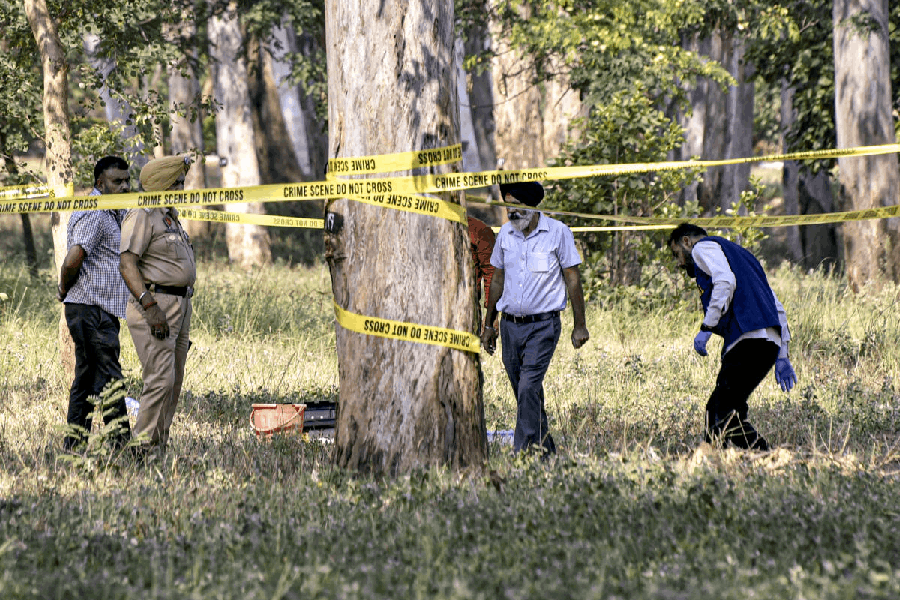
One year ago, on this day, the blood spilled in Pahalgam — 26 people, most of them tourists, were killed by terrorists in a major strike — led to yet another intense military confrontation between India and Pakistan. After the terror attack, India responded with Operation Sindoor, which, the government believes, achieved objectives in the short and the long terms. The general consensus on this side of the border is that the technical and the military superiority of India’s retaliation forced Pakistan to opt for a ceasefire. Islamabad gloats in a narrative that is the exact opposite: it touts India’s initial reversals in the form of the loss of aircraft as a testament to its triumph. One unsurprising consequence of that brief military engagement has been the process of political rehabilitation being sent to the proverbial deep freeze. The hardened positions in New Delhi and Islamabad imply that the possibility of the resurrection of bilateral talks remains slim. A churn in the international situation — the conflict in Iran is one manifestation — has augmented competitiveness between New Delhi and Islamabad on a new front. New Delhi, under Narendra Modi, continues to pull in the direction of the bloc dominated by the United States of America and Israel despite Donald Trump’s cantankerousness. Islamabad, through its placation of the intemperate American president and its role as a mediator between Iran and the US, is attempting to recover lost ground.
The domestic lessons from that bloodied valley must not escape policy attention either. The dip in terror attacks since India’s impressive retaliation is held up for public consumption as one of the long-term benefits of that cross-border aggression. But that does not quite explain how terrorists infiltrated the borders in the first place. Moreover, Operation Sindoor also exposed deep structural deficiencies as well as gaps in strategic thinking. In a world where the rules of military engagement are in flux — the Iran war is a case in point — New Delhi must plug these holes. And, as always, there is the challenge on the ground. The economic framework of the affected region, disproportionately reliant on tourism, was adversely affected and several tourist sites were shut. Some have reopened but the challenges — economic and security — remain. Moreover, New India had witnessed another spell of bigotry directed at Muslims, abetted by politicians and the media, after the bloodbath. This divisive rhetoric must not be allowed to be repeated. Terrorism’s most effective deterrent is a united people.