|
|

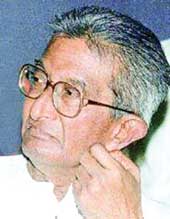
A Prattler’s Tale: Bengal, Marxism, Governance, By Ashok Mitra, Samya, Rs 350
The author is an amazingly prolific writer. Thousands of addicts wait with bated breath every week for his columns of bile; thousands more turn away disappointed that he has not abused them. This book was initially written in Bengali, so that those non-Bengalis who wished to find out what nasty things Mitra had written about them would have to engage translators and increase employment of Bengalis. Now it has been translated into English for their convenience. But they will still have to work at it, for Mitra has discreetly omitted the names of most people he dislikes. But if they are lucky, they will find they have earned the author’s worst abuse — which is to be called a gentleman. Only one gentleman earns the highest encomium, a communist — Mitra himself.
Chronic writing is only the author’s latest activity. Those who can, do; those who cannot, write. Now that Mitra is in his eighties, not many jobs may come his way. But in his long career, he has done many things. I got up to ten before I stopped counting. He worked in Lucknow, Calcutta, Delhi, Amsterdam and Washington amongst other places. Mitra exhibits the strongest characteristic of an entrepreneur, who never misses an opportunity when it comes along. Sometimes he changed jobs so fast that he did not even have time to say goodbye to his last employer.
His most important job was as finance minister of West Bengal after the Left Front came to power in 1977. He gives many pages to it; he was clearly in his element. He took it as his mission to battle the capitalist government in Delhi and to get as much money out of it as possible. He ran up an overdraft with the Reserve Bank of India as finance minister; he finds it shocking that the RBI made this fact public. He met other states’ finance ministers to organize a trade union against the Centre. He must have hated the Union finance minister, H.M. Patel, for he does not name him. He does not even name I.G. Patel, under whom he worked in the finance ministry, except to say that the nameless son-in-law was not as good an economist as Professor A.K. Das Gupta, Patel’s father-in-law.
Ashok Mitra came from Dacca as a refugee at the time of Partition and rose after doing a series of jobs in the Central government and elsewhere, to be West Bengal’s finance minister. In this, his career bears a remarkable similarity to that of Manmohan Singh, who too had to run out of west Punjab while still in school, and who rose via a series of government jobs to be India’s finance minister. Manmohan Singh rose even higher to become prime minister; but the story has not ended. If the communists won the next general election, Jyoti Basu would be too old by then to be prime minister.
Mitra writes with much affection about Sachin Chaudhuri, the founder of Economic Weekly and Economic and Political Weekly. The story as I experienced it was slightly different from the way Mitra relates it. Sachin was a remarkable collector of ideas. When I went to teach in Bombay University in the early Sixties, I soon became a hanger-on of Sachin. His flat behind the Taj was on the way from the university to my bachelor pad in Colaba; I would drop by on Sachin on many evenings. He would start chatting on some economic issue or another, arising out of current events, or something someone had written in the Weekly, or some bit of theory. We would have a scintillating conversation. At some point, Sachin would say, “Why don’t you write that up for me?” And an article would emerge in the ensuing days. He did this, not only to me, but to every economist who passed by — and his reputation was such that all economists who passed through Bombay dropped in on him. He published all that they wrote for him, irrespective of politics; Economic Weekly was a most catholic forum of debate for Left, Right and Centre. It was the birthplace of so many seminal ideas in that intellectually active age.
Unfortunately, Sachin died an untimely death. To give the Weekly a more permanent form, he set up a trust and started the Economic and Political Weekly in his last days. After he went away to Kotagiri on his last journey, leaving young Krishna Raj in charge, EPW was in bad shape. Every Thursday, Ashok Rudra, Ravi Hazari and I would drop by and fill up all the empty spots in EPW. After Sachin died, Ashok Mitra was the most influential trustee — the heir so to speak. He gave EPW a leftward orientation. If a leftist sent a piece by one of his students, it was published forthwith; if someone who was not a leftist sent an article, he would not even get an acknowledgment. I remonstrated about this bias with Krishna Raj for years. He would say, “Give me six months.” Six months would pass, and nothing would change. Thus I persisted for 20 years, and finally gave up. Ashok Mitra served the cause of the Left, but he destroyed an invaluable part of our intellectual heritage.
Anyway, those days are history, and Ashok Mitra has changed. What is surprising about this book is the number of people Mitra says good things about. It is almost as if he recognizes that he has not been the most loving of friends, that life has been too short and friends too many, that he has not been able to see as much of them as he would have liked, and he is giving them a farewell hug. While he does so, he tells many stories. Quite a few of them are amusing; even when not, they give Mitra’s side of the story. It was a story worth telling.