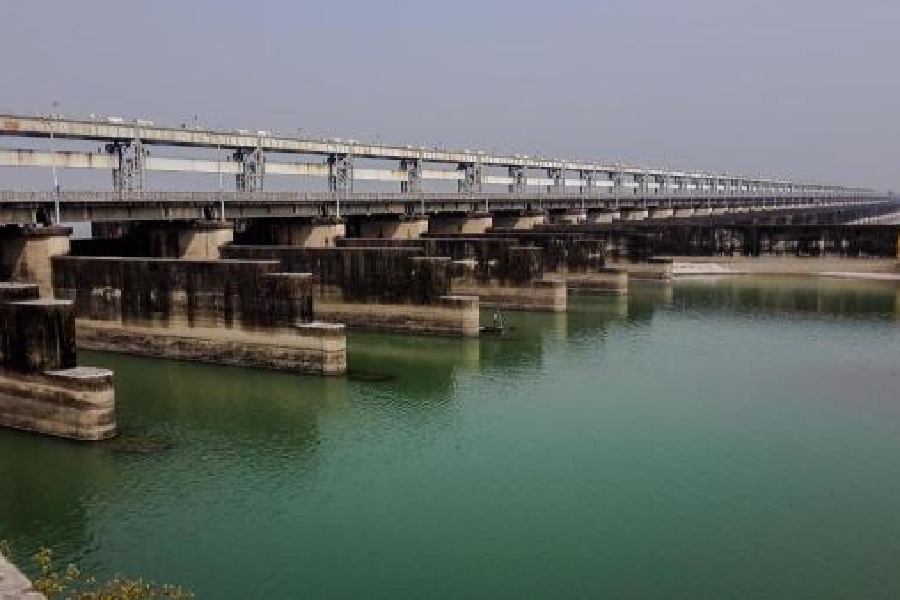
South Asia is approaching a decisive moment in transboundary water governance as the Ganga Water Treaty nears its expiry in December 2026. Signed on December 12, 1996, the agreement institutionalised dry-season water-sharing between India and Bangladesh based on flow measurements at the Farakka Barrage in West Bengal, close to the international boundary. For nearly three decades, the treaty has functioned primarily as a geopolitical bargain over allocation. Yet the emerging crisis is no longer limited to distribution. The more fundamental question today is whether the river system itself can withstand mounting ecological stress.
When it was concluded, the 1996 arrangement was hailed as a diplomatic breakthrough. It followed years of discord after India commissioned the Farakka Barrage in 1975 to divert water towards the Hooghly to maintain navigability at the Calcutta Port — which, Dhaka argued, worsened downstream scarcity during lean months, especially in its southwest delta. Interim agreements in the late 1970s and the 1980s had provided temporary relief but lacked durability. The 1996 formula created a structured mechanism, yet grievances never fully subsided. Bangladeshi experts have often contended that the country has not consistently received its ‘fair-share’ during most of the critical lean-season periods — pointing towards the structural weakness in the treaty’s water-sharing formula.
On the Indian side, water pressures have also intensified. Expanding irrigation demand, rising urban consumption, thermal power generation, and industrial growth have increased withdrawals across the basin, strengthening the domestic development imperative to retain more water upstream. For Bangladesh, however, reduced discharge translates into cascading vulnerabilities: rising salinity in Khulna and Satkhira, declining agricultural productivity, stressed fisheries, and deepening ecological degradation in the delta.
Overlaying these longstanding tensions is a rapidly shifting hydrological regime driven by climate change. The Ganga basin is witnessing increasing variability in rainfall and river flow. Assessments by the Intergovernmental Panel on Climate Change and regional climate models suggest that South Asia is moving toward more intense precipitation events, punctuated by longer dry spells. In recent years, erratic monsoons have overwhelmed embankments and triggered devastating floods across Bihar and Assam, while Bangladesh has faced recurrent flash floods and severe riverbank erosion, displacing thousands each year. Such volatility has made water availability far more unpredictable, weakening the reliability of treaty assumptions rooted in older climatic patterns.
The Himalayan cryosphere dynamics add another layer of uncertainty to treaty negotiations. Climate change is disrupting snowmelt and glacier-fed flows that sustain the Ganga during the dry months, making lean-season discharge increasingly volatile. As a result, the agreement can no longer rely on fixed formulas and must shift toward adaptive, climate-informed governance.
Pollution further compounds the crisis. Despite major national initiatives, stretches of the river continue to record elevated biochemical oxygen demand and coliform levels. Industrial clusters along the Indian stretch discharge effluents containing heavy metals, such as chromium and cadmium, while agricultural runoff adds nitrates and phosphates that degrade water quality. During low-flow months, reduced dilution capacity sharply lowers dissolved oxygen levels, undermining aquatic biodiversity and weakening the river’s natural self-purification processes. Emerging evidence of microplastic contamination reveals an even more alarming trend: plastic particles — reportedly discharged in significant volumes annually — are accumulating in sediment layers and estuarine zones, threatening fisheries and potentially weakening the carbon sequestration capacity of the Sundarbans mangrove ecosystem.
Given these evolving pressures, a routine renewal of the treaty would be inadequate. What is required is a structural rethinking of basin governance. Contemporary international water law principles, including the Helsinki Rules on the Uses of the Waters of International Rivers or the UN Water Convention — focusing on equitable and reasonable utilisation of transboundary waters — provide a useful foundation. More importantly, integrated river basin management must replace a narrow, volumetric allocation approach. Sustainable Development Goal 6.5 explicitly calls for cooperative management of shared watercourses; the Ganga basin offers an opportunity to translate that ambition into practice.
This is not without precedent. Across the world, several transboundary rivers have moved away from rigid, allocation-based treaties toward cooperative ecological governance models. The Rhine, once considered as the ‘sewer of Europe’, witnessed a remarkable recovery after riparian states created the International Commission for the Protection of the Rhine, adopting joint pollution standards, coordinated industrial regulation, and basin-wide restoration goals. Another instructive example comes from the Danube River Basin where multiple European countries developed a cooperative framework combining flood management, biodiversity protection, and water-quality monitoring under a shared basin commission. Even the Mekong River Commission, though challenged by dam politics, demonstrates how joint monitoring, hydrological data-sharing, and basin-wide scientific modelling can improve collective decision-making in a climate-volatile region.
These global experiences underline a central lesson: durable water diplomacy depends more on shared institutions capable of responding to ecological and climatic uncertainty rather than solely focused on fixed volumetric promises. The Ganga Treaty, in its present form, lacks such resilience-building architecture.
A major limitation of the current arrangement lies in its hydrological baseline. The treaty’s formula was built on flow records from 1948 to 1988 — a period that predates accelerated climate variability and contemporary abstraction levels. Updated discharge data from the 1990s through the 2020s must form the basis of any renegotiation. Incorporating climate projections, satellite-based monitoring, and real-time telemetry systems could allow adaptive allocation models rather than fixed volumetric guarantees.
Recent diplomatic signals indicate that both New Delhi and Dhaka are open to technical-level consultations ahead of the deadline. Bangladesh has formally requested early discussions, while Indian officials have suggested that renewal remains feasible within a cooperative framework. This presents a rare window to embed new elements into the agreement: joint drought protocols, flood forecasting coordination, sediment management planning, and climate risk modelling.
Groundwater — currently outside the treaty’s scope — demands urgent inclusion. Transboundary aquifers in the delta region are increasingly stressed due to overextraction and saline intrusion. Joint mapping and recharge strategies are a need of this hour. Pollution control must also become a shared responsibility, supported by enforceable water-quality standards, data transparency, and coordinated investment in wastewater treatment infrastructure.
The environmental footprint of the Farakka Barrage itself warrants reassessment. Studies over the years have linked altered sediment transport to intensified erosion in parts of Malda and Murshidabad districts, while downstream morphological shifts have affected navigation channels and agriculture. As climate volatility amplifies river dynamics, infrastructure designed for 20th-century hydrology may require redesign, operational recalibration, or complementary sediment management strategies.
A renewed treaty should, therefore, institutionalise periodic review — for instance, every five years — allowing recalibration based on updated hydrological trends and ecological indicators. Joint basin-level cooperation on sedimentation, embankment planning, and ecological restoration, supported by shared scientific panels and transparent data repositories, would strengthen long-term resilience.
The strategic calculus for both India and Bangladesh is shifting. Water can no longer be negotiated solely as a divisible commodity; it must be recognised as shared climate infrastructure underpinning food security, energy stability, and human settlement across the delta. Equitable distribution remains essential, but without ecological restoration and climate adaptation, allocation itself becomes meaningless.
The approaching expiry of the treaty is not merely a diplomatic milestone. It is an opportunity to redefine cooperation around sustainability through an ecological reset. A river that sustains nearly 600 million people cannot survive on arithmetic formulas alone. Its future depends on whether the two riparian nations choose competition over scarcity — or stewardship over survival.
Mahesh Ganguly, Teaching Assistant and Research Fellow, based at IIT Bombay, focuses on energy transition, public health, water governance and South Asian policy issues