When the national security adviser, Ajit Doval, met the Chinese foreign minister, Wang Yi, on the sidelines of the 16th BRICS NSA meeting in New Delhi on June 22, the distinct divergences in their world views became glaringly apparent. Doval spoke of stable and predictable bilateral relations alongside gradual normalisation since the Galwan border clashes while Wang scaled the same meeting up to a broader movement by declaring that China and India should together “accelerate the modernisation process of the Global South”. The Narendra Modi government had previously chosen to host multiple Voice of Global South Summits without Chinese participation, which had irked Beijing immensely. The recent Chinese White Paper on global governance argues that a Global South excluding China is a false premise while emphasising a harmonious approach to the grouping. Wang’s statement was thus a pointed reminder that Beijing sees the grouping as its domain, while India presents itself as a natural leader without demonstrating the material or political weight that leadership of the Global South
requires.
India invokes the Global South as a civilisational inheritance and a diplomatic identity by virtue of its sheer size but lacks the deep pockets necessary to fund vast infrastructure projects across Africa and Latin America. The Indian economy lost its momentum in recent years due to stagnant growth and domestic inequality, which constrain the resources available for foreign assistance. China has the deeper economic footprint, the larger trade surplus with much of Asia, Africa and Latin America, and a far greater capacity to shape outcomes through lending, infrastructure, manufacturing and supply chains. China consistently delivers while Modi primarily offers empty rhetoric and grand assertions.
But this gap between rhetoric and reality is not solely due to the lack of financial resources. It is also about the lack of political will. In the previous century, a newly-independent and economically much-weaker India was able to take principled positions and shape global institutions that helped the then recently decolonised countries. Like the many medals that he collects on his foreign trips, Modi now wants the titular crown of the leader of the Global South only for the prestige of it without standing up for anything that these countries want. That perception matters because the Global South is not a club that rewards only size. It also rewards credibility and commitment.
For example, the Modi government’s position on Gaza has made it harder to claim moral leadership in the developing world. Much of the Global South has expressed deep solidarity with the Palestinian cause and condemned Israel’s military actions in Gaza. Modi’s line stresses terrorism and self-defence but that posture sits uneasily with the Global South where the Palestinian issue remains central to ideas of justice, peace and humanity. By providing unquestioned support to Benjamin Netanyahu, the Modi government has isolated India from the very nations it claims to lead.
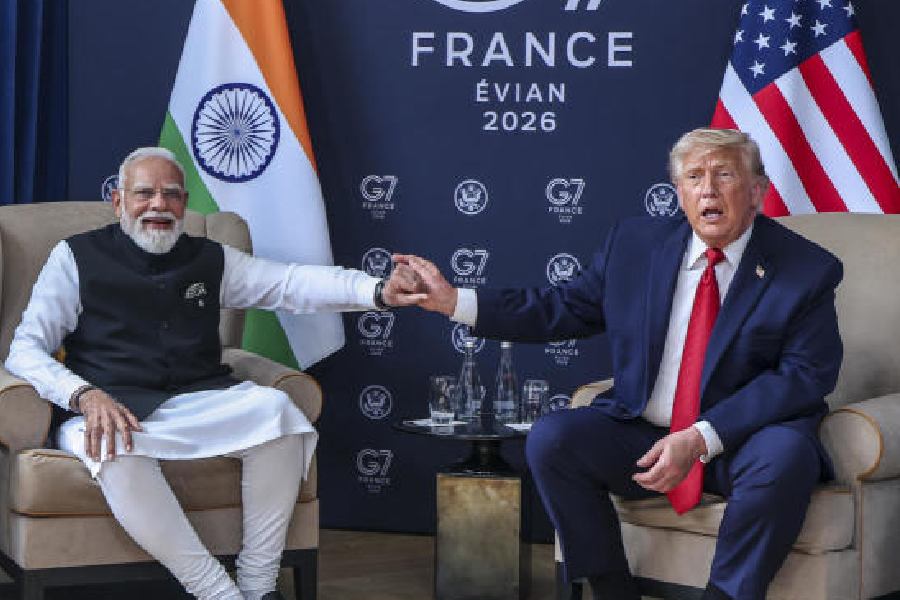
Even domestically, India once projected a democratic legitimacy that gave its foreign policy a distinctive tone. But it is now classified as an electoral autocracy. The Nehruvian tradition, whatever its limitations, offered a language of non-alignment, anti-colonialism, and third-world solidarity. That sheen has faded, replaced by a narrower calculus of trade advantages and security benefits. This unprincipled opportunism does not inspire confidence in places where India wants influence. Under Modi, India now appears as a nation-state that calibrates its positions to convenience, especially in relation to Washington’s demands. This deference to the United States of America contradicts the fundamental desire of the countries in the Global South to maintain strategic autonomy from Western powers. Yielding to American pressure on every single issue renders the Indian quest for leadership a total failure.
This desire to please the US at all cost brings us to the second term that the Modi dispensation frequently treats as a permanent reality. The Indo-Pacific label began as a strategic way to connect the Indian Ocean and the Pacific theatres, with India placed in a larger maritime balance against China. When the US renamed Pacific Command as Indo-Pacific Command in 2018, the addition of a word was a political message that suggested that India mattered to the US’s concept of regional order through maritime connectivity. Now, the Donald Trump administration has removed the prefix and reverted to its legacy designation of US Pacific Command, signalling a shift towards the western Pacific and a more restrictive, Taiwan-centred focus in which the Quad loses its relevance even though many argue that the command’s operational boundaries remain unchanged. This weakens the idea that India sits at the centre of an integrated Indo-Pacific strategy and suggests that Washington is willing to discard New Delhi when domestic politics or military priorities change. The decision highlights the fragility of the Modi government relying on American semantic gestures because labels do not grant geopolitical power; domestic capabilities and independent strategic thought do.
The most revealing part is New Delhi’s silence. It has not officially reacted to the reversal of the Indo-Pacific label. It suggests either comfort with dependence on the US or reluctance to contest a relationship that the Modi government has invested in heavily. The most glaring evidence of this shifting dynamic sits on the official website of the US Pacific Command which displays a map that excludes parts of Jammu and Kashmir from India’s territorial outline and places them outside India’s borders. A nationalist government that claims territorial sensitivities abroad cannot ignore a public display like that at the core of a key US military command. It exposes the limits of a foreign policy that seeks applause from Washington while claiming leadership of the Global South.
Taken together, the Global South and the Indo-Pacific — geopolitical terms that once possessed substantive strategic utility — now expose the same problem in India’s foreign policy. Modi has wrapped both terms in assertive language, but by substituting spectacle for substance, he has stripped them of real meaning and reduced them to slogans that serve domestic politics more than national strategy. India ends up projecting itself to be larger than it is in the Global South and more central than it is in the Indo-Pacific, while the actual record points to a narrowing of influence, a shrinking moral voice, and a nation that has traded strategic seriousness for hollow posturing.
Sushant Singh is lecturer at Yale University