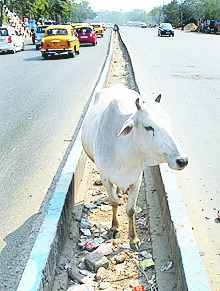

The cow must be mooing her way back to the meadows, now that her delirious days at the hustings are over. But the pastures cannot confine her might: so far as our everyday life is concerned, she is a ubiquitous presence. She can be found masticating placidly on roads, throwing traffic into a tizzy; almost every passing truck has her image - with the udders exaggerated - painted on its sides; Indian children hone their writing skills by composing the famous essay on cow.
Scholars have spent litres of ink by now trying to establish the fact that the taboo surrounding beef is a fairly recent one, that it has been upheld by a particular section of Hindus and that the Vedic people themselves ate beef when they wanted to. But it is probably useless to parade facts in this debate - taboos cannot be rationalized. Indeed, the tumult over beef signifies a triumph of the irrational, which is sought to be equated with faith, devotion, even patriotism.
In early 19th century Bengal, a group of young men from Hindu families had revolted against the orthodoxies that circumscribed their lives. These men - called Derozians, after their young teacher from Hindu College, Henry Derozio - made the eating of beef a token of their rebellion. The Derozians, also known as the Young Bengal group, were rationalists. English education had made them aware of the values of the European Enlightenment. It had taught them to think through received structures, which discouraged questioning, lest the loopholes in them get exposed. Armed with logic, they could see for themselves, and show others, how inhuman some of the prevailing social practices - such as suttee - were. Many members of the Young Bengal group helped bring about important social and judicial reforms; they made India take the first steps towards becoming a modern State.
In one of the earliest novels in Bengali, Alaler Gharer Dulal (1857), the writer, Pyari Chand Mitra (1814-1883) - who belonged to the Young Bengal group - paints an entertaining picture of Brahmin pandits splitting hair over trivial issues from the shashtras. They debate over the appropriate day for eating pumpkin, the inauspicious day for having brinjal, and declare pompously that having salt with milk is as bad as eating beef.
But the pandits' authority was already on the wane - people who had started thinking for themselves no longer needed diktats to guide their lives. A popular Bengali couplet from the 19th century bemoaned the fact that the caste system has been messed up by three "Sens". The first is Keshab Sen, one of the leaders of the Brahmo movement, which challenged Hindu dogmas; the second is "Ishtisen", the station, standing for the railways, which, by transporting people, also dislocated them, sometimes from rigid caste hierarchies; the third is Wil sen, standing for Wilson's Hotel on Chowringhee that was famous for its beef steak.
Things have come a full circle. People who eat beef now are in danger of being beaten up. The cow has won the day. It is the age of unreason.