|
|
| Lost kingdoms |

The Story of Asia?s Lions
By Divyabhanusinh,
Marg, Rs 1,850
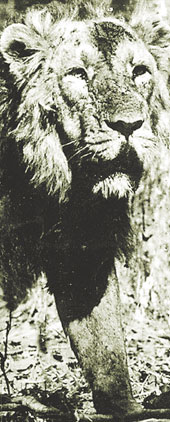
Everyone knows that the lion, once found all across west and south Asia, is confined to the Gir Forest of Gujarat. Divybhanusinh sets out to ask the whys and hows of the story of its survival. This is an amazing book for another reason: its history of lion symbolism, imagery and its relationship with successive rulers and peoples. The illustrations, both the miniatures from the medieval period and the black-and-white photographs, drive up the cost.
The story of the nawabs of Junagarh and how they limited hunts to provide a handful of trophies has never been told and told so well. The two successive nawabs who sought to save the species also put the animal on a postage stamp, a first for any wild animal in India. Their hunting grounds became the nucleus of what is today the Gir National Park. The evolution of the lion into a regional symbol in today?s Gujarat, where it is the state animal, has its roots in the period of the nawabs? rule, the history of which present-day rulers are doing so much to obliterate. The cultural resonance of the lion in western India in general, and in Gujarat in particular, is explored with thoroughness and lucidity.
This is the second such offering from Divyabhanusinh, and comes a decade after The End of a Trail, a study of the cheetah. The latter is extinct in India, and only a handful is left in Iran. But the lion has a safe home in Gir. The author strongly advocates relocation of a few lions to a second home in Kuno, Madhya Pradesh. He warns that a rabies epidemic not so long ago killed off possibly 2,000 lions in Tanzania?s Serengeti. However, to avoid putting all eggs into one basket, what is required is an alternative home with a sufficient prey base. It also has to get over the hurdle of Gujarati regional pride. Successive regimes in the state have refused to part with any lions. Divyabhanusinh feels that the lions which live outside the park boundaries can be taken off without affecting the source population. He also underscores the fact that Gir will always be the first and original home.
The species that enraptured people through the ages is today in a sorry state, extant in less that one per cent of its habitat. It first became a major royal symbol some 2,300 years ago, even in parts of India, like the east, where tigers were far more familiar to people. What is more amazing is how often translations missed out on the Mughals? considerable knowledge of the large fauna. The author painstakingly shows how it was the lion, and not the tiger which was the major target of the padsahs. The Persian word for lion is shir, while the tiger is called babri. The 19th century translators mistook the former for sher, an Urdu name mainly used for the tiger.
In the early British period, lion hunts were commonplace. The animal lived in prides in open country and was an easy target. Charles O?Doyly?s amazing paintings of 1807 document a host of ways of hunting the big cats. By the end of the century, the lion was gone expect in the Gir hills and this is where the nawabs? passion played a critical role in staying the gun as much as the axe and plough.
Mahabat Khan, the nawab from 1920 to 1947, is shown as being very choosy about which specimen he shot. On one occasion, he deigned to shoot a male, as the mane was not black. The number of animals shot was few and far between; there was none of the hunter?s thirst that led the ruler of Sarguja to shoot over 1,000 tigers and 2,000 leopards in a lifetime.
This work is interesting for its blend of narrative and biology. It has a visual appeal and finish that more than justifies its price. And there is the appeal of an unusual subject given its pride of place. The tale stretches across centuries but the pace never flags.