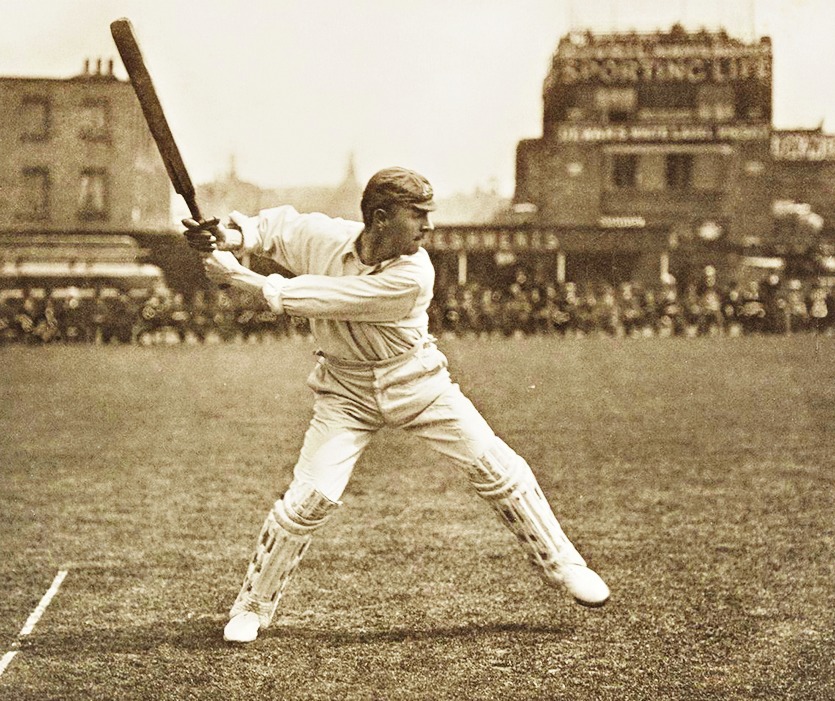

STROKE OF GENIUS: VICTOR TRUMPER AND THE SHOT THAT CHANGED CRICKET By Gideon Haigh, Simon & Schuster, £18.99
This review for the sake of honesty should begin with an admission. Victor Trumper became my childhood hero and has remained one since then. I was brought up on stories about him which were told to me by a cricket-mad father. The famous picture of Trumper jumping out to drive - the subject of this book - is among the earliest photographs I knew and learnt to appreciate. I have gazed and gazed at the reproductions of that photograph in many of the books in my father's rather large collection on cricket. Thus, in some ways, I am not the right person to review this book since I am a priori in favour of the book; in other ways I am perhaps the right person since I can understand exactly the impulse that made Gideon Haigh write this book.
It would be simplistic to take the title and the subtitle of this book at their face value. This is a layered and complex account of how a legend was born and made. It also tells the story of Trumper's life and career but does so unfailingly in admiring and appreciative terms. I thus hesitate to use the term biography. The book also does two other things. For those cricket lovers interested in the technical aspects of the game, Haigh provides a rather perceptive and informed analysis of the evolution of the art of batsmanship till the time of Trumper's death in 1915 at the relatively young age of 37. At another level, through a study of George Beldam's famous photographs of cricketers in the Golden Age of Cricket, it tells readers about the emergence of photographs of sportsmen in action. The most famous of these was of course the one of Victor Trumper jumping out to drive.
In the words of Ranji, in his magnum opus, Jubilee Book of Cricket, the immortal WG made the single stringed instrument of cricket into a "many chorded lyre". Shorn of its lyricism, what Ranji perhaps meant was that WG transformed batting by bringing into a batsman's repertoire powerful stroke-making on the leg side - the pull and the hook - to punish deliveries pitched short. Ranji enriched and expanded this art with his famous leg glance and the use of his steel-like wrists to score runs on the leg side behind square leg. These innovations had their inevitable impact on bowling and field placing. There also existed at the same time other modes of batting - defensive play (Arthur Shrewsbury, about whom WG said, when asked to pick his best eleven, "Give me Arthur", thus implying the other nine were inconsequential.) and big hitters (Bonnor or Trott). Into this scene came Trumper at the end of the 19th century.
Apart from bringing to batting an incomparable aesthetic dimension, Trumper made possible what is best described as scientific fast scoring as distinct from big hitting. It is said that he had three strokes for every ball. Hence Archie MacLaren's memorable comment (after Trumper's century before lunch at Old Trafford in 1902; those days lunch was taken 90 minutes after start of play), "I put the fielders where I like, Victor puts the ball where he likes." Trumper thus became a phenomenon. No one who saw him bat could quite believe that batting could be so powerful, so effortless and so graceful. His contemporaries, senior and junior, who began the process of legend formation, were amazed and overwhelmed by what this young man could do with the bat. In their eyes, he was supreme.
The legend came down to future generations through two distinct channels. One was the writings of Neville Cardus, who, as a school boy, had seen Trumper bat at Old Trafford. Later on in life, Cardus, as cricket writer and music critic, was to compare Trumper's batting to "the gorgeous bannered beauty" of Wagner's Die Meistersinger. The other was Beldam's famous photograph which Haigh analyses in some detail.
This is a cricket book like no other. And I say this as an avowed admirer of Cardus, who, more than anyone else (save my father), taught me to love cricket. This book tells many interrelated stories, draws attention to technical details and depicts a deeply humane man and the game he loved. Cricket in its Golden Age - the era which Trumper personified - was a humanizing game. That Mammon has made a monster of it is another story.