
VINEGAR GIRL: THE TAMING OF THE SHREW RETOLD By Anne Tyler, Hogarth, Rs 1,241
So strong is the resemblance between Anne Tyler's Vinegar Girl and Anne Fletcher's 2009 romantic comedy, The Proposal, that one is forced to wonder whether Tyler had the film in mind while writing the novel. The Proposal features Sandra Bullock as the irate editor-in-chief of a publishing house and Ryan Reynolds in the role of her assistant. In order to avoid being deported to Canada, Bullock's Betty decides to force Andrew, her assistant, to marry her. Predictably, Betty ends up falling in love with Andrew. Tyler's book does have all the ingredients that make a typical romcom: idiosyncratic characters, a love-hate relationship, comedic moments and a happy ending. But there is one problem, this novel is not just any other boy-meets-girl story, it is an adaptation of Shakespeare's The Taming of the Shrew.
One of the most debated of Shakespeare's plays, The Taming of the Shrew has divided critics, both men and women, down the ages, on issues such as who tames whom in the play? Was it merely a product of its time, when money and property, not love, ruled the choice of a spouse or did Shakespeare conceive a proto-feminist text some 400 years ago? The Taming of the Shrew has been accused of being a misogynistic play. What piques one's curiosity is how will readers, already armed with feminist theory, react to an adaptation of this play? The labels of a shrew, a scold or even the name "vinegar girl" can put them on the defensive. But again if the play is a proto-feminist text and Katherina was playing Petruchio's game all along, then how innovatively can it be retold in the modern age? Tyler has cleverly bypassed all the debates with a simple trick: she has situated her plot in the postfeminist era. Postfeminism, a contested term, is generally used to indicate the redundancy of feminism in developed countries.
Although Shakespeare's enduring appeal lies in his creation of timeless characters, modifying The Taming of the Shrew for 21st century readers is no mean task. This is because both the characters and the plot may seem anachronistic. With a nod towards Cole Porter's Kiss me, Kate Tyler situates her novel in Baltimore. Baptista Minola is Louis Battista here, an eccentric and clueless scientist. The whole group of suitors who woo Katherina's sister Bianca - here Bunny or Bernice - has been substituted by an idle boyfriend who does pot and pretends to know Spanish. Swashbuckling Petruchio of the original text has been portrayed, surprisingly, as a shy and clumsy immigrant from Russia, Pyotr Cherbakov. He is a microbiologist who drives a battered Volkswagen Beetle and speaks English in the strangest manner possible.
Unlike Shakespeare's Katherina who is defined by her anger and the articulation of it, Tyler's Katherina, here Kate, is one with whom readers will be able to relate to. She is a modern-day, Levi's-clad woman who in the absence of a mother and in the presence of her absent-minded father and sister runs the house. Kate works as a teacher's assistant in a preschool and is capable of making both peanut butter sandwiches and witty remarks. Her sharpness of tongue is restricted to checking people's grammar. Kate is defined by two predominant emotions - irritation and boredom - that fuel most of her decisions in the novel. Irritated by her teacher's lecture, she drops out of school; she stops cutting her hair because she was irritated with the female customers who could not stop chattering in the parlour. Boredom prevents her from quitting her job and it is boredom that makes her agree to her father's proposal to marry Pyotr.
The episode where she visits Pyotr's house reminds one of Elizabeth Bennet's visit to Pemberley in Pride and Prejudice. The desire to become the "mistress of Pemberley" was a definitive reason that led Elizabeth to accept Darcy's hand in marriage. For Kate, Pyotr's house and his garden are not symbols of household happiness, but means of breaking away from the cycle of boredom that she was caught in. Marriage becomes a way of thrill-seeking. This is why even when the situation arises where she could choose not to marry Pyotr, she drags him up the aisle and takes the vows.
Marriage is one of the most important themes in the source text. In the original text, Baptista Minola tries to marry off his daughters, while the men in the play try to court them both successfully and unsuccessfully. But marriage is not central to this novel. Rather, a research on autoimmune diseases, involving sanitized and well-fed mice, and the relationship between Pyotr and Louis take centre stage. On one occasion Kate muses that it is too bad that her father could not marry Pyotr. In stark contrast to Baptista Minola, Louis Battista is fully aware that the marriage between Kate and Pyotr was to be on paper only.
Tyler's men are anything but misogynistic. They are comical, even weak and pathetic. While Louis Battista is hopelessly dependent on his daughters, Kate's colleague, Adam, hired to be a disciplining force for the children, turns out to be "so gentle and solicitous" that he is asked to tend to two-year-olds. Petruchio might be abusive and brusque, but it must be acceded that the play derives most of its humour as much from the lines spoken by Petruchio as from the lines of Katherina. By portraying a simple and vulnerable Pyotr, the plot has lost much of its vibrancy. For humour it largely depends on the sarcasm of Kate. Pyotr recognizes that Kate is an independent woman with a mind of her own and she could have anybody she likes. His desperation to make her like him stems from a consciousness of his shortcomings. His loneliness, as an orphan and an immigrant, is laid bare when he says "I am homesick in this country, but I am thinking I would be homesick in my own country now, also. I have no longer any home to go back to... There is no place for me." This explains why Tyler replaces the famous monologue that Katherina delivers at the end of the original text, in which she upholds wifely duties and monogamy, with a speech defending men. Befitting the postfeminist setting of the novel, Kate says, "[t]hey're a whole lot less free than women are... [women] know how things work underneath, while the men have been stuck with the sports competitions and the wars and the fame and success... I'm not backing down... I'm letting him into my country. I'm giving him space in a place where we can both be ourselves."
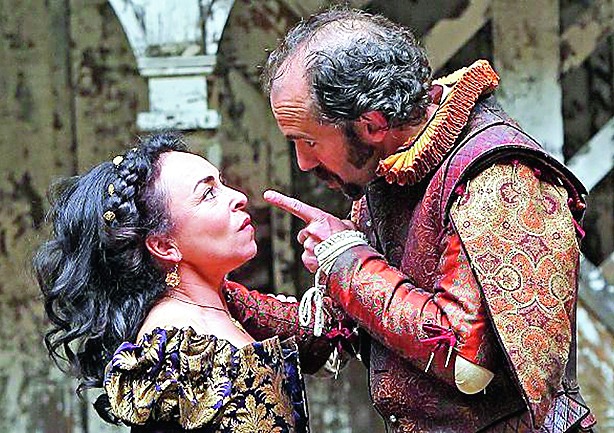
Most adaptations of The Taming of the Shrew, whether it is Phyllida Lloyd's 2016 production or Gregory Doran's 2003 stage adaptation or film adaptations such as 10 Things I Hate About You, have tried to interpret the taming that takes place in the play. They either take a stand against it, or choose to fall in line. Tyler does away with the taming. The postfeminist era is not devoid of a power struggle between the two sexes, but it does not necessarily entail taming. This makes Tyler's adaptation both dependent on and independent of the parent text and therein lies its uniqueness. However, some of the exchanges that she uses from The Taming of the Shrew to ornament her novel, like the moment when Bunny asks Kate, "are you chattel?" or even the episode where Pyotr turns up looking shabby on his wedding day seem like forced interpolations from the play.
There are two questions that can be pondered by readers: why was it necessary to include the epilogue which shows the couple living happily ever after? Has it got anything to do with the framing action of Christopher Sly - a drunken tinker who is duped into believing that he is a nobleman and for whom the play, 'The Taming of the Shrew', is put up - which has led people to suggest that the literary artifice undercuts the misogyny in the play. Also should it really have been 'kiss me Katya' or 'kiss me Pyotr' in the end? In the source text, the line "kiss me, Kate"- one of the most popular lines - indicates the accomplishment of the taming. But at a time when the battle of the sexes is obsolete, which would have been more suitable?