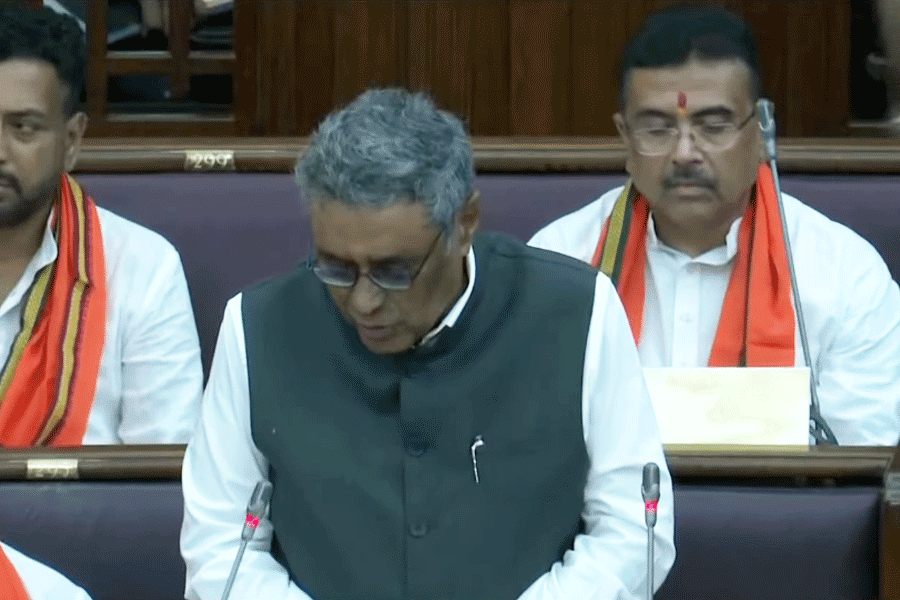
The Bharatiya Janata Party’s maiden budget in West Bengal, presented by the finance minister, Swapan Dasgupta, seeks to balance a development-oriented economic agenda with the need to honour the BJP’s electoral promises. With a total outlay of over Rs 4.38 lakh crore, the focus of the budget has been on fiscal consolidation, welfare expansion and industrial revival. The government has projected a revenue deficit of 1.02% of GSDP, a fiscal deficit of 2.91%, and a debt stock equivalent to 37.98% of GSDP, acknowledging an inherited debt of Rs 8,15,891 crore. In spite of this constraint, the budget signals a shift towards growth-led governance through a Rs 5,000 crore industrial incentive package, the re-examination of the Urban Land (Ceiling and Regulation) Act, plans for industrial corridors, a semiconductor unit in Durgapur, and an infrastructure push for North Bengal. The decision to revisit land regulations addresses a long-standing leash on industrial investment by improving access to large contiguous land parcels. The focus on North Bengal, an electorally significant region for the BJP, through proposed institutions such as IIT, IIM, AIIMS and an IT park as well as improved connectivity, reflects an attempt to correct regional imbalances. Measures to support tea cultivation and mango farmers indicate a recognition that agricultural growth must be built on the state’s existing strengths.
Equally significant is the government’s willingness to leverage Central schemes that had remained underutilised in recent years to avail a corpus of about Rs 42,000 crore. This is a pragmatic approach for a state burdened by high debt and with limited fiscal room. The Rs 36,000 crore allocation for the Annapurna Yojana, the 20-percentage-point increase in dearness allowance for government employees, free bus travel for women, pensions for retired journalists, higher honorariums for frontline workers, one lakh vacancies for government jobs as well as a Rs 3,000 monthly allowance for unemployed graduates are a testament to the government’s welfare — populist — commitments.
Some concerns remain. The debt stock is still projected to rise in absolute terms, leaving future dispensations with a substantial repayment burden. The government speaks of fiscal discipline while ruling out major tax increases. Yet, there is limited detail on how revenues will be expanded sufficiently to fund welfare commitments, capital expenditure and salary hikes simultaneously. The budget presents itself as a shift from welfare to growth, yet its largest allocations remain concentrated in transfers and subsidies. Many of its headline projects remain at the level of announcements, with limited detail on implementation timelines, financing structures and expected employment outcomes. Further, the proposed greenfield airport near Kalyani appears ambitious given the challenges — infrastructure, patchy services, volume of flights and so on — confronting Calcutta’s existing air traffic. But the budget does mark a clear departure in policy direction and contains constructive signals.