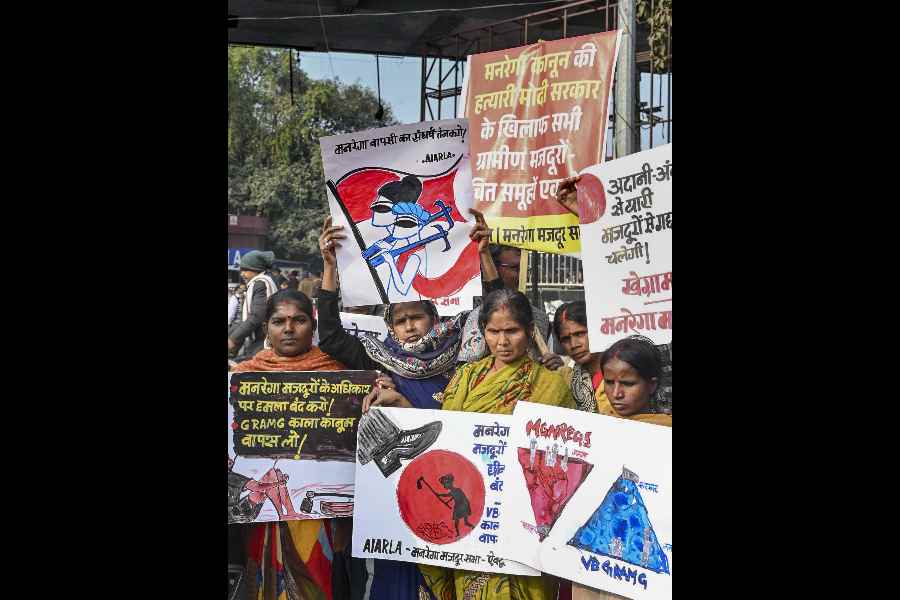
The Mahatma Gandhi National Rural Employment Guarantee Scheme had come into effect through legislation that had been debated for months, that had gone through a parliamentary committee before which several persons had testified, that had been the final product of a consensus, and that had been passed in Parliament unanimously. It represented, as it were, the will of the nation, and it conferred a right to employment. True, the right was for one person per rural household and promised a maximum of 100 days of work at a stipulated wage; but it was a partial implementation of the Directive Principles of State Policy enshrined in the Constitution. It was perhaps the most significant legislation in post-Independence India, in effect a constitutional amendment, and set up the world’s largest employment programme.
This right of the people has now been withdrawn unilaterally by the National Democratic Alliance government through a new legislation, the Viksit Bharat-Guarantee for Rozgar and Ajeevika Mission (Gramin), that has been passed by a mere voice-vote in Parliament without any attempt at building a consensus, and in a hush-hush manner: it was presented to Parliament on December 15, debated on the night of December 17, and passed on December 18 without being referred to the parliamentary standing committee on rural development, ignoring a written request by the chairman of that committee. To remove a right of the people, sanctioned by the nation’s will in accordance with the Constitution, by a mere voice-vote in Parliament represents an incredible assault both on the people and on the Constitution. The new legislation also constitutes an assault on federalism by unilaterally dictating inter alia a change in the financing pattern of the employment programme from 90:10 between the Centre and the states under the MGNREGS to 60:40; and on decentralisation to local self-governing institutions, visualised by the 73rd Constitutional Amendment, by making the selection of projects a responsibility of the Centre rather than the LSGIs.
After the deed is done, government spokespersons are now busy covering it up. The Union minister for rural development, Shivraj Singh Chouhan, for instance, has claimed (The Hindu, December 24) that state governments were consulted on the matter. It is not clear where this happened, but the whole purpose of consultation on such an issue is to arrive at a consensus, as the MGNREGS had done; it is not just to convey the Centre’s diktat. But no consensus was ever reached with the states, let alone with political parties, civil society organisations, or workers’ representatives.
Likewise, the claim that the Central allocation of funds proposed for VB-G RAM G would be higher than it was for the MGNREGS, making the former superior, is meaningless. If a scheme is demand-driven, then the size of prior allocation is irrelevant; the actual allocation depends on demand. Besides, since 40% of expenditure is now going to come from states, which are severely finance-constrained, the size of the Central allocation itself means nothing.
Consider an example. Suppose, under the old scheme, where the financial burden was shared 90:10, the total expenditure last year was Rs 1000 (of which Rs 900 was spent by the Centre and Rs 100 by the states). If the demand for work increases by 10% this year, then the Centre should be spending Rs 990 this year and the states Rs 110. But under the 60:40 formula, the states would now be asked to spend Rs 440 to meet this demand and the Centre Rs 660; if the states’ resources permit a maximum expenditure of only 200 (which itself represents a 100% increase over last year), then the Centre will spend only Rs 300 under the 60:40 rule, and the total spending will be only Rs 500 (with the Centre conveniently blaming the states for the shortfall). Hence, whether the Centre allocates Rs 1000 for the scheme or Rs 2000 is immaterial; it has created a dispensation where it will never be called upon to spend this amount.
This also shows why Chouhan’s claim that the new Act does not take away the people’s right rings hollow. A right is respected if spending is demand-driven; a fixed allocation for a programme that is decided beforehand runs contrary to the spirit of a right. And when this prior allocation is made conditional upon states spending a certain amount that is beyond their reach, it entails, in effect, an abandonment of the right. Besides, when the Centre is going to dictate the regions where the projects are to be located, as the new law provides, the right to employment of people residing outside these regions has been effectively nullified. For the bulk of the rural poor, therefore, the right to work has become infructuous; at best, they may get a dole but no work or wages.
This is also why the talk about 100 days maximum employment under the MGNREGS being replaced by 125 days under the new law, making the latter superior, is so utterly false. It gives the impression as if the new law amounts to the MGNREGS plus an additional 25 days of work for anyone demanding work. This is simply wrong. The MGNREGS, with the right to work for one person per rural household, has just been abolished, which makes the stipulation of 125 days utterly irrelevant and meaningless for the bulk of the rural poor.
The MGNREGS was a lifeline for the poorest segment of India’s population. Its abrogation is a blow against it; it is also a blow against the nation, the Constitution, and even against India’s international commitments: it violates the universal right to livelihood, subsumed under the right to life that is upheld by the International Covenant on Civil and Political Rights; India has been a signatory to this Covenant since 1979.
Prabhat Patnaik is Professor Emeritus, Centre for Economic Studies, Jawaharlal Nehru University, New Delhi