There is a paradox at the heart of West Bengal’s democracy. Scheduled castes constitute about 23.5% of the state’s population — one of the highest proportions in India — while the state accounts for roughly 10-11% of the country’s total Dalit population, the second-largest share after Uttar Pradesh. Yet, for most of independent Bengal’s political history, this community has been the state’s most politically invisible constituency. As the state prepares to vote on April 23 and 29, that invisibility is finally — and unevenly — cracking.
Before understanding how Dalits vote, one must first dismantle the myth of ‘Bengali exceptionalism’, which claims that caste lost relevance in West Bengal under 34 years of Left Front rule as class displaced caste in politics. In reality, this was less a social transformation than an ideological concealment: Dalit grievances were repackaged in the language of class and absorbed into a framework that the upper-caste leadership could manage without surrendering social dominance.
The relative invisibility of caste politics in West Bengal arose from a convergence of factors: the rupture of Dalit mobilisation after Partition, the subsumption of caste within Left class politics, the dominance of ‘party society’ at the grassroots, and the fragmentation of Dalit constituencies. Partition was decisive: it dispersed communities like the Namasudras, undermining the geographical concentration and the organisational continuity necessary for sustained political assertion.
As elsewhere, Bengal’s SC population is not a monolithic bloc but a constellation of sub-castes with distinct histories, geographies, and political trajectories. It may be conceived into three blocks that dominate the electoral calculus.
The Namasudra-Matua community, shaped by successive post-Partition migrations and organised through the Matua Mahasangha headquartered at Thakurnagar in North 24 Parganas, exerts significant electoral influence across parts of southern Bengal, especially the North 24 Parganas, Nadia, and the adjoining districts. Its defining political issue has been citizenship: the Bharatiya Janata Party’s CAA promise drew large sections of the community toward it in 2019, but delays, ambiguities, and implementation anxieties later produced frustration and political restlessness.
The Rajbanshis of North Bengal — comprising both indigenous groups and Hindu refugee sections from Bangladesh — form a major social bloc concentrated in Jalpaiguri, Cooch Behar, and Darjeeling. Their politics has long revolved around the demand for Kamtapur, a separate statehood aspiration that no party has fulfilled, although the BJP has exploited it most effectively, helping turn North Bengal into one of its strongest regional bases.
The remaining SC communities — Bagdis, Bauris, Pods, Haris, and Chamars — are concentrated in rural south Bengal and Jangal Mahal. Compared to the relatively higher literacy and mobility of the Namasudras, these groups remain more agrarian, less educated, and economically marginal, and have been less effectively mobilised as distinct political constituencies by any party.
The crucial point — often ignored — is that there is no unified ‘Dalit vote’; internal divisions are sharp and structurally significant.
The Namasudra-Matua community’s refugee history has made citizenship security and Hindu consolidation especially salient, rendering it more receptive to the BJP’s CAA promise than communities such as the Bagdis or the Bauris. Among Rajbanshis, too, support for the CAA exists across factions but for different reasons: refugee sections seek citizenship security, while indigenous sections often seek recognition and political assertion, producing contradictory pressures within the same community.
There is also a class contradiction within the Namasudra community itself. The more mobile, peri-urban sections around Calcutta have interests — land titles, education, urban employment — that differ from those of rural Namasudras whose concerns remain wages, housing, and documentation. A community so internally differentiated by class cannot vote as a single bloc regardless of what its religious leadership recommends.
The historical pattern is one of bloc loyalty repeatedly converted into political capital by parties that delivered little structural change. The Left retained Dalit support for decades within its class framework while the leadership remained overwhelmingly upper caste; the Trinamool Congress inherited much of this vote in 2011 through Mamata Banerjee’s populist identification with the dispossessed.
The disruption came in 2019 when the BJP’s CAA promise offered the Matua-Namasudra community not welfare or representation but the prospect of legal recognition, driving a significant shift toward the party in the 2019 Lok Sabha and, to a lesser extent, in the 2021 assembly elections. This electorate remains decisive in several dozen constituencies, particularly along the border belt.
Yet the BJP’s prolonged failure to implement the CAA has generated visible disillusionment, which the TMC has sought to exploit through both symbolic inclusion and welfare delivery. By fielding a large number of Dalit and Tribal candidates and extending schemes such as Lakshmir Bhandar, Kanyashree, and Swasthya Sathi deep into poor households, it has offered a more materially immediate appeal than the BJP’s deferred ideological promise.
Three factors will determine the Dalit vote in 2026.
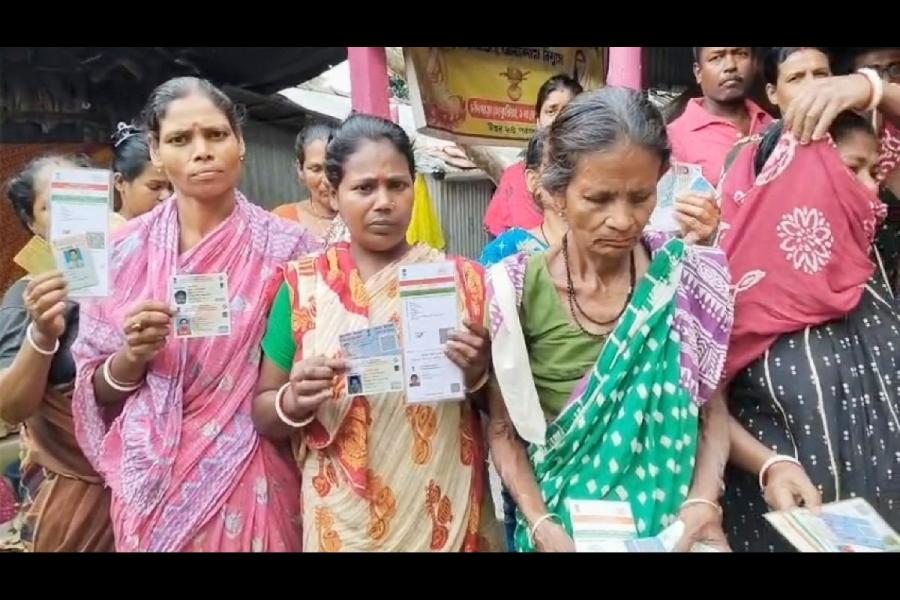
First, the Special Intensive Revision controversy has paradoxically hurt the BJP among the very constituencies it sought to consolidate. Preliminary data indicate that the Matuas are overrepresented among ‘unmapped’ voters —reportedly reaching around 7%-8% in some of their strongholds, well above the state average — largely due to incomplete documentation stemming from their refugee histories. A process framed as targeting illegal Bangladeshi migrants has thus fallen disproportionately on Bangladeshi Hindu refugees themselves. Reports of distress, including suicides linked to SIR-related panic, have further deepened anxiety across affected communities.
Second, the BJP’s biggest liability remains the non-delivery of the CAA: the promise that drew Matua support in 2019 has still not translated into citizenship documents. The emotional credit once extended to the party is now under strain.
Third, the TMC’s welfare reach has deepened. For communities whose everyday relationship with the State is mediated through ration cards, housing, cash transfers, and health coverage, the party that delivers materially often outweighs the party that promises symbolically.
Whatever the 2026 outcome, it is unlikely to produce a Dalit political agenda on its own terms. In West Bengal, despite a substantial Dalit population, there is no autonomous Dalit political formation; Dalits will vote in large numbers, but largely for parties whose leadership and agenda remain shaped by communities historically advantaged by their subordination.
The issues that most directly affect Dalit communities — land rights, wage theft, caste violence, educational exclusion, and weak SC sub-plan implementation — are unlikely to define this election. Instead, it will turn on polarisation, welfare delivery, and the citizenship anxieties of refugee communities, leaving large sections of the Dalit population, especially the agrarian poor of South Bengal and the Jangal Mahal, politically present but substantively unrepresented.
Bengal’s invisible majority is likely to remain invisible.
Anand Teltumbde is a scholar and civil rights activist