|
|
| Strong ties |

Children of the Raj
By Vyvyen Brendon,
Weidenfeld and Nicolson, £ 20
Recalling Lindsay Emmerson, the British journalist who married W.C. Bonnerjee?s granddaughter Mrinalini and spent nearly 40 years in Calcutta, it is understandable that when the United Nations added a list of the fundamental rights of children to its post-war Declaration of Human Rights, it also proclaimed, as Vyvyen Brendon reminds us, ?A child of tender years shall not, save in exceptional circumstances, be separated from its mother.?
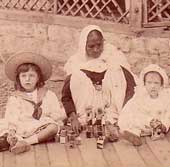
Like Vivien Leigh, John Masters, M.M. Kaye, George Orwell and so many members of Rab Butler?s family who pass fleetingly through the pages of this engaging book (as Emmerson does not), he, too, was an archetypal child of the raj. His father was a Hooghly pilot who lived in Rainey Park where he was born. Like the offspring of all British soldiers, civil servants, missionaries and box-wallahs, he was not allowed to speak in English to the servants lest he pick up what used to be called a chi-chi accent. Like them, he was also packed off to England when he was only four, to prep school followed by Eton and Cambridge. Kipling?s St Xavier in Partibus in Lucknow or Darjeeling?s Eton of the East might have been all right for Indians and Eurasians but the children of the raj had to be ?brought up English?. Their parents regarded India as physically and morally unhealthy. But we must look beyond this deeply held conviction for the true reason why generations of expatriates subjected toddlers to the heartache and hardships of life among often-unsympathetic strangers thousands of miles away where they were suddenly transformed ?from Somebodies to Nobodies?.
The reason lies in what Brendon calls British India?s ?inveterate snobbery? without, however, fully grasping all its nuances or following the observation through every logical ramification. In Orwell?s view ? and he should have known ? British soldiers and officials did not come to India to make money but to chase an illusion of class. ?They went there because in India, with cheap horses, free shooting, and hordes of black servants, it was so easy to play at being a gentleman.? Like Emmerson the Hooghly pilot, they also made enough money to be able to transform aspiration into reality by sending their sons to Harrow or Haileybury and their daughters to Cheltenham or Roedean. London society is dotted even today with well-known personalities who have no direct connection with India but whose public school upbringing and upper class accents were made possible by fathers who toiled in places like Midnapore and Madura.
Brendon glosses over this endearing aspect of empire. Perhaps she has only a limited insight into her subject?s psychology since she herself is not a child of empire. Perhaps she feels that any acknowledgement of sentiment would be at odds with the stereotype of stiff upper lip and service (or, better still, sacrifice) before self that the raj is supposed to evoke. As a result, the image that emerges is quite unblemished by any human frailty. This old-fashioned idealism is not really necessary for the majority of today?s Britons are as unaware as they are uncaring about the myths of empire. Nevertheless, the further Britain?s imperial past recedes into the mists of never-never land, the more it seems to spin out its tales for the benefit of a hardy few. A book about the British soldier in India appeared recently; and no doubt enterprising authors will continue to fasten on other increasingly minor imperial sub-texts and research them to death. Brendon certainly has uncovered a wealth of information spanning three centuries though her manner of marshalling it can sometimes be confusing.
Though she writes with sympathetic understanding, too much detail is crammed into every page. Too many names flit past for recognition, and the network of Anglo-Indian (in the old sense of English living in India) relationships is not always properly explained. There are also far too many casual references to events and episodes that were obviously of some magnitude in their time and deserve more exhaustive exploration. We are offered tantalising glimpses into other worlds that are never fully unveiled. For instance, the Englishwoman who admits to ?the economic hardship and social condescension often suffered by her coconut-planting family on their lovely Travancore estate? must have a fascinating story to tell. Did the plantation not prosper? Did other Brits look down on them? Did they not hob-nob with the Travancore royals? Many such questions remain unanswered.
The theme, with its implicit and explicit racism, will probably not evoke much interest in India. The author herself is aware of the irony of 19th century fears of ?a very extensive importation of persons of colour? (meaning Eurasians) in a country that now gorges on chicken tikka masala. But little point is served today by waxing indignant about the incidents of segregation that crop up every so often. People and events cannot be judged out of the context of their age, and many British children did look back on their Indian ties with genuine affection. India?s parting gift to one of the Butler girls was a ?built-in transcendental spirit? that enabled her to cope with life. Finally, as Brendon says, a twist in the kaleidoscope means that ?now it is the sons and daughters of prosperous Asians who are likely to be packing school trunks for England?. Though this development lies outside the scope of her book, Winchester is a hot favourite among rich Indian businessmen.
Far from mocking or condemning what we so sedulously emulate, we must acknowledge that the story Brendon tells did not end in 1947. As Han Suyin says, the real Eurasian is a person not of mixed blood (covered in Brendon?s second chapter, ?A Forlorn Race of Beings?) but mixed culture. With their fondness for acronyms, American academics now call one variant of the breed TCK or Third Culture Kids. In that deeper sense, the children of the raj continue to multiply and flourish.