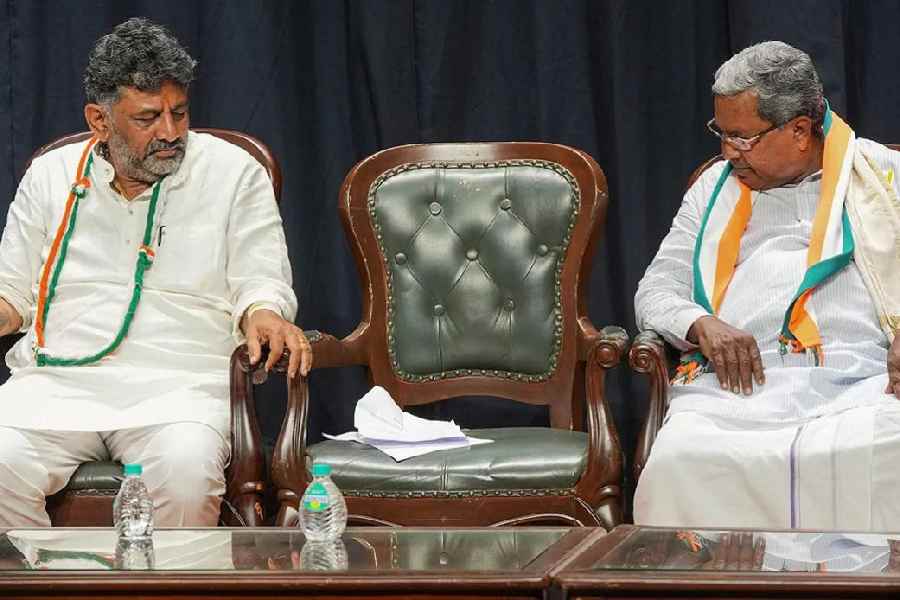
In recent weeks, the newspapers in my home state, Karnataka, have carried numerous reports about the tussle of power between the state’s chief minister and its deputy chief minister. The latter’s acolytes claim that when the Congress regained power in May 2023, the party’s high command told Siddaramaiah to serve as chief minister for the first two-and-a-half years, whereupon D.K. Shivakumar would take over his job. The followers of Siddaramiah dispute this, saying that their man will stay in power for a full five years. As that halfway mark approached, and the high command stayed silent, there were a series of breakfast, lunch and dinner meetings where each leader canvassed support for his case among local legislators, heads of caste bodies, etc.
This column goes beyond the leadership dispute to examine the performance of the Congress government in Karnataka as a whole. Let us first recall the months before the last assembly election. Then the news reports were dominated by issues such as hijab, halal, love jihad and the like. The Bharatiya Janata Party was in power in the state, and, as ever, sought to win re-election by stoking communal polarisation. Its administrative performance had been underwhelming; knowing this, it hoped that by demonising the state’s Muslims, it would somehow recover enough ground among Hindus to win re-election.
Fortunately for Karnataka, this strategy failed. The Congress won the election by a substantial majority, and Siddaramaiah was sworn in as chief minister. One undeniable feature of his government’s term in office has been a significant lowering of the communal temperature. The state has a large population of Muslims (roughly 13% of the total), as well as a not insignificant number of Christians, and both these communities have, without question, felt more secure since May 2023 than they had been in the months and years prior to that.
The Congress was propelled to power in Karnataka by, among other things, its promise of five guarantees: free bus travel to women and girls, cash transfers to women-headed households, additional foodgrains and 200 units of free electricity to each household and, finally, a stipend to educated but unemployed youth. Though no full-scale scholarly studies of these schemes have been carried out yet, reports by independent observers suggest that they might have enjoyed a modest success in creating a social safety net.
These then are the achievements of the Siddaramaiah government in Karnataka; relative communal peace and a targeted welfarism. It is hard, if not impossible, to think of any other positive outcomes of thirty one months of Congress rule in my home state. The signs of administrative indifference and incompetence are particularly visible in the capital, Bengaluru, where the deteriorating conditions of the roads and the ensuing traffic gridlocks have caused much distress to the city’s residents. The national and even international press have carried a series of stories of how the city that is the showpiece of India’s IT revolution faces stagnation and decay owing to the collapse of its infrastructure.
Faced with public outcry, the deputy chief minister — who is also the minister in charge of Bengaluru — has proposed building an underground tunnel to connect the northern part of the city — where the airport is located — with the southern part, where the major software and biotech firms are based. This, it is claimed, will ease the movement of engineers and white-collar workers, while also helping citizens at large. Yet if any government programme deserves the moniker, ‘white elephant’, it is this one. The leading transport experts in the country work in Bengaluru, at the Indian Institute of Science. They have categorically stated that the deputy CM’s scheme is unwise and unworkable, since it is unmindful of the city’s complex geology and unduly favours the owners of private automobiles. These experts argue that a far better option to solve the city’s transport bottlenecks would be to have a greatly enlarged fleet of buses, whose movement can be co-ordinated with the existing metro system. Strikingly, the deputy CM has declined even to meet with these experts, and plans to go ahead with his utterly ill-conceived tunnel project at vast cost to the public exchequer.
Shivakumar’s politics is marked by ambition and haste. Meanwhile, Siddaramaiah, once an assured and composed politician, with an authority that comes from having a genuine mass base, now seems preoccupied with retaining his post, and becoming the only chief minister in the state’s history to complete two full terms in office. This tussle between these two men has adversely affected the governance of the state. Though there are several cabinet ministers who are extremely capable, they have been unable to focus on their respective portfolios, caught as they are in the cross-fire between the two top leaders.
The problems of the Karnataka Congress are compounded by the exasperating incompetence of the party’s national leadership. This stems from their being multiple nodes of power. Mallikarjun Kharge is technically Congress president, and since he is himself from Karnataka one would expect him to have a decisive say in the high command’s position on the chief ministership. However, Kharge is extremely deferential to Sonia and Rahul Gandhi, and it appears Priyanka Gandhi likes to have her say too. So there are four distinct sources of authority in New Delhi to whom Siddaramaiah and Shivakumar, and their supporters, have to appeal. Little wonder that the state Congress is in the state that it is.
I have spoken earlier of the problems that Bengaluru faces. However, it is important to recognise that the city represents less than one-fifth of the state’s population. An all-round development of Karnataka would require much more than fixing its capital’s transport and water problems. It involves creating other nodes of modern economic activity, so that, like the neighbouring states of Tamil Nadu and Maharashtra, Karnataka does not depend on one city alone for generating large-scale industrial/commercial employment and tax revenues. And since a large section of the population still depends on agriculture, it involves focusing on providing irrigation and credit to farmers, while also orienting them towards more sustainable practices. Further, for urban and rural residents alike, much more needs to be done by the Karnataka government to improve public health and education facilities. Finally,
given the state’s extraordinarily rich natural and cultural heritage, tourism should really be a core area of interest for the government, not least because of its enormous potential in generating both employment and revenue.
Yet if one scans the reports of the local press, none of these issues, each so vital to the state’s present and future, gets remotely as much attention as the dispute between the chief minister and the deputy chief minister. Indeed, it sometimes appears that even these two men are interested in little else. Siddaramaiah once had a vision for the state; he has lost sight of it along the way. As for Shivakumar, apart from his desperate desire to become chief minister, the only other thing that seems to interest him is that ill-conceived and very costly tunnel project.
Strikingly, these larger questions of the social and economic development of the state do not seem to concern the Opposition at all either. The Bharatiya Janata Party in Karnataka has become ever more sectarian, following the example set by Narendra Modi and Amit Shah at the Centre and by influential chief ministers such as Adityanath in Uttar Pradesh. It is animated more by hatred and suspicion of religious minorities than by anything else. The BJP has no positive vision to offer to the electors of Karnataka. And as for the Janata Dal (Secular), it exists only to promote the self-interests of H.D. Deve Gowda and his descendants.
In his first term, between 2013 and 2018, Siddaramaiah provided a stable and reasonably competent administration. In his second term, the story has been one of drift, confusion, and intense factional rivalry. In other circumstances, a citizen would have asked the Opposition to get its act together. But in this case, were the BJP-led Opposition to come to power in the next assembly election, due in May 2028, any government it forms is likely to be as incompetent, and certain to be more malevolent, than what we have at present. However, there are more than two years to go before the next election, time enough for the Karnataka Congress to regroup, refocus, and provide the state and its citizens the sort of administration they want and deserve. Whether the Congress can actually do this is another matter altogether.
ramachandraguha@yahoo.in