The years between 1961 and the early Seventies were a time of transition in the nature of both the Hindi cinema and the new- ish republic of India. Hindi films moved from the rhetoric of innoce- nce and idealism to a curious modern hedonism which, from naive beginnings, became more and more knowing till it became indistinguishable from the vigilante cynicism that came to characterize Ami- tabh Bachchan's films in the Seventies.
While looking up the landmark films of this decade, I realized that many of the films that I associated with the haloed Fifties - Chaudhvin ka Chand, Mughal-e-Azam, Sahib Bibi Aur Ghulam - were, in fact, made in the early Sixties. Around 1964, Hindi films stopped talking about goodness and its travails and and began attending to the good life and its rewards. The metaphors changed: Guru Dutt's films sought their melancholy truth in the language of dust, blood, vines, doves, dru- nkenness and ashes; Shammi Kapoor's films weren't in search of truth at all, they were looking for Modern Happiness, and their props, which were also metaphors, were appropriately different: exotic telephones, hill stations, frosted lipstick, flash cars and stretch pants. If these two styles of cinema had to be exemplified by one film each, Kaagaz Ke Phool (1959) and Junglee (1961) would be my choices.
But Junglee, pioneering and wonderful though it was, was merely the first swallow; the summer came three years laterNineteen sixty four was the year when the sensibility of Hindi cinema changed perceptibly and, I think, irrevocably. Till then, despite Junglee, the cinema of rectitude, tragedy, nobility and sacrifice, the cinema epitomized by Sahib, Bibi Aur Ghulam (1962), Bandini (1963) and Shaher Aur Sapna (1963), held sway.
What happened in 1964? Two watershed films were made: Sangam and Kashmir Ki Kali. Both were hugely successful and both made by veterans of the Bombay cinema who began their careers in the late Forties: Raj Kapoor and his one-time assistant director, Shakti Samanta. For both directors these films were their first foray into colour. Both films were set in locales that would become the defining staples of Sixties cinema: foreign countries and hill stations. The next year was to see this new trend consolidated by Waqt, the mother of all lost-and-found melodramas, a great, overblown film which helped define the fantasized lifestyles of the newly rich.
This is not to say that the films in the earlier style were no longer made. They were, but they no longer defined the form. Symbolically, the death of the earlier kind of cinema happened as late as 1969 with Satyakaam, the last, rigorous celebration of idealism and saintly innocence in Hindi films. Contrast this film with three other films made in 1970, which, instead of examining the consequences of idealism, use idealism to give the narcissism of their male stars a justification. The films were Mera Naam Joker, Anand and Prem Pujari. The first and third marked the beginning of the end for two stars who had dominated Hindi films for nearly 20 years, Raj Kapoor and Dev Anand and the second featured the only two superstars the Hindi cinema has had: Amitabh Bachchan and Rajesh Khanna.
It is interesting and, I think, revealing, that this new hedonistic cinema became dominant at a time the republic had entered a period of great material austerity, when compared with contemporary consumerism. Nineteen sixty four wasn't just the year Sangam and Kashmir Ki Kali were made; it was also the year Nehru died - it was, as the newspaper headlines of that time must have said, the end of an epoch. After Nehru, who? was the question on everyone's lips. There were names that answered that question: in real life, after the Shastri interregnum, his successor was his daughter Indira Gandhi; in reel life, his son was Shammi Kapoor.
It was strange and yet appropriate that life and cellulloid threw up such unlike inheritors. Indira Gandhi, even more than her father, came to stand for the state-controlled, rigorously regulated economy. It was the high noon of autarky, the proud emblems of which were the unchanging contours of the Ambassador and the Fiat. It was a time of planning, socialism and, by the late Sixties, nationalization.
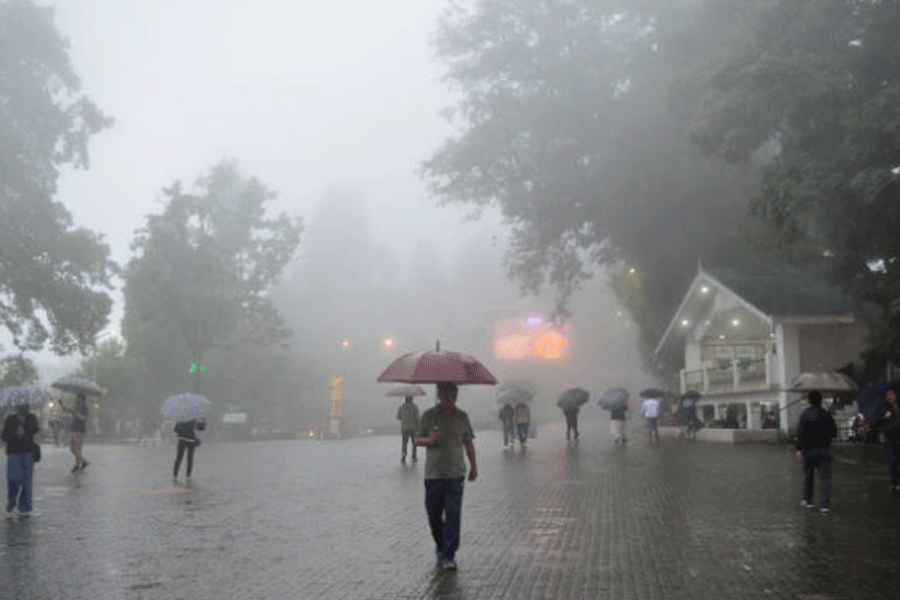
In this context, the new Hindi cinema, the cinema of Junglee, Kashmir Ki Kali, Sangam and Waqt, became a gigantic peepshow, through which the still mainly middle-class audience of the Bombay film industry lived at secondhand a lifestyle lived Elsewhere. Bombay began to produce a wholly voyeurist cinema, where the object of desire could be anything from Dutch tulips to fancy telephone instruments. Social historians of the future will record that the Indian fetishization of things foreign was achieved through the cinema of the Sixties for an audience that could only enjoy them vicariously, handicapped as it was by low salaries and high customs barriers. The films of the Sixties created a fantasized not-India. It was ironic that less than 20 years after decolonization, so many films were set in hill stations, settlements invented by the British to escape the sub-tropical reality of India.
In the Sixties, the cinema hall was the only place in India's mixed economy, where private enterprise dwarfed the public sector. The state was represented (in reversed order of appearance) by the national anthem at the end of the film, the censor board certificate before it began and the Indian News Review. The Indian News Review was always in black-and-white in a decade when Hindi cinema had gone Technicolor, it featured glimpses of war, of important people and, more important than important people, of sport. Regardless of whether the game shown was tennis or cricket, the sound of the ball being hit registered on the soundtrack as a gunshot. But this was the only footage a Sixties audience ever saw of real life and so the Indian News Review was an indispensable part of the movie-going experience.
Its only competition in the real life (that is, the public sector) stakes was the news on a fledgling Doordarshan or the Films Division documentary (also shown in cinema halls before the main feature), then in its heavy industrial phase, dominated by dramatic shots of large tilted vats pouring molten metal in Bhilai Steel Plant. Thus an austere, monochrome, tightly edited capsule of real life was followed by a lush, colourful, three hour spread of fantasy. The Indian News Review was a necessary part of going to the movies but it didn't sell tickets; it rode piggy-back on the main feature.
It is not a coincidence that Junglee, Kashmir Ki Kali, Sangam and Waqt were in colour, or that colour became mandatory for commercial films in the Sixties. The technology of colour had been used much earlier, as early as 1952 with Aan, and then in 1953 for Jhansi Ki Rani. But till Junglee, colour was confined to spectaculars and costume dramas. So why did it become mandatory in the Sixties? Because lifestyles couldn't be sold in black-and-white, because the apparatus of Modern Hedonism - sports cars, powder pink bedrooms, the sights of Paris or Tokyo - had to be seen in colour. Colour was the Indian middle-class's guarantee that it was in touch with the real thing.
It is revealing to notice the circumstances in which colour was not used. It was not used, for example, in war films. India fought three wars in this decade (if we count the military operation to annex Goa) all of which were memorialized in celluloid. Haqeeqat (1964), Shaheed (1965) andSaat Hindustani (1969), are all shot in black-and-white. It was, clearly, inappropriate to dress up the tragedy of war in colour; the austerity of monochrome was more seemly. Manoj Kumar's Upkaar (1967) was in colour, but this was not, strictly speaking, a 'war film'. Most of the screen time was taken up by Manoj Kumar as 'son of the soil', and in keeping with Lal Bahadur Shastri's slogan, 'Jai Jawan Jai Kisan', Upkaar had more to do with the organically patriotic peasant who made the Green Revolution than with soldiers and war.
The cinema of the Sixties is important not just as a chapter in the history of Indian films, it is indispensable if we want to understand and reconstruct the mind of the great Indian salariat - its dreams and prejudices, its fears. Because in the Sixties, before Amitabh Bachchan and video recorders, Hindi films were made for a middle-class audience. Filmgoing was a relatively expensive business: Rs 3.20 for the Balcony, Rs. 2.90 for the Rear Stall. The poor went to the cinema - but they didn't define the form, as they did, briefly, when Bachchan was king. They were confined to the 60 paise seats, for a very good reason: in the mid-Sixties, a domestic servant made thirty-five rupees a month, all found. Anything beyond the 60 paise seats represented a day's wages.
This middle-class for which the Hindi cinema of that decade was produced was the white collar salariat, wonderfully pictured in a television serial some years ago, Wagle ki Duniya. The serial was ostensibly set in the Eighties but in fact it was R.K. Laxman's nostalgic evocation of the middle-class of the Fifties and the Sixties when civil servants wore bush shirts and sandals and motor cars came in black and white. To be middle class in that India was to have a flat with electricity, enough to eat and ironed clothes to wear. Respectability on a budget was the daily challenge. Every tic and gesture in Anjan Srivastava's wonderful rendering of Wagle expressed the elephantine prudence on which middle-class lives were once built before Mastercard and Visa. Wagle lived cautiously because he lived within his means.
It was for this middle-class of Satyug, this world before the Fall - which Fell with the Samastipur blast...or was it the Emergency? - that the houseboat-and-hill station Eden of Sixties cinema was made. Given hindsight, the death of such innocence should be decently mourned.
 Monday, 06 April 2026