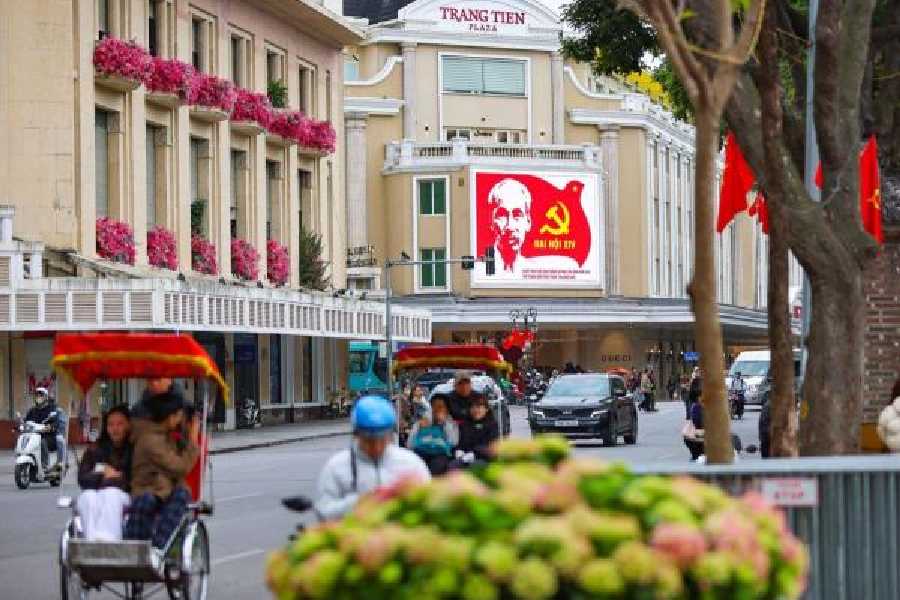
‘Tomar Naam, Amar Naam…’ — ‘Vietnam’, the final word of the slogan that was emblazoned, in scarlet, on the walls of Calcutta in the 1970s, can well be replaced, over five decades later, by bún cha. The craze for these grilled pork patties, dipped in savoury fish sauce and accompanied by gossamer-like noodles and herbs, is, if Hanoi’s streets are proof, truly global. At any hour of the day, the serpentine queue in front of, say, Bún Cha Huong Liên, a modest establishment in Le Van Huu street made famous by a visitation by Barack Obama and Anthony Bourdain a decade ago, has a truly cosmopolitan flair with Europeans, Americans, Chinese, Russians and, of course, the Bengali tourist, their mouths drooling, standing for a bite of its signature bún cha.
This is just as well because the flavours of Vietnam’s election, much like its national dish, pho, are decidedly austere. On the morning of March 15, the bus that trundled out of Hanoi bearing a motley crew of Turkish, German, Polish and Indian tourists — this columnist was among them — towards the scenic northern province of Ninh Binh, famous for its rocky cliffs and enchanting lakes, did not
have a single Vietnamese save for the tour guide who announced, dutifully, that his countrymen were busy casting their votes for the National Assembly. Indeed, that dawn, Hanoi’s Old Quarter had woken up to a blaring, marching-band-like tune emanating from loudspeakers fitted on mobile vans: was that the Party’s way of summoning the comrades to appear in the poll booths?
To the Indian eye, used to the hustle and bustle of democracy, the polling booths — several had been set up on Hanoi’s streets — embodied anodyne efficiency. Several personnel in crisp military fatigues sat motionless in these booths, their countenances set in stone; volunteers milled about even as citizens strode in, stern, purposeful, sans the languor and loquaciousness that characterise India’s voting centres, to cast their votes — for the one and only Party.
The operative word describing the elections on the lively, narrow streets of the Old Quarter was duty. For a people welded by revolutionary flames that had defeated multiple occupations — imperial and colonial, by the Chinese, French and American — both the memory and the modern conception of a functioning polity is informed — clouded — by an urgency, a moral fidelity, to adhere to a post-revolutionary political edifice that demands loyalty and compliance on the part of its citizenry.
This is not to suggest that Vietnam has not been served well by the choice of its political template. For a country emaciated by French colonialism and, then, within a few years, singed by America’s Napalms that decimated agriculture and indigenous production, the lifelines of both North and South Vietnam, the recovery of Vietnam’s economy, where the Doi Moi reform philosophy launched by the Party corralled Marx to cohabit with the Market without much muttering, has been impressive. International Monetary Fund data peg Vietnam’s real GDP growth at 5.6% along with moderate inflation (3.2%) and low unemployment (2.2%). Its social indices are, in fact, equally commendable. Vietnam has a commendable literacy rate, improved health outcomes, high labour force participation among women, and considerable female political representation. There is, of course, the other, less salubrious, side of the economy, one that comes to life, after dark, in Hanoi’s poorer neighbourhoods where tourists are peddled the lure of illicit pleasures. This underbelly, part of every city, reeks of iniquitous wealth redistribution and gender disparities.
Hours later, even the lushness of Ninh Binh’s wilderness cannot quite still this visitor’s consciousness shaped by the seemingly rough edges of Indian democracy. Can/should public docility — and electoral hegemony? — be the trade-off with the lure of collective prosperity? Admittedly, the principle of duty is no longer the monopoly of totalitarian polities. It has acquired potency in democracies being constricted by authoritarian, albeit charismatic, leaderships. So much so that India, the proud bearer of an anti-colonial consciousness that once prized dissent, is now being schooled to debate the right to abstain from voting while advocating pusillanimity towards strident nationalism.
The results of Vietnam’s elections pour out a few days later; the Communist Party of Vietnam had won 482 seats in the 500-seat legislature, magnanimously setting aside representation for a handful of independents.
Duty has prevailed; but, as we shall see soon, at a cost.
*******
Salted coffee is tasty. It is even more addictive than Hanoi’s signature, saccharine egg coffee. Such a revelation would have been apt for a tourist long seduced by Darjeeling’s First Flush. But the revelation is not this visitor’s; it spread its light, one morning, on the face of Vincent, a 24-year-old Vietnamese, at Hanoi’s famous Café Giang. Vincent is studying nursing in Canada. He lives in Saigon and hails from a family of relative affluence. That perhaps explains his ability to afford an education overseas.
It is the sense of duty that has brought Vincent back to Vietnam on vacation this summer. For this South Vietnamese youngster, with a palpable excitement for reels and football, his first-ever visit to Hanoi, the country’s capital, is about understanding ways of serving the nation upon completing his education abroad. But, as he confided over his third cup of salted coffee, duty can be a perilous inner terrain, throwing open windows and letting in light, like the luminescence that bathed Hanoi that morning, that he did not know exists. For instance, even though Vincent perceived Vietnam’s way of voting as an extension of the people’s obligation, he was realising, after his years spent in and his experiences of Canada and its democracy, that Vietnam’s electoral contest was political but not much of a contest.
He had also expected Vietnam, like the Party, to be uniform, undifferentiated, homogeneous. Yet, in Hanoi, his Saigonese dialect, appearance, even his choice of sauce and condiments, drew attention, revealing regional and ethnic differences — chasms — whose entangled, complicated histories and consequences were only beginning to dawn on him. He said he was looking forward to the rest of the trip with excitement but also unsettlement — for his duty to know his own country was beginning to transform into a sojourn that was making his land unfamiliar to him.
*******
Evenings near the Hoan Kiem Lake are wondrous. A mellow, setting sun and Hanoi’s illuminated skyscrapers turn the waters amber. Spring has made the flowers bloom: the boulevard is a riot of lavender, yellow, burgundy. There is a balmy breeze; but it leaves a bite. Tourists and locals throng the precincts that cast a recreational spell.
My eyes catch an elderly couple by the water. The lady, her skin wrinkled, sits on a bench knitting. Her husband is by her side, looking away, towards the birds returning home at dusk. They talk little; but their lengthy silences are companionable. Suddenly, the man stands up and takes out an old, small, portable cassette-player from his pocket. He switches it on: the notes of “Guantanamera”, its Vietnamese version, fill the air. The man beckons his wife; she stands up, moves closer to him, and they begin to dance — slowly.
Watching the couple dance, haltingly but with joy, it is possible to forget, momentarily, that wars are ravaging corners of the world; that Vietnam’s revolution has arrived but is now past; that it is a privilege, for a few, to seek shelter and solace in travel in a bid to escape, temporarily, the spectres, outside and within.
That evening, in that moment, all I wanted to do was try to hold on to, remember, return with, the glimpse of a man and a woman, broken and remade by life and revolutions, showing the world what it means to be free of duty, righteous or otherwise.
uddalak.mukherjee@abp.in