The recently-held assembly elections in several states brought to my mind a book I had read half a century ago. It was a strange, rather ruthless, depiction of a dystopia. Brave New World (1932) by Aldous Huxley depicts the technocratic subjugation of women. In the State that Huxley depicted, almost two-third of the women population had been forced to become “freemartins”, leading them to being deprived of their femininity.
I thought of that novel because the two states which the Bharatiya Janata Party won have a much higher male-female ratio than the two states where it did not. Going by the 2011 census, Assam has 958 females per 1000 males. West Bengal has 950 females per 1000 males. I have not looked at the women-men ratio among the voters excluded by the Special Intensive Revision of the electoral rolls. As against these two states, Kerala has 1084 women per 1000 men and Tamil Nadu has 996 women per 1000 men (2011 census). No Indian psephologist, no political party, no television channel may find this data point of any great interest in decoding the way society makes a political choice.
But the National Archive of Criminal Justice Data in the United States of America has hinted at the link between the decline in the gender ratio and the rise in social violence, eventually getting translated into an enhanced political choice in favour of autocratic regimes.
There is a significant body of sociological research pointing to how ‘bare branches’ (unmarried males) cause structural pressures, which become vulnerable to exploitation by authoritarian regimes. The Central Intelligence Agency’s World Factbook 2024 mentions that the male-female ratio at birth was 1.04 for Bangladesh, 1.05 for Sri Lanka and Pakistan, 1.06 for Nepal and 1.10 for India. The last census in India had recorded the total population to be 121 crore, with 62.31 crore males, 58.74 crore females, and a sex ratio of 943 females per 1000 males. When Amartya Sen published his study of the ‘missing women’ in Asia and North America in 1990, he was looking at the question of how social pressures cause lopsided gender-ratios. Today, we also know that the lopsided gender ratio puts political systems into reverse-gear. Next year, when the much-delayed census brings new data, we will know if India continues to have a similar male-female disparity and whether the sex composition permits a continued exploitation of the ‘bare branches’ for violence as a means of spreading the ideology of hatred and capturing power.
The women’s question as well as Census 2026 brings to mind another famous novel, F. Scott Fitzgerald’s The Great Gatsby (1925). It is about deception and its eventual exposure. First, the census ought to have been conducted in 2023 after the Covid epidemic obstructed it in 2021. Most other countries completed theirs in 2023. India postponed it to 2026-27, driven by the desire to begin delimitation of voter constituencies. Additionally, while the voter lists of 2024 that formed the basis of the third success of the National Democratic Alliance, the SIR was imposed on the states headed for assembly elections this year. In order to base delimitation on the joint outcome of the SIR and the census, the women’s reservation amendment bill was presented in the Lok Sabha. The lollipop of a 50% increase in the Lok Sabha seats failed to convince the country that the offer was sincere. The bill failed; and with that failed a long-cherished dream of giving women the share of power which is legitimately theirs. Interestingly, during the three terms of the NDA government, there have been 36 women MPs out of the 282 BJP MPs in 2014-19, 42 women MPs out of 303 BJP MPs in 2019-24, and 31 women MPs out of the 240 BJP MPs in 2024-29. Never once was the share of women above 13% in these governments. The content of the proposal placed in Parliament thus did not quite match with its intent.
The fact is that totalitarian regimes shun women’s participation. The last democratic elections in the Weimar Republic of Germany in 1932 brought 37 women into the Reichstag. After Adolf Hitler captured power through elections, no woman was elected to Parliament. Women in Nazi Germany were forced to take care of children, the kitchen, and church rituals. In fact, that regime also passed regulations removing married women from public employment. In a way, Huxley’s dystopia played out in Germany just about three years after the book was published.
During the days just before the West Bengal election, my mind kept going back to Bernard Shaw’s Saint Joan, published in 1924, particularly to the court scene in which the Bishop and the Vice-Inquisitor of France open the trial aimed at proving Joan of Arc a heretic. The prefixed court wanted to question the logic of her actions. Her famous response, when asked if she was in a state of grace, “If I am not, may God put me there; and if I am, may God so keep me”, shows how ‘logical discrepancy’ was a baseless accusation in the case. History knows why the Bishop and the Inquisitor finally declare her guilty and push her to the gallows. Most Indians know it well that the SIR exercise was timed in view of the elections, just as the absurd delimitation in Assam was.
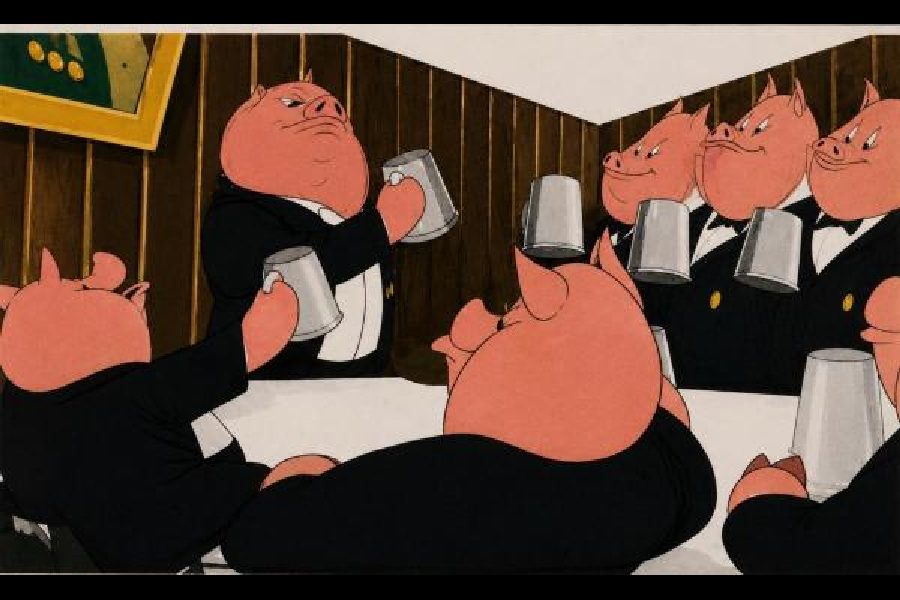
All through the weeks of election campaigns, I also kept thinking of George Orwell’s Animal Farm (1945), particularly the parts where the pig, Napoleon, keeps accusing Snowball, another pig, of sending intruders during the night to destroy the great windmill being created in the Farm. Napoleon’s bhakts continue to corroborate the intruder theory even though no one else ever sees any ghuspetia. I should mention that Orwell had based his characters, intended to represent the autocrats of the world, on a real-life episode from Napoleon Bonaparte’s life. It is believed that when he was 14, he had organised a mime-battle in which one side created a large snowball and the other side was asked to lay siege and capture it. The battle mimicry went on for a week till some of the students got seriously injured. The school authorities then stepped in and brought the battle to a halt. During the days of voting and counting, I kept worrying if the 70,000 Central Armed Police Force personnel and the millions adversely affected by the SIR would clash.
Of course, Orwell, Shaw, Fitzgerald and Huxley are an ‘evil colonial influence’. India is now truly decolonised. In this decolonised India, everyone is taught to recite “yatra naryastu pujyante, tatra ramante devatah” (gods reside in the lands which respect women), a celebrated line from the Manusmriti, the book of all books for the current regime.
G.N. Devy is the author of Citizen Under Siege