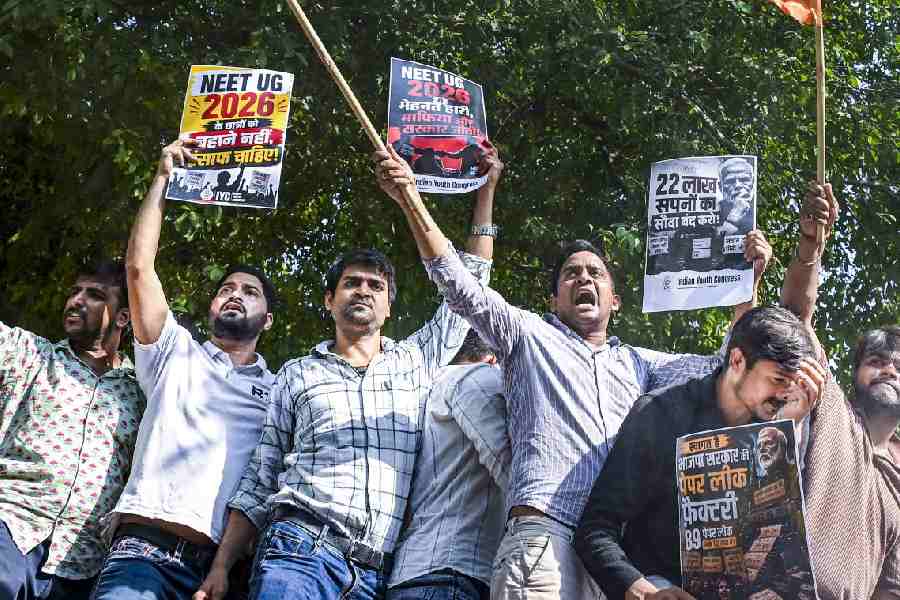
The cancellation of the National Eligibility cum Entrance Test-Undergraduate 2026 after allegations of a paper leak points to a persistent institutional failure. More than 22 lakh students who had appeared for the examination now face the prospect of another prolonged cycle of preparation, uncertainty, and consequent psychological distress. Investigations by the Rajasthan Police into information from a whistle-blower indicate that portions of the exam paper were circulated weeks in advance through organised networks operating across multiple states. Incidentally, the NEET has repeatedly faced allegations of paper leaks, impersonation rackets, irregularities in evaluation and failures in examination security — such charges led to a retest for a section of applicants only two years ago. This had prompted the Centre to constitute a high-level reform committee, which recommended computer-based testing, encrypted paper delivery systems, hybrid examination models and stronger accountability mechanisms. Shockingly, these recommendations remain unimplemented. A petition has now been filed in the Supreme Court seeking the restructuring or the replacement of the National Testing Agency, which conducts the NEET, after its assurances regarding biometric verification, Artificial Intelligence-based surveillance, and GPS tracking have proved to be inadequate against organised malpractice. What is worse, the burden of suspicion continues to fall disproportionately on students. Candidates undergo a humiliating scrutiny over dress codes and intrusive checks at exam centres even though institutional accountability remains weak.
The consequences of this systemic failure are far-reaching. Competitive exams like NEET exert immense psychological pressure on students: aspirants organise their lives around rigid schedules while enduring social isolation and intense performance anxiety. The sudden invalidation of the exam has forced lakhs of students back into that cycle. There is an economic cost as well: the coaching centres that students flock to in order to prepare for such tests often charge a fee that is substantial. Worryingly, persistent disruptions can erode confidence in public institutions and deepen anxiety among young candidates. The government’s stubborn dependence on leaky private logistics operators has further undermined the credibility of the exams. A reform process must begin immediately and it must entail full implementation of technology-driven safeguards, encrypted last-mile paper transmission, stricter oversight of examination vendors and a phased transition towards secure computer-based testing. The integrity of national examinations cannot be allowed to be compromised on account of laggardly institutions.