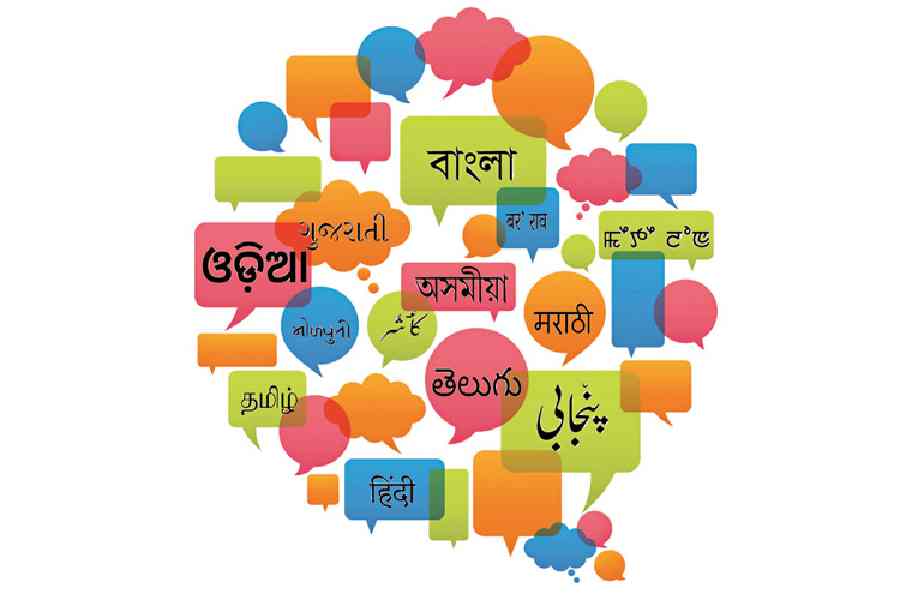
Colonial prejudice is a useful notion in the project to replace learning with ideology. The Bharatiya Bhasha Samiti, a government body formed in 2021, has claimed that the diverse languages of India are “one family”. This rejects the four-fold classification of languages made much earlier by linguists — Indo-Aryan, Dravidian, Austro-Asiatic and Tibeto-Burman — as a “colonial perspective”. The single family of Indian languages is supposed to be tied together by Sanskrit which, without being claimed as the root, is seen as providing something called “Bharatiyata” or Indianness through the strange phenomenon of spiritual grammar springing from Sanskrit texts such as the Vedas and the Upanishads. Since grammar is one of the distinguishing features of language classes, merging them into a single family means ignoring linguistics and invoking something that is not grammar but a misty and mistaken idea. The link is meant to be “something far deeper than grammar”. This revolution in linguistics manifests itself in the claim that the Ramayana and the Mahabharata form the bases of a “common cultural grammar” absorbed across the country on the one hand, and the canny claim that Tamil grammar is underpinned by Sanskrit on the other. Pushing grammar into spirituality and the present government’s concept of culture are some of the ways to make Sanskrit all-pervading.
Experts have suggested that the panel has mixed up influence with genesis. The influence of Sanskrit is undeniable. During migrations into India for thousands of years, inter-marriage between populations and other connections among them led to the mutual borrowing of features from different language families. Linguists thus point towards convergence because of geographical proximity but that cannot make all languages into ‘one family’. But there is a flaw in the experts’ approach. They are basing their argument on logic and learning, neither of which has anything to do with the Samiti’s claims. The latter consist of proving the superiority and the pervasiveness of Sanskrit, supposedly the ‘Aryan’ language, to which all diversity is to be made subservient. By implication, of course, this also links “Bharatiyata” to the majority religion. The fact that the Samiti is chaired by the head of a Rashtriya Swayamsevak Sangh affiliate whose academic qualifications have not been made public seems perfectly appropriate. The government, it would appear, is not interested in scholarship; erasing it with the ruse of colonialism suits its goals.