|
 |
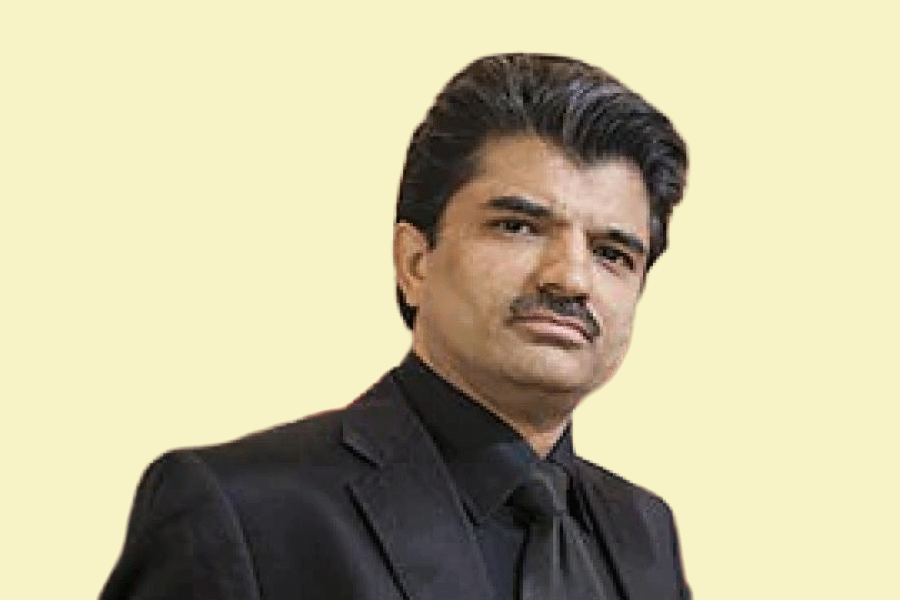
| Amaan Ali Khan (top) and M. Venkatesh Kumar |
This year’s Dover Lane Music Conference (January 22 to 25) commemorated the 150th birth anniversary of Swami Vivekananda. Held at Nazrul Manch, this four-day long festival was graced by the presence of 20 artists, who are doyens in the field of Indian classical music. Vocalist Girija Devi was felicitated on the first day, which began with a shehnai recital by Ali Ahmed Hussain Khan, grandson of the shehnai maestro, Wazir Ali Khan. He presented Raga Nandakedar beautifully and ended with a dhun. Then it was Girija Devi’s turn. She started with vilambit dhrupad in Raga Jog, followed by a tappa in Raga Bahar, a thumri in Raga Mishra Desh, and a hori bhajan. After having entertained audiences for years, it is perhaps time for the 83-year-old artist to retire.
Shujaat Hussain Khan, son of the sitar maestro, late Vilayat Khan, was next. He performed alap, jor and jhala in Raga Jhinjhoti. With the dhun of the sitar in the background, he presented a ghazal and a few folk tunes, which could easily have been avoided. Vocalist M. Venkatesh Kumar was next, and he started with Kaushi Kanada, the bandish being the famous “Kahe karata mose barajori”. He was probably the best vocalist to perform in this edition of the Dover Lane Music Conference. He also sang a bandish in Basant Bahar. The composition was enriched by its complicated taans and vistar. His clear and powerful voice enthralled the listeners. The first day came to a close with alap, jor and jhala in Ahir Bhairav by Aashish and Alam Khan, illustrious sons of the famous sarodist, Ali Akbar Khan, and their nephew, Siraj Khan. One longed for the vistar to be stretched still more. They ended with a ragamala based on Bhairavi.
The second day commenced with a rudra veena recital in Raga Durga by Mohi Bahauddin Dagar. Then the veteran kheyal singer of the Bishnupur gharana, Amiya Ranjan Bandyopadhyay, sang Raga Malkauns. Another artist of the Bishnupur gharana, Manilal Nag, gave a sitar recital in Maru Bihag. The bandish in Raga Jog touched the heart. Pandit Ajoy Chakraborty presented Raga Chandrakauns, vilambit ektaal, madhyalaya jhamptaal and drut teentaal. He sang Bade Ghulam Ali Khan’s “Kate na viraha ki raat” and the song, “Jodi kontho dao”, composed by his guru, Jnan Prakash Ghosh, in his own style, although there was not much difference between the songs other than their respective languages. At the break of dawn, Shahid Parvez Khan’s Ramkeli bewitched the audience. He was probably the best of all the sitarists who performed in this music festival. His presentation in Bhairavi Dadra was as beautiful.
Kaushiki Desikan inaugurated the third day’s programme with a kheyal in Raga Bageshree, madhyalaya jhamptaal, drut teentaal and drut ektaal. Since Kaushiki possesses a pleasant voice and is well-trained, the audience expected much of her. But they were disappointed. Her voice often jarred, especially when she sang out of tune. The flautist, Rajendra Prasanna, gave a wonderful performance. His presentations in Raga Kedar, Chandrakauns and in pahari dhun were engrossing. In an electrifying performance, vocalist Ashwini Bhide-Deshpande rendered Raga Jaijaiwanti and Raga Shankara. But there was more to come — as was evident when Amaan Ali Khan took the stage. He started with Raga Malkauns, the alap of which was long and beautiful. He seemed to bring the star-spangled night sky into being as he played the komal ga, dha and ni with all his heart. His next presentation was Miyan ki Todi. The way he repeatedly came back to, lingered in and then left behind the kori madhyam and pancham added to the audience’s anticipation of dawn. After him, Rashid Khan took the stage. He presented Raga Lalit and Sohini Bahar in his signature style. His full-throated performance mesmerized the audience.
The last day’s programme was enlivened by Ustad Amjad Ali Khan’s sarod. He started with a mixture of ragas, presenting an ‘offering’ based on Gauri, Marwa and Kedar, which he dedicated to Rabindranath Tagore. Then he transfixed the audience with alap and jor in Shuddha Kalyan. A composition in Bageshree created by his sons was interpreted in his own style by Ustadji. From there, he glided effortlessly to a bandish in teentaal in Raga Durga. He ended with “Jodi tor daak shune keu na ashe” and a medley of folk tunes.
Then it was the turn of the vocalist, Manjiri Asanare-Kelkar, who performed a madhyalaya kheyal in Malkauns. She could not quite pull it off. The last performer of the evening was Pandit Jasraj. His kheyal in Gunkeli was lovely. He sang a Shib stotra and a Krishna bhajan with effortless ease, although one still longed for a complete kheyal in his melodious voice. A short bandish in Bahar was touching. The 60th session of the Dover Lane Music Conference ended with the promise of return, as yet another day broke in Calcutta.