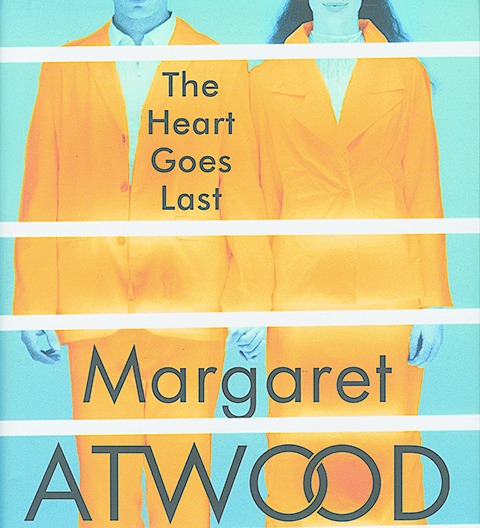

THE HEART GOES LAST By Margaret Atwood, Bloomsbury, Rs 499
Margaret Atwood’s new novel, The Heart Goes Last, is a rather crazy mix — it has elements of a spy novel, speculative fiction, Swiftian satire and Wodehousian humour all in one. In the book’s epigraph there is an eye, which immediately brings to mind George Orwell’s 1984. The eye, however, is embedded within a heart, and the pupil is replaced with a keyhole. Beneath this image runs a cryptic formula: “Consilience = Cons + Resilience”. This word, ‘consilience’, is difficult to roll around the tongue — its close resemblance to the words, compliance and conscience, struck me.
Much like Atwood’s Oryx and Crake, which created a post-apocalyptic world, The Heart Goes Last picks up after an economic meltdown reminiscent of the one that occurred in 2008. A young couple, Charmaine and Stan, are forced to live in a car and subsist on doughnuts and energy bars. The world outside is overrun by rapists and thugs. Charmaine works part-time at a bar, while Stan is out of a job. In the course of their struggle to make ends meet, they chance upon an advertisement on television, about the “Positron/Consilience project”. This project turns out to be a social experiment built around a prison system, and claims to seek a solution to the problem of unemployment. Volunteers for the experiment will be given employment, food and shelter. Desperate to lead a ‘normal’ life, Stan and Charmaine agree to sign up for the project — the passage describing their journey, along with other desperate, hopeful participants, to the Positron project brought to mind images from the iconic prison film, The Shawshank Redemption. Atwood manages to capture the ordinariness of — and the similarities in — human aspirations with great sensitivity (“Charmaine said at breakfast, with lattes and grapefruit, ‘Honey, are you sure?’ — the bath towels clinched the deal.”)
According to the rules of the project, half of the residents of Consilience town would dress in orange boiler suits and live in prison cells in Positron for a month; the next month, they would come back to their normal lives. (This is what the Consilience motto, “Do time now, buy time for our future”, hinted at.) But while they stayed in prison, the other half of the population in Consilience town — the Alternates, whom the prisoners were not allowed to contact or see — would take their place in their homes. The following month, their situations would be reversed — the prisoners would come home, and the Alternates would go to jail. The design of the book is in keeping with this theme: the inner flaps of the jacket are blue and white, while the cover is orange, like the boiler suits prisoners wear.
All goes well with the project till Charmaine meets her Alternate, Max. She breaks Consilience rules, and has an affair with him. Stan, on the other hand, begins fantasizing about his Alternate, Jasmine, whose lipstick-marked handkerchief he discovers. He breaks some more rules in order to track her down. As a result of their disobedience, the plot splits into two parts — one follows Charmaine’s journey while the other follows Stan’s.
The Heart Goes Last is unlike any of Atwood’s earlier novels. It has a distinct moral tone, and raises existential questions. Apart from taking digs at capitalism, for-profit prisons, governmental surveillance and human frailties in general, Atwood asks some of the oldest and the most troubling questions: what is the meaning of life? What is it that we want out of life, and who are we? She alludes to several literary texts in the course of the novel, emphasizing not just the importance of such questions, but also the fact that the answers to these questions have eluded the human race down the ages. Does an important job lend meaning to life? Can meaning be found in wild sex, in the thrill of having (and hiding) secrets, in getting three square meals a day? Or does the meaning of life lie in rebellion? Atwood also manages to dispel fixed, arrogant notions about human identity — in one part of the project, humans and robots are put together, so much so that one can easily be confused for the other, and stand in for each other. This frightening reality is captured brilliantly by Stan when he says, “Is that all we are... unmistakable clothing, hairstyle, a few exaggerated features, a gesture?”
Atwood also deals with two poignant, connected subjects — human emotions and the need for control. Before Stan lost his job, he tested mannequin-like robots called “empathy models”. These models flash perfect smiles at shoppers, thus giving them a complete shopping experience. The Positron/ Consilience project conducts several experiments, including the selling of baby blood to make older people feel younger. It manufactures “possibilibots” or “prostibots” — customized sex dolls that people can order according to their sexual preferences. Atwood turns these prostibots into symbols of different kinds of desire — sexual desire as well as the desire for control.
The laboratories manufacturing these sex robots — strongly reminiscent of Swift’s Laputa — deconstruct and dismantle the human body. They manufacture overtly sexualized plastic imitations of human body parts, and then put them together. Alongside these laboratories are departments such as the “expression department”, which commercialize and dehumanize emotions. The dolls can be tailored to the customer’s taste. The orders that come in reveal the macabre, tragic reality of human lives. In The Edible Woman, Marian loses her sense of taste because she realizes that she changes herself according to the instructions of the men in her life. Marian is like food: she is seasoned according to the taste of different people, revealing the ugly manner in which human relationships can often turn emotionally cannibalistic. In The Heart Goes Last, the Duncans, Peters and Marians of the world, who cannot have their way in real relationships, now have the Faust-like option to go to bed with people manufactured for them. These robots are designed to help reduce crimes like rape and trafficking. But if Bret Ellis’s American psycho internalized R.L. Stevenson’s Hyde in a modern world, Atwood’s vision of the future is strewn with Hydes who do not need to wear masks of civility anymore, simply because they can play their savage games minus any bloodshed (robots do not bleed). The Positron project also comes up with a solution to the matters of heart. A brain operation can make a person fall in love with the first object it sets its eyes upon.
Atwood leaves her novel open-ended. Readers are left with a question: would they rather undergo a brain operation and live life like a human robot, or forgo the operation, let their hearts run riot and then deal with the consequences? Perhaps this is why Atwood places the heart within the 1984-esque eye in the epigraph, and ends the book with a picture of a key and the Consilience motto written under it. Under similar circumstances, would the readers make similar choices? The body can be imprisoned in Consilience/ Positron, in Orwellian Oceania, in Gilead, but can the heart be imprisoned? Would it be preferable to the readers if the heart, too, could be controlled? Is there a key to the human heart?
Atwood approaches all these questions with her characteristic wit, giving readers many opportunities to laugh.
The Heart Goes Last is the craziest work in Atwood’s oeuvre, but there is a clear method in this madness. Readers are left to decide whether they will choose to laugh at or feel ashamed of the human vulnerabilities she exposes so skilfully.