There is a strange soul-sickness in public discourse today when a name — a simple word — becomes a battleground for political immaturity and intellectual incoherence. Yet here we are in West Bengal, debating whether the state should be renamed Bengal (Bangla in Bengali). To some this suggestion is heresy; to others it is overdue. What is at stake, however, is not mere nomenclature but memory and identity. At some point, a society must decide whether it wishes to live as a direction on a map or as a civilisation with a name. But ‘West Bengal’ is not the name of a civilisation. It is a leftover, a colonial relic, merely a hyphen-less reminder of a fateful amputation — the infamous Radcliffe Line drawn amid the carnage of the 1947 Partition. In this age of ‘decolonisation’, why persist with it then?
If the recent move by the Kerala assembly to officially use ‘Keralam’ in place of Kerala signals anything, it is that Indian states are increasingly willing to align their constitutional names with linguistic and cultural self-understanding. Whether or not Parliament ultimately formalises that change — it most likely will, because it has already been approved by the Union cabinet — the gesture itself is telling. It asks a simple question — why should a people not be known by the name they call themselves? In the cases at least of Tamil Nadu, Odisha, and Uttarakhand, this has already been answered in the positive.
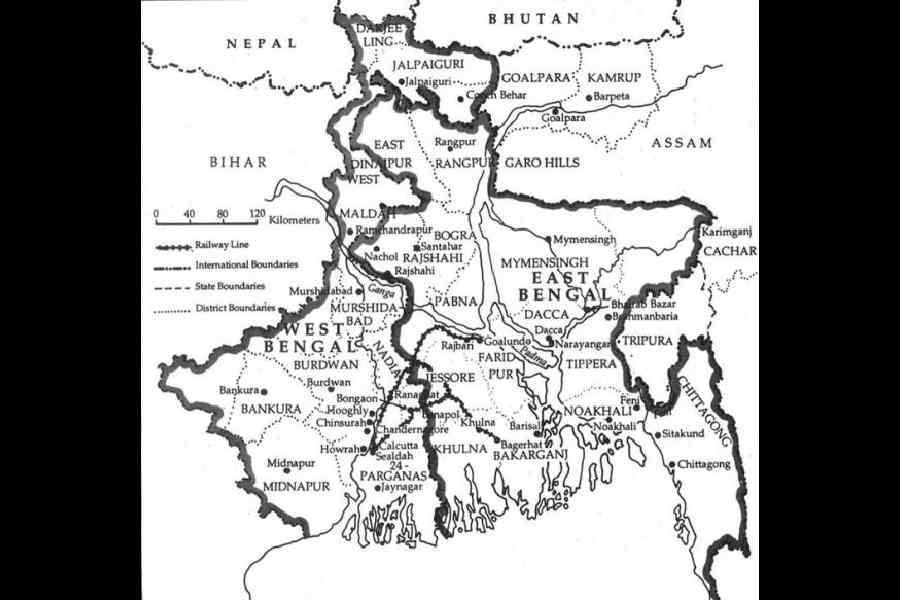
Before 1947, ‘Bengal’, of course, was not an east-west puzzle, but a region — vast, internally diverse, yet recognisable as a linguistic and cultural entity. The Bengal Presidency under British rule — including large chunks of Bihar, Orissa, and Assam — was sprawling, but the idea of Bengal long predated colonial bureaucracy. It lived in literature, in riverine trade networks, in devotional movements, and in the cadence of Bangla speech itself — a historical fact vindicated by the recent recognition of Bengali as a ‘classical’ language.
Partition ruptured this continuity, with the eastern half becoming part of Pakistan and emerging as an independent Bangladesh in 1971. The western half came to be called, awkwardly, West Bengal — a truncated fragment of something larger, a ‘remainder’ after the Partition, as well as a constant reminder of it. Almost eight decades after Independence, the qualifier, ‘West’, continues to remain a scar, permanently inscribed into the state’s identity. No other Indian state carries this directional signage in its name. During 1947-49, the Indian segment of Punjab was called ‘East Punjab’, but the Constitution of India dropped the ‘East’, possibly to distinguish it from the cluster of eight ex-princely states clubbed together under the title of Patiala and East Punjab States Union, which merged with Punjab in 1956.
In July 1949, when the Constituent Assembly was discussing various provisions to be included in the Constitution, including the renaming of a few states, Jawaharlal Nehru wrote to B.R. Ambedkar that “we should call the West Bengal Province just ‘Bengal’” because “the Pakistanis have dropped the word ‘Bengal’ from their area” (in reality, though, the eastern wing of Pakistan, constituting East Bengal and most of the Sylhet district of Assam, continued to be called East Bengal till October 1955, when the name ‘East Pakistan’ came up) and because “it [Bengal] sounds better and people like it.” The transcripts of the Constituent Assembly deliberations don’t provide a clue to why ‘West Bengal’ was not renamed like Punjab in 1950. However, since Pakistan’s eastern wing was called ‘East Bengal’ till 1955, the ‘West Bengal’ nomenclature in a neighbouring part of India made some sense and pre-empted confusion.
Recent resistance to a name change has often harped on the projected ‘fear’ that ‘Bengal’ evokes myths of homogeneity at a time when linguistic minorities — Urdu, Hindi, Nepali, tribal languages — coexist. To such naysayers, the name, ‘West Bengal’, is a neutral, administrative label that avoids uncomfortable identity politics. But this ‘fear’ appears to be a rhetorical sleight of hand, saying more about political paranoia than about the actual cultural dynamics of Bengal, which has always been porous, hybridised, and exceptionally syncretic in its traditions. The poser that renaming can take the state down the slippery slope of a regressive regionalism, contrary to ‘national unity, does not hold water. The long history of Bengal is a living testimony that cultural pride has always coexisted with national belonging in this part of the world.
Opponents of renaming ‘West Bengal’ to ‘Bengal’ have also often invoked the spectre of diplomatic confusion. If India has a state called Bengal, must the world struggle to distinguish it from Bangladesh? Well, one look at the map of the world reveals that international geography is full of overlapping names, and diplomacy has never collapsed under the weight of such coincidences.
The sovereign state of Papua New Guinea occupies one half of the island of New Guinea, while the other half — under Indonesian administration — contains provinces historically called Papua and West Papua. Yet no one confuses the two in international affairs. Similarly, the country, North Macedonia, coexists with a major region of Greece called Macedonia. Somalia shares its name with Ethiopia’s Somali Region, and Azerbaijan with provinces in Iran called East and West Azerbaijan. Georgia doubles as both a country in the Caucasus and an American state, while Luxembourg is both a European country and a Belgian province. The lesson is obvious enough — shared names are a routine feature of political geography, not a diplomatic catastrophe.
The prefix, ‘West’, in West Bengal is itself a relic of 1947, a cartographic scar left by Partition. Across the postcolonial world, renaming has been part of reclaiming identity from colonial nomenclature. To oppose such a change in the name of bureaucratic clarity is disingenuous. If the world cannot parse Bengal and Bangladesh as distinct entities, that’s a problem of international literacy, and not Bengal’s identity. And the perception of this ‘problem’ stands on thin ice. If the world already manages its Papuas, Macedonias, and Azerbaijans without chaos, it could surely handle a ‘Bengal’ as well?
Is the ‘confusion’ argument then really masking something else, like an acute anxiety about identity and the unresolved ghosts of Partition? Can it be that the resistance to renaming West Bengal as ‘Bengal’ or ‘Bangla’ is not a matter of bureaucratic hesitation but of ideological discomfort? The Bengali identity — layered with Aryan and non-Aryan inheritances, and shaped by Buddhist, Islamic and vernacular traditions — has historically resisted being boxed into a narrow religious nationalism. That cultural pluralism sits uneasily with the sangh sarivar’s project of folding India into the Vedic-Hindu imagination of ‘Aryavarta’, centred in the north and the west. For the parivar — especially at a time when playing the card of a muscular and communally divisive nationalism promises rich electoral dividends — the political utility of Partition memories and the narrative of Hindu victimhood in East Bengal remain far more valuable than any celebration of a shared Bengali cultural world that still stretches across the border into Bangladesh. Allowing the state to call itself simply ‘Bengal/Bangla’ would symbolically acknowledge that deeper civilisational continuity. Denying the name, therefore, becomes a way of disciplining memory and weakening the cultural cord that binds Bengalis on both sides of the border.
It’s just an extension of the sinister habit, recently introduced, of making an annual celebration of a ‘Partition Horrors Remembrance Day’ each August 14 — only regionally tailored for a state that remains an ‘unconquered frontier’ for the sangh parivar and its style of politics. It’s truly ironic that, for all of its tirade against the spectre of illegal immigration from Bangladesh, the ruling dispensation in Delhi continues to pay its eastern neighbour a backhanded compliment by keeping the directional signage hanging around the neck of one of India’s own states.
Jayanta Sengupta is Director, Alipore Museum; jsengupt@gmail.com