
GATHERING THE ASHES By Amritlal Nagar, Harper Perennial, Rs 399
... I shall fight the angrez to death/ And lay in wait among the reeds.../ Another brave one was Balbhadra Singh/ He leapt upon the angrez, killing them all.- A popular ballad
While assessing the nature of the Revolt of 1857, the eminent historian, Ramesh Chandra Majumdar, labelled the uprising as a "disorganised and limited revolt by the disgruntled native sepoys of the British army". The learned scholar was wrong in his evaluation. Refuting the statement of R.C. Majumdar, the author of the book under review, Amritlal Nagar, states categorically "The ghadar of 1857... must not be seen as only an impulsive sepoy uprising. The ease with which leaders like Maulvi Ahmedullah Shah and Tantia Tope managed to collect and mobilize local forces against the British, shows that it was a far more comprehensive uprising."
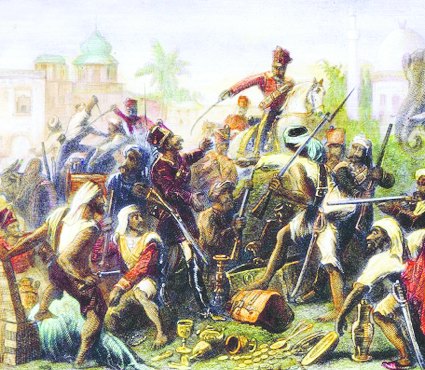
Indeed, the local rajas and nawabs who decided to militarily assist the beleaguered queen, Hazrat Mahal, had their own armies. Pitched battles were fought between the East India Company's forces and these local armies in several regions of Awadh, especially under the leadership of brave nobles like the Raja of Chahlari, Balbhadra Singh, and Ahmedullah Shah. In order to underline the worth of this popular and across-the-board engagement, the author quotes from the ballad Jangnama which makes it "amply clear that not only the nobles but common farmers and artisans, palanquin bearers (Kahar), even barbers from all castes and communities had chosen to join the Begum's (Hazrat Mahal) armies in the fight against the British".
In point of fact, this opinion of the author has been buttressed by the candid observation of Rudrangshu Mukherjee, who, in his seminal book, Awadh in Revolt 1857-58, stated that the revolt was nothing short of a general uprising which "pertained to the people". Both Nagar and Mukherjee hold the view that "the signs of an impending public revolt in the entire countryside of Awadh were clearly visible".
The most dependable evidence of this people's uprising is to be found in the oral narratives or ballads that have come down to us crossing generations. The author has done a splendid job by collecting these ballads and including them in his book. In fact, this poetic dimension reminds us of the ballads that had been composed during the Fakir-Sanyasi revolt in Bengal against the common enemy, the British, and these were meticulously collected by the great Bangladeshi novelist, Akhtaruzzaman Elias. Common village bards composed these ballads and they formed an integral part of the collective unconscious. One such ballad recited by the villager, Tulsi Das, honours the indomitable Raja of Chahlari. It reads : "The Raja of Chahlari talked to his men./ We shall attack the cannons that are aimed at us.../ We shall put the gunners to swords and grab the cannons/ And then kill and feed the firangees to the vultures."
Another ballad commemorating the unsullied bravery of Rana Veni Madhav Baksh and signifying the fervent relationship that existed between him and his followers, reads: "It was the Rana alone whose raised eyebrows sent tremors of fear./ Making the whites... tremble in England./ He grabbed the cannons from the shaken enemy./ Who cannot eat till the Rana stands in the battlefield."
Should these ballads, stirring and spontaneous, prompt us to describe the Revolt of 1857 as the First Indian War of Independence as Karl Marx and Veer Savarkar had done? The answer may vary from one person to another though one point of view remains firm. Namely, it was not a revolt engineered by the sepoys only. To be even more specific, sepoys and farmers often fought together against the common enemy in the same battlefield.
In order to underline this heroic engagement of the people, truly comprehensive and cutting across even gender division, the author has emphasized the role of women in the uprising. He has dwelt elaborately on the role of Hazrat Mahal and the Rani of Jhansi, Lakshmibai. In fact, any serious reader who intends to know more about the indefatigable and peripatetic Hazrat Mahal needs to read this book. The translator of this excellent book (the original is called Ghadar Ke Phool), Mrinal Pande, observes, "One of the most interesting features of this remarkable compilation is the key roles repeatedly played by a few spunky women who discarded the veil and led armies of rebels during the ghadar." Even the British enemy had grudging words of admiration for Begum Hazrat Mahal who rushed from one village to another to seek the support of noblemen and commoners.
Yet another reason why this revolt went far beyond the preordained characteristics of a sectarian outburst is embedded in the praxis of Hindus and Muslims, who fought together, just as the sanyasis and fakirs did in Bengal. In the chapter on Faizabad, Nagar recollects that a Hindu landowner, Thakur Amreth Singh, gave shelter to some Muslim courtiers who had been driven away by the British. But when the British demanded an explanation from Amreth Singh, the latter feigned utter surprise and ignorance and said, "How on earth could a high caste Hindu offer shelter to Muslims?" The British, who thought that the division between the two communities was unbridgeable, accepted the version of Amreth Singh. Thus, during the ghadar "both Hindus and Muslims maintained a deep sense of respect and love for each other". The active supporters of the queen Hazrat Mahal were Hindu noblemen like Raja of Chahlari and Rana Veni Madhav who followed the footsteps of secular leaders like Tantia Tope and Nana Sahib Peshwa. In short, "the ghadar... despite being a period of great unrest... managed to forge a rare Hindu-Muslim unity". This feeling of camaraderie and unity, says the author, outlived the ghadar and once again manifested itself in 1919 when a massive nationalist movement against the dreaded Rowlatt Act was unleashed.
Armed with only a few khatas, sheaves of paper and pencils, the author literally raced from one village to another to excavate the truth of 1857. As the translator, Pande, suggests, his hectic peregrinations led him to the 'heart of 1857' and he returned with ballads, eye-witness accounts and memories, the compilation of which unrolls the human history of the 1857 uprising. A secret letter written to the East India Company by a Britisher, surprisingly enough, endorsed the valuable estimate of Nagar. The letter stated, "...under these circumstances, the hostilities which have been carried on in Oudh have rather the character of a legitimate war than that of rebellion". This book, one hopes, will prompt the students of history to abjure the term 'Sepoy Mutiny' because the reality at that point of time comprised something much more than a mere localized rebellion. It was, to stress yet again, a people's revolt against the ruling firangees.