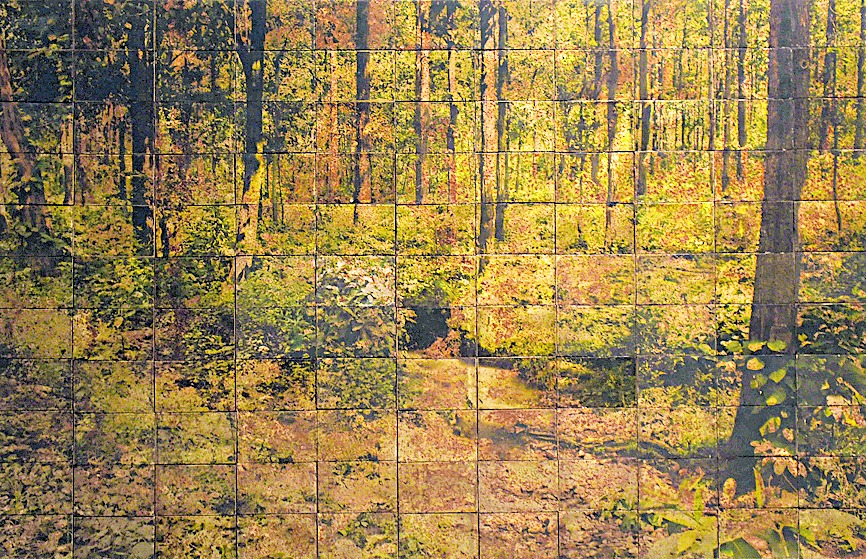

Jamini Roy (1887-1972), the giant of modern Indian art, had gone back to the Bengal folk traditions of nameless patuas to discover the wellsprings of his inspiration in our artisanal crafts as a gesture of resistance to the dry academism inherited from Europeans and the soppiness of Abanindranath's "revivalist" Bengal School. Roy, the son of small-time landholders of the remote Beliatore village in Bankura, is nonetheless a puzzling artist for two distinct reasons that are closely related to each other. This became abundantly clear at the exhibition, Jamini Roy: A Retrospective (August 8-31) organized by the West Bengal Housing Infrastructure Development Corporation in collaboration with Rajya Charukala Parshad at Nazrul Tirtha, which has two art galleries, in distant New Town. The exhibition was hardly a retrospective - although the paintings of his post-Impressionist phase, including his copy of the van Gogh self-portrait, and his works on chatai (mat) were included, there was no trace of his painted earthen pots. Only 50 works, all culled from the same source, were on display. Again, the catalogue - if the slim volume with poorly-printed reproductions of some of the paintings deserves to be called so - looks like it was hurriedly put together. No wonder the text is full of typographical errors. This is a shame because we rarely enjoy the opportunity of seeing Jamini Roy's original paintings. Jogen Chowdhury, chairman of the Parshad, said the organization is in possession of 700 Jamini Roy paintings, many of which are in urgent need of restoration. Storage is a huge problem, given the cramped space allotted to it.
Now to return to the artist who had ardent admirers among the Bengali intelligentsia, some of them left-inclined, like poets Sudhindranath Dutta and Bishnu De, who was himself a painter. Roy also enjoyed a following among foreigners, leading among whom were E.M. Forster, John Irwin - who had organized Roy's first exhibition in London - the Indologist, Stella Kramrisch, and Maie Casey, wife of the penultimate governor of Bengal. She had organized an exhibition of Bengal artists in Government House - today's Raj Bhavan - and likened Jamini Roy's powerful head to that of Picasso's. Her writings are available at Raj Bhavan and the National Library of Australia. Outstanding among his local patrons was confectioner Sarada Charan Das of K.C. Das fame, who had commissioned the artist - who lived in penury at his Ananda Chatterjee Lane home in north Calcutta - to create a suite of 17 paintings based on important episodes of the Ramayan. Well looked after by the Das family, it is not in the public domain.
Now what is puzzling about Jamini Roy is that having been trained at the Government Art School, while he was obviously not making straightaway copies of pats, which he collected from faraway districts, and often experimented with form, particularly in his calligraphic works from the mid-1920s, his paintings depicted either mythological figures or well-muscled Santhals and folk doll-like village belles. His work never reflected the turbulent socio-political realities of the India of his times. While he was being true to vernacular traditions, drawing upon a bucolic paradise in an attempt to resist the all-pervasive European influence, he was turning his back on famines and various forms of oppression.
There is no denying the power of that monumental blue boy in a yellow loincloth holding a pet bird, the vigour and fluidity of his lines like alponas on the floors and walls of village huts, the formalism and sophistication of his figures and the vibrancy and warmth of his colours, but his paintings revert to the village scenes of his childhood. Surprisingly, while his earlier depictions of young Santhal women had a certain sensuality, in his later pat-style works he ironed out their breasts, although like all his humans, animals and even Christ, they have " patalchera chokh" (eyes like halved parval) in keeping with the pat style. Poet Nissim Ezekiel had wrongly described those eyes as 'almond shaped'. Sculptor Ravinder Reddy's monumental women are like folk goddesses with a bold, direct gaze, but the contemporaneity of his images is never in doubt. His women have a will of their own.
It is common knowledge that Jamini Roy often signed the handiwork of other painters who replicated his style in an attempt to sweep aside the 'aura' of artwork and its associations of the marketplace. While this may have been a noble intention, given the lack of proper documentation, how does one separate chaff from grain? The proliferation of fakes makes it even more problematic. Jamini Roy can be a bundle of problems.