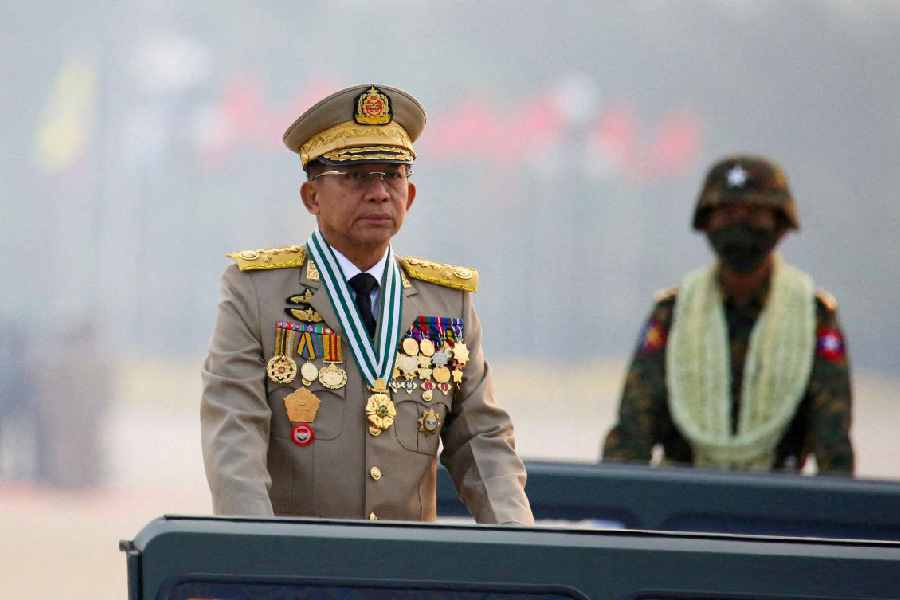
Myanmar’s former army chief, Min Aung Hlaing, assumed the presidency, switching his green uniform for civvies, amid massive fanfare in April. It was a foregone conclusion that he would be appointed the country’s next president. He was anointed after elections for a new Parliament were held in three phases. But in effect, less than 50% of those registered to vote — in less than a third of the country as a result of the raging civil war — cast their ballots in what was regarded by many within the country and abroad as a sham election.
Many of the existing political parties, including Aung San Suu Kyi’s National League for Democracy, were banned from participating in the polls. Those that were allowed to run candidates faced harassment and intimidation; even those whose values were aligned with the commander-in-chief were not exempt. The Union Solidarity and Development Party, formed by the then military commander-in-chief, Than Shwe, to fight the 2010 elections, convincingly won more than two-thirds of the seats. Credible election monitors and Western diplomats based in Yangon have dismissed these results as part of a ‘rigged election’.
In the weeks before Parliament convened to formally elect the president, Myanmar’s military rulers tried to talk up the country’s recent political changes as the ‘dawn of a new state’ that will be based on democracy and civilian rule. The key step was the election of the new Parliament — after five years of direct military rule which followed the coup by the army chief, Min Aung Hlaing, in 2021. These parliamentarians are expected to become the custodians of the new regime and chart its course to a new dawn. But most people in Myanmar remain highly sceptical and few outside the country believe these changes will bring with them a new era. Most academics and diplomats believe Min Aung Hlaing will continue to rule the country with an iron fist despite having discarded his green uniform for civilian clothes. A symptom of this is the intense increase in the surveillance of anyone who is suspected of harbouring anti-military sentiments.
Moreover, there are significant structural changes in the pipeline that could lead to considerable political instability. At the root of it is the inherently disruptive relationship between the party and the army which revolves around who should take the leading role in the administration of the country. This was also a fraught issue during Thein Sein’s administration. But the USDP then was much more solidly integrated with the Tatmadaw than it is now. Personalities are also crucial in the political interplay between party and the army. Currently, there are growing tensions and divisions between the former army chief, Min Aung Hlaing, and Khin Yi, the elected leader of the USDP. Several of Myanmar’s regional allies favoured Khin Yi becoming president rather than the former army chief as they believed his ‘civilian credentials’ made him a more appropriate choice. But the most crucial issue is the role and the importance of the party: after all, it was the USDP that fought and won the election.
A compromise was obviously worked out — the army chief would become president and Khin Yi the Speaker of the lower House where he would control all the legislations that is introduced in Parliament. This is a crucial role in the context of steering the country’s economic development and the popularity of the government.
But seasoned observers believe this may not be a long-term solution. They point to the relationship between Thein Sein when he was president and the former general, Shwe Mann, who was the then Speaker of the lower House. Many believe he was promised the presidency at a later stage to entice him to take the Speakership. Shwe Mann proved to be an immense thorn in the side of the government and Thein Sein’s entourage within the party launched a coup against him mid-term.
The tension between Khin Yi and Min Aung Hlaing has been evident for some time. They often crossed swords during the run-up to the election. Although he had no formal role in the USDP, the general insisted on choosing the candidates and even the constituencies they would contest.
Khin Yi was convinced by the former strongman, Than Shwe, to accept the situation in the interests of unity: for party and nation, according to an informed insider. When the USDP leader visited his former boss and mentor before the elections, he was ‘advised’ to ensure that the USDP won the elections with a whopping majority. It was after that meeting that the authorities began to take tough action against some parties that may have posed an electoral threat — especially those of Thet Thet Khine and Ko Ko Gyi.
Diplomats and observers in Myanmar have also noticed the growing distance between the two ‘axes of power’ within the Establishment. This was especially discernible at the special seminar-workshop in mid-March, organised by the then information minister, Maung Maung Ohn — now deputy Speaker of the lower House and a close confidant of Min Aung Hlaing — to brief the new MPs on the issues that will preoccupy Parliament and government in the ‘new dawn’.
According to several observers, there were two distinct groupings — the army and the party — at the event. Min Aung Hlaing briskly entered the convention centre flanked by his generals and immediately went and sat at the seat at the head of the stage and virtually greeted no one while Khin Yi, accompanied by senior party officials, ambled in and greeted and chatted with the participants and speakers. It is unlikely that these two will be able to coexist for long, according to a Myanmar professional with strong connections to the country’s Establishment who now lives abroad.
While the emerging friction between army and party will dictate policy and Myanmar’s stability in the coming months, Min Aung Hlaing understands that Myanmar needs to reach out to the world if it is to end its isolation and roll back the sanctions much of the West has levied against it. To this end, the men in green, now in civilian clothes, are seeking the support of their traditional allies, China and ASEAN, especially Thailand, as well as Bangladesh and Pakistan, in an effort to reset Myanmar’s foreign policy and regain international acceptance.
So far, Asia has responded relatively enthusiastically. Senior diplomats from China, India and Thailand have all made hasty trips to Myanmar’s capital, Naypyidaw, to congratulate Min Aung Hlaing on assuming the role of elected leader and peacemaker. China remains the key to Myanmar’s stated long-term ambitions. The Chinese ambassador to Yangon was the first diplomat to congratulate Min Aung Hlaing personally and held several lengthy bilateral discussions with him.
The special envoy of the Chinese president, Xi Jinping, to Myanmar, Jiang Xinzhi, attended the inauguration ceremony on behalf of the Chinese leader, followed by the foreign minister, Wang Yi, a week later. For his part, Min Aung Hlaing’s appointment of Tin Maung Swe as foreign minister — he was ambassador to Beijing since the coup and a former military officer — is seen by diplomats as a tilt towards Beijing.
For its part, the current ASEAN approach is engagement rather than endorsement even though there are differences within ASEAN as to how firm a hand to take on Myanmar.
Min Aung Hlaing is desperate for international legitimacy. Myanmar is also keen to lobby the United Nations Credentials Committee, which has allowed the Opposition representative, Kyaw Moe Tun, to remain in place rather than allow a military representative to replace him.
Larry Jagan is a former BBC World news editor for Asia and an expert on Myanmar