
My desk is in a room that overlooks the drive-way of a neighbouring building and my window also has a partial view of the parking lot of yet another adjacent apartment block. Even if I don't actually look out of my windows, I can hear the sound of different kinds of labour starting very early in the morning. From the big crossing outside starts the assault of traffic and horns. From the parking lot I can hear the water being splashed from buckets as the workers start cleaning the row of automobiles; occasionally one of the cleaners hits the wrong thing and the morning is rent with the ghastly coda of a car alarm - this incenses me till I remind myself that I have nothing more onerous to do in the morning than flip through my newspaper and worry my mouse and keyboard - sometimes I suspect the alarms are deliberately set-off to wake up the slumbering rich fatsos in the flats above, and even in my fury I find myself sympathetic. Then, around 9.30 or so, begins the whine of some construction machine, for somewhere or the other in the surrounding jungle of high-rises, some cretin or the other with more money than taste has ordered the polishing of a new marble floor.
Since the beginning of April this genre of noise has jumped out of the confines of apartments and provided an up-close modern music orchestra to accompany my working day: the people in the building next door decided to re-do their whole driveway - from scratch. So, first, right in my ear, was the thump and hammer of jackhammers as workers tore up the old concrete, then there was the cement-mixer and assorted timpani as the ground was flattened and a welcoming bed prepared for the new surface. Then, across two long months, came the sound of the electric saw as each tile was cut into the correct shape by hand. When the laying of the tiles was completed I breathed a sigh of relief, but this was premature. Out came the polishing machines and their whine kept me company for another two weeks. After which began inlay work to challenge that of the Taj Mahal, which, again involved the electric saw cutting strips and triangles of marble, followed yet again by more polishing.
I was angry at first and then resigned. And then, in some version of the Stockholm Syndrome, I actually began to miss my tormentors whenever they took the day off. Over three months, every time the phrase 'writer's block' traversed my head, or some vague thought connected to the notion entered my mind, I would get up and look out of my window at the people working below. The man cutting the tiles sat on the ground, toes of one leg braced against a support as he manoeuvred the heavy tile against the deadly, whirring blade of the saw. As soon as a tile was done another man came and carried it to its place in the grid. There, two other men, trowels in hand, slapped down cement before gluing in the tile with great care. All of this took place under the scorching heat of April and May, with no shade, with nothing more than headcloths to protect the labourers from the sun overhead.
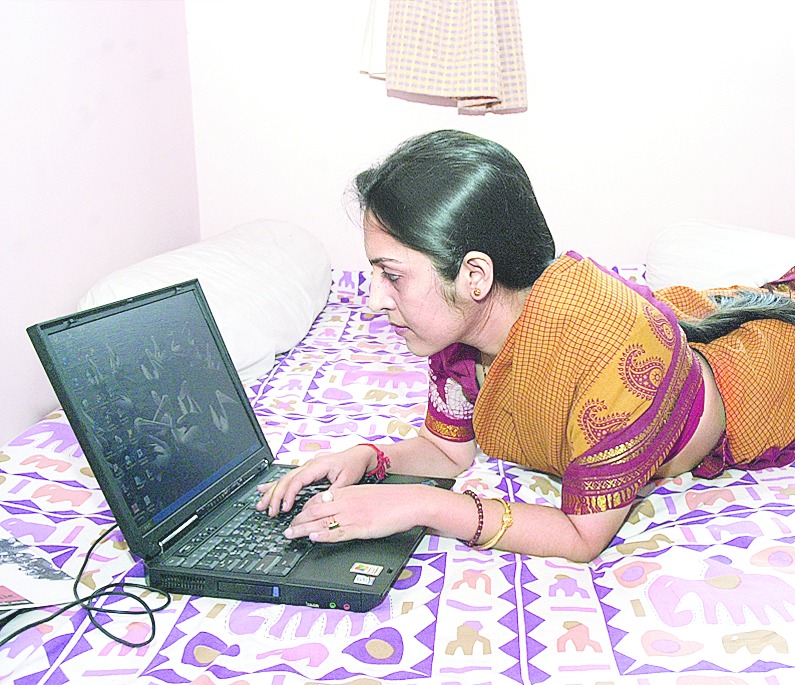
During this time it occurred to me that I could divide the people I know into two categories. There are people who do work that involves their bodies, or have a regular activity that requires some physical labour, and then there are the majority of my bourgeois acquaintances who do nothing more strenuous than working a keyboard or a smartphone. Many of us leaven this desk-bound life (or perhaps better to call it 'text-bound', since many people actually work lying supine on beds) by some health-enhancing physical activity such as walking, swimming, going to the gym or doing some kind of yoga; some of the people I know occasionally go dancing in clubs and at parties; plus clearly a few of my jaan-pehchanites have active private lives which they conduct in partnership with others, one imagines both in and out of bed. All of the preceding I would unemotionally put under the heading of 'exercise', i.e. less or more pleasurable exertions that are primarily about making you feel physically better while releasing a few endorphins - something that is fundamentally different from actually doing work that involves using most sectors of your body.
In a different category are the friends who are yoga teachers, dancers (I don't know any serious sports people but they would be included here), photographers, cinematographers, trekking guides and such like. Now their relationships with their bodies are different according to what they respectively do (for instance, even in just the area of image-production, being a press photographer is very differently demanding from being a cinematographer on a feature film) but all of them need to function physically at a certain level to execute their main jobs. Somewhere as a sub-category of this would come people who need to stand a lot such as teachers and cooks, though, again, serious cookery is physically more akin to being a sculptor or a painter of large canvases, whereas being a college lecturer is closer, though not that close, to being a traffic-policeman. Yet another sub-category would be that of the surgeon, someone who uses their own body to work on the living bodies of others, who again, not so unlike chefs, stand for long hours while bending forward and working with great concentration.
A third category is one I find mostly missing in India. These are people you find much more easily abroad, specifically in the West: middle-class or affluent people who engage easily and happily in physical labour such as heavy gardening, farming, carpentry and housebuilding, who will repair a chair, do the wiring of a house or strip down a car engine just for fun. I genuinely admire this category of person because she or he has not let material or monetary comfort disconnect them from certain basic human labour. In a sense, to deploy two clichés in a row, this lot have their feet firmly on the ground because they are not afraid to get their hands dirty.
All of this naturally leads one to consider the truisms about mind-body unity and indivisibility of the interior work of the brain from the interior and exterior work of the body. From this one could then move to ideas of poverty and wealth, and of enslavement and freedom. That back-breaking, repetitive, low-paid labour deadens the mind and shrinks the soul is an obvious truth humanity has lived with forever. But now, especially in our Indian and other third-world cities, one can see a strange spread of physical impoverishment that cuts across class. There is the horribly stationary labour of the security guards, there is the trapped labour of the car driver, whether owner or chauffeur, there is the quite different fatigue of the driver of large vehicles, again codifiable into passenger transport and freight, each involving different physical challenges. There is the ennui-ridden standing around of the shop-assistant and there is the torture of the customer who can't bend down to try their shoes. There is the executive or businessman imprisoned by his desk and 'boss chair' and there is the shifting from foot to foot incarceration of the kid trying to sell a stack of heavy glossy magazines at a traffic light. In all sorts of environments, in all kinds of sites around the Indian city there is a sense of people increasingly in exile from their own bodies.
This physical exile is inescapably twinned with an estrangement of the mind. We don't always realize it, but so much of the prevalent public violence comes from this mindlessness, from this seized-up brain and locked muscle. There are many reasons why young people nowadays will not move sideways on the pavement to make way for people coming from the other direction but its partly because it's a doubly difficult manoeuvre: one, you have to break stride and two, you have to momentarily put yourself in the other person's place. There are several reasons that buses plough into pedestrians, but at least one of them is that after a long period of stop-start traffic the driver's hamstring is much happier pushing down on the accelerator. If you cannot connect with love to your own body and mind you will find it impossible to do so with the body and mind of somebody else; if the anubhuti is vitiated so will the sahanubhuti be impaired. At least, this is what I tell myself as workers in hard hats start jackhammering a trench in the parking lot of the next building, working late into the night, the racket drowning out the sound of the rain.